

Nearly 50% of Ukrainian readers haven’t bought books in the last three months, while 34% have purchased only print books, according to a study by Gradus Research commissioned by the Ministry of Culture of Ukraine.
In particular, the study also showed that printed books remain the most common reading format. Specifically, 58% of respondents said they choose printed books, 44% choose e-books, 35% choose audiobooks, and 3% found it difficult to answer.
Respondents who prefer printed books were asked where they obtained them. Of these, 47% said they used books they already had at home, 43% said they bought new ones, 31% borrowed them from friends or acquaintances, 19% received them as gifts, 19% bought used copies, 17% borrowed them from a public library, 7% borrowed them from a school library, and 5% used a corporate library.
Among respondents who bought books, 40% said they did so at an online bookstore, 33% at a brick-and-mortar bookstore, 27% on a publisher’s website, 24% at a market or bazaar, 18% on a marketplace (e.g., Rozetka, Prom, Kasta, etc.), 17% at a book fair or festival, 14% at another brick-and-mortar store, 13% at a supermarket, and 4% each via Instagram or Telegram.
When broken down by age, the study shows that teenagers buy print books from online stores, while people aged 55 and older still prefer book markets.
The study revealed that nearly half of Ukrainian readers have not purchased any books in the last three months. Specifically, 38% said they had purchased print books (34%—exclusively print), 8% had purchased e-books, 5% had purchased audiobooks, 48% had not purchased any books, and 6% found it difficult to answer.
When asked how their spending on books for leisure had changed over the past year, 13% said it had increased, 39% said it had remained almost the same, 37% said it had decreased, and 12% found it difficult to answer.
When broken down by age, the survey indicates that young people are increasing their spending on books, while older readers are doing the opposite. Specifically, 29% of teenagers aged 14–17 and 21% of young adults aged 18–24 spent more on books than in the previous year.
The comprehensive study “Reading in Ukraine: Behavior, Motivation, and Engagement Tools” was conducted by Gradus Research with support from the “Believe in Yourself” Foundation. It included 41 in-depth interviews (March–May 2026) and a survey of 2,200 respondents aged 14 and older (August 17–25, 2026). The survey did not cover temporarily occupied territories or areas of active hostilities.
As previously reported, the Ministry of Culture of Ukraine initiated the national reading survey in the spring of 2026. The first insights from the qualitative study were presented on May 30 at the “Book Arsenal.”
The quantitative study, published on October 20, showed that 59% of Ukrainians had read or listened to books at least several times a month over the past year, 22% read several times a year or less, and 13% had not read a single book in the past 12 months.
book market, Gradus Research, MINISTRY OF CULTURE, printed books, READING

Bogdana Layuk, Ukraine’s Deputy Minister of Culture, believes that literary awards are one of the most effective ways to influence readers’ tastes, but Ukraine currently lacks them.
“In fact, this is the case in every country. And today, romance and dark fantasy are at the top of the charts everywhere: that’s the spirit of the times. People are trying to escape reality and enter another, imaginary world, such as the one offered by fantasy literature… I think it’s worth considering how bestseller lists are formed and who can influence them: how market players affect this and how the state can influence it. One way to exert such influence is, for example, through prestigious literary awards. “We all follow the Booker Prize, which is one of the most prestigious awards in the English-speaking world,” said Layuk in an exclusive interview with the “Interfax-Ukraine” news agency, responding to a question about the reading preferences of Ukrainians.
She noted that when a book makes it onto the longlist and then the shortlist—for example, for the Booker Prize—and ultimately wins, it has a massive impact on sales.
“And that’s what we call the ‘high shelf.’ “I think we should consider how the reading infrastructure is formed and how we can influence it—both as the Ministry of Culture of Ukraine and as bookstores, publishers, cultural centers, and cities. And literary awards are one of the most effective ways to influence the formation of such best-seller lists,” the deputy minister added.
When asked whether there are enough literary awards in Ukraine, Lajuk stated that, in her opinion, there is currently a shortage of such awards in Ukraine.
“In fact, there are a great many literary awards in Ukraine. But the question is how they influence the discourse, whether they affect sales, and whether they bring the author recognition, fame, and money. In my opinion, Ukraine currently lacks such awards. And when we look at the experience of European Union countries, we see that there are state and non-state awards, national awards, as well as regional and city awards,” the deputy minister noted.
As an example, she cited the “Angelus” Prize in Wrocław for literature from Central and Eastern Europe, which has been awarded at various times to Ukrainian authors: Yuriy Andrukhovych, Oksana Zabuzhko, Serhiy Zhadan, and Kateryna Babkina.
“Awards serve very different functions in literature. But a literary award should give the author a chance to pause and reflect on what he or she wants to write next. Because truly outstanding novels don’t just happen by chance. They don’t come about when a writer pens them at 3 a.m. during the first five free minutes of the day. An outstanding book requires space. And we must—both as a country and as a cultural community—create that space so that Ukrainian writers can write new, outstanding books,” Lajuk believes.
As previously reported, Ukraine has the following literary awards, among others: the Taras Shevchenko National Prize of Ukraine, the BBC Book of the Year, “Coronation of the Word,” the Yuri Shevelov Prize, the Lesya Ukrainka Prize, the Pavlo Tychyna Prize, the Maksym Rylsky Prize, and several others.

Japan International Cooperation Agency JICA and the Ministry of Culture and Information Policy of Ukraine intend to cooperate in the restoration of cultural infrastructure.
“We are working on bringing the storage facilities for cultural property in museums in line with technical requirements. We also need the creation of a specialized depository, in particular, the development of project documentation and financial support for technical re-equipment. In addition, another global project is the renovation of the National Restoration Center. This institute is working at the maximum of its capabilities, but in rented unsuitable premises. We have already found premises for re-location. Now it will be necessary to re-equip and improve the qualifications of employees”, – Acting Minister Rostislav Karandeev is quoted by the press service of the Ministry after a meeting with the team of the Japanese Agency for International Cooperation JICA.
Ot also noted the information challenges, said that Ukraine is actively strengthening work with the frontline territories, the most exposed to the influence of enemy propaganda, and emphasized the interest in cooperation in information support of these regions.
“Our team is engaged in the reconstruction of Ukraine. We are providing assistance that aims to provide emergency needs, but we are also interested in cooperation on cultural issues because we understand its potential,” Naomichi Murooka, deputy director general of the Local and Regional Development Group of the Infrastructure Management Department of JICA’s head office, said at the meeting.
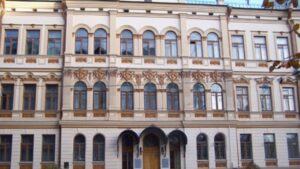
The Ministry of Culture and Information Policy of Ukraine (MCIP) presented a new visual brand of the department.
“The rebranding aims to show the ministry as a modern state institution that meets today’s challenges. The new brand style represents the current Ukrainian culture – attractive and understandable for modern Ukrainians,” the ministry’s press service said.
It is noted that the new logo of the Ministry of Culture is “light and graceful”, the sketches of the letters in the logo have careful references to ancient Russian calligraphy, such as “The Tale of Igor’s Campaign” and the manuscripts of Kyivan Rus.
“The abbreviation MCIP is sewn into the new logo, the thin outline and rounding are subconsciously read as soft and friendly elements that create dynamics like a reflection of a new round of history and culture. The intersection of letters in the abbreviation reminds of the interdisciplinarity of the areas of MCIp’s work. The logo can be used as a full-color sign, combining two colors, and as a monochrome sign, which provides for the use of only black or white,” the message says.
The logo is based on two colors: yellow and red, which are supposed to be used only on a contrasting background.
It is noted that minimalism is taken as the basis for the new corporate identity of the ministry.
“When developing the new identity, the main attention was paid to such strategic directions as: culture, creative economy, information policy, tourism, as well as major restoration,” the ministry said.
The ministry’s new identity was reportedly developed by Green Penguin creative agency with the support of USAID Transformation Communications Activity.
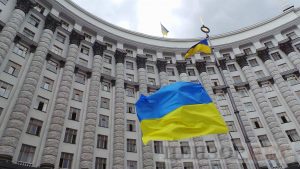
The Cabinet of Ministers of Ukraine has renamed the Ministry of Culture, Youth and Sports into the Ministry of Culture and Information Policy. Also, by resolution No. 231 of March 23, the government amended acts that related to the activities of the Ministry of Culture, Youth and Sports, replacing the name of the department with the Ministry of Culture and Information Policy.
In addition, the Cabinet of Ministers abolished all the functions of this ministry, which related to youth and sports.
As reported, on March 4, the Verkhovna Rada supported the appointment of Vadym Gutzeit as Minister of Youth and Sports of Ukraine.



