

According to the analytics department of the Fixygen.ua project, the passage of a U.S. law on the structure of the digital asset market, the finalization of stablecoin regulations, and the further expansion of banks’ access to cryptocurrency transactions could be the key government decisions capable of positively impacting the cryptocurrency market in the second half of 2026.
Analysts at JPMorgan, Citigroup, and Bitwise cite the passage of the U.S. Digital Asset Market CLARITY Act as the most significant potential development. The bill aims to delineate the authority of the U.S. Securities and Exchange Commission (SEC) and the Commodity Futures Trading Commission (CFTC), as well as establish federal regulations for cryptocurrency exchanges and token issuers.
JPMorgan analysts, led by Nikolaos Panigirtzoglou, previously noted that the passage of legislation regarding the structure of the crypto market could serve as a positive catalyst for digital assets in the second half of 2026. The law has the potential to reduce legal risks and facilitate participation in the sector by banks, asset management firms, and other institutional investors.
Citi strategist Alex Saunders also believes that regulatory changes will stimulate the further adoption of cryptocurrencies and an influx of capital. However, the bank warned that the window for passing the law in 2026 is narrowing. The delay in considering the CLARITY Act has already become one of the reasons for Citi’s downward revision of its forecasts for Bitcoin and Ethereum.
Bitwise Chief Investment Officer Matt Hogan expects a sharp improvement in market sentiment if a version of the CLARITY Act acceptable to the cryptocurrency industry is passed. In his view, the lack of a final decision maintains uncertainty and is causing institutional investors to postpone investments.
As of the end of July, the bill had made progress in the Senate, but it requires the support of some Democrats for final passage. Controversial issues include rewards for stablecoin holders, anti-money laundering requirements, regulation of decentralized platforms, and restrictions on high-ranking politicians’ involvement in cryptocurrency projects.
A second potential catalyst could be the publication of the final implementing rules for the GENIUS Act, which was signed into law in the U.S. in July 2025.
The law established a federal regulatory framework for payment stablecoins, but a number of provisions require additional regulations from the Department of the Treasury, banking regulators, and financial monitoring agencies.
On April 1, 2026, the U.S. Treasury Department presented the first draft of regulations defining the conditions under which state-level regulation of issuers can be considered comparable to the federal system. A week later, FinCEN and OFAC proposed requirements regarding anti-money laundering and sanctions compliance.
The publication of the final rules could allow banks and payment companies to launch their own stablecoins more quickly, as well as increase demand for blockchain infrastructure, tokenized assets, and digital asset custody services.
Bitwise notes that the volume of tokenized real-world assets has grown by 50.3% since the beginning of 2026, reaching $32.89 billion. In terms of transaction volume, stablecoin transactions are already 2.3 times higher than those of the Visa payment system.
Ethereum, Solana, and other networks actively used for issuing digital dollars, tokenizing assets, and international settlements stand to benefit most from the completion of stablecoin regulation.
A third potential positive development will be further clarification of the legal status of certain cryptoassets and staking transactions.
On March 17, 2026, the SEC and CFTC issued a joint interpretation stating that most cryptoassets are not securities in and of themselves. The document also clarifies the application of the law to mining, staking, airdrops, and inverse tokens.
The next positive step for the market could be formal rules that allow cryptocurrency companies to determine in advance whether a specific token falls under the jurisdiction of the SEC or the CFTC.
Another catalyst could be the further approval of exchange-traded funds that utilize staking. Such products allow investors not only to gain price exposure to cryptocurrencies but also to participate in the revenue generated from transaction validation.
By 2026, exchange-traded products featuring staking of Solana, Avalanche, Ethereum, and other tokens had already appeared in the U.S. The expansion of such authorizations could increase institutional demand, primarily for cryptocurrencies that operate on a Proof-of-Stake mechanism.
A fourth potentially positive development could be the CFTC’s authorization for regulated U.S. platforms to organize spot trading in digital assets.
The CFTC’s Crypto Sprint program is scheduled to run through August 2026 and aims to develop regulated spot trading of crypto assets, enable the use of stablecoins and tokenized assets as collateral, and adapt infrastructure to support 24/7 trading and blockchain-based settlements.
The emergence of regulated spot trading platforms could attract brokers, banks, and professional managers to the market, who are currently constrained by internal rules or counterparty requirements.
This could also reduce U.S. investors’ dependence on foreign trading platforms and increase the liquidity of Bitcoin, Ethereum, and other assets that the CFTC officially classifies as digital commodities.
Analysts consider the further lifting of regulatory restrictions on banks to be a fifth potential catalyst.
The U.S. Office of the Comptroller of the Currency has already confirmed that national banks may provide crypto-asset custody services, buy and sell them on behalf of clients, and engage third-party sub-custodians.
The next step could be broader harmonization of regulations by the Federal Reserve System, the Federal Deposit Insurance Corporation, and state banking regulators.
The issuance of new banking licenses to companies working with digital assets, the launch of cryptocurrency custody services by major banks, and the provision of access to trading through traditional banking apps would send a positive signal to the market.
Such decisions could reduce operational risks for institutional investors and create additional channels for capital inflows into cryptocurrency funds.
Further support for the market could come from the convergence of digital asset regulations between the U.S., the U.K., and the European Union.
On July 14, 2026, the U.S. Department of the Treasury and the UK Treasury presented recommendations on the development of cross-border transactions involving digital assets. The parties separately supported the expansion of international circulation of private stablecoins and the reduction of regulatory barriers between the two financial markets.
A positive development could be the mutual recognition of licenses or reserve requirements for stablecoins, which would facilitate the use of digital dollars and pounds in international settlements.
In the European Union, the MiCA regulation has already established a unified licensing system for cryptocurrency companies. Granting licenses to large international banks and exchanges could boost confidence among institutional clients and accelerate the development of a legal market for digital assets.
However, the most important regulatory factor for the market in the coming months remains the fate of the CLARITY Act. Its passage could reduce the likelihood of legal disputes with regulators and open the U.S. market to a greater number of institutional products.
However, a positive outcome is not guaranteed. Excessively strict requirements for DeFi, stablecoins, or software developers could limit the growth of certain market segments.
Furthermore, even favorable legislation cannot eliminate the impact of interest rates, geopolitics, liquidity, and investor activity. Bitwise notes that in the second quarter of 2026, the index of the largest crypto assets fell by 15.4%, and U.S. spot Bitcoin ETFs recorded a record quarterly outflow of funds.
At the time of writing, Bitcoin was trading at around $63,400, and Ethereum at around $1,625. Thus, the most positive scenario for the crypto market would be the simultaneous passage of the CLARITY Act, the finalization of regulations for stablecoins, and the expansion of banks’ access to digital assets. These decisions have the potential to reduce regulatory uncertainty, but their impact will depend on the final wording of the regulations and the state of global financial markets.

According to Fixygen, the global cryptocurrency market is nearing the end of the week without a clear direction: Bitcoin held steady at around $64,500, while Ethereum fell significantly, and inflows into U.S. cryptocurrency ETFs remained volatile.
As of Friday, Bitcoin was trading at approximately $64,400. On Monday, July 20, the leading cryptocurrency opened the week at around $64,680. Thus, the weekly decline was less than 0.5%, indicating consolidation following the market’s massive drop in previous months.
Ethereum showed significantly weaker performance over the same period. At the start of the week, its price was around $1,870, while by Friday it had fallen to approximately $1,620. The weekly decline reached 13%.
The total market capitalization of the cryptocurrency market was estimated at approximately $2.2 trillion. Bitcoin accounted for about 59% of the total market value, reflecting sustained investor demand for the largest and most liquid digital asset amid uncertainty.
U.S. spot Bitcoin ETFs saw about $274 million in net inflows over four trading days from July 20 to 23. On Monday, inflows totaled $226.8 million; on Tuesday, $203.2 million; and on Wednesday, $69.1 million.
However, on Thursday, investors withdrew $225.1 million from Bitcoin ETFs. The bulk of the outflow—$202.5 million—came from BlackRock’s IBIT fund. This virtually wiped out a significant portion of the positive results from the beginning of the week. Data for Friday had not yet been published at the time of writing.
Spot Ethereum ETFs attracted approximately $174.5 million from Monday through Thursday. Net inflows were recorded daily, including $72.7 million on Wednesday and $26.3 million on Thursday. However, these inflows were unable to prevent a decline in the price of Ethereum, indicating that pressure on this asset persists across the broader market.
Earlier, U.S. Bitcoin ETFs broke an eight-week streak of outflows, during which investors withdrew more than $8 billion from the funds. The return to inflows was a positive sign, but the volume remains insufficient to indicate a sustained recovery in institutional demand.
A report published this week by CoinGecko showed that the cryptocurrency market capitalization in the second quarter of 2026 fell by 12.6%—from $2.4 trillion to $2.1 trillion.
The market capitalization of stablecoins decreased by 1.6% to $305.1 billion. This marked the first quarterly decline in this metric since the third quarter of 2023 and may indicate a partial withdrawal of liquidity from the cryptocurrency system.
Spot trading volume on the ten largest centralized crypto exchanges fell by 27.9% in the second quarter—to $1.95 trillion. In May, the figure dropped to $619 billion—the lowest monthly level since the start of the year—before rebounding to $695 billion in June.
Trading volume in perpetual futures on the largest centralized exchanges decreased by 10%—from $14.1 trillion to $12.7 trillion. The more moderate contraction of the derivatives market compared to the spot segment indicates that traders remain primarily interested in short-term and speculative trades.
One of the week’s major regulatory developments was the publication on July 22 of an updated version of the U.S. CLARITY Act. The bill aims to establish comprehensive rules for the digital asset market and allocate authority between the U.S. Securities and Exchange Commission and the Commodity Futures Trading Commission.
In May, the Senate Banking Committee approved the bill by a vote of 15 to 9. However, the updated version sparked new disagreements, particularly regarding investor protection, combating illicit financing, and limiting conflicts of interest among government officials.
Thus, the week did not provide the market with a clear signal. Bitcoin showed relative stability, but Ethereum’s decline, the sharp reversal of flows into Bitcoin ETFs on Thursday, and weak quarterly figures for exchange activity indicate that market participants remain cautious.
The final results of the week will depend on Friday’s flows into U.S. ETFs, the situation in global risk markets, and further progress on cryptocurrency legislation in the U.S.

According to Fixygen, the cryptocurrency market is ending the week of July 13–17 at a level close to where it started: Bitcoin is trading at around $63,000, while the total market capitalization of digital assets stands at approximately $2.2 trillion.
As of Friday, Bitcoin was trading at around $63,020, down approximately 1.7% over the past 24 hours. The leading cryptocurrency’s share of the total market capitalization is estimated at 56–58%. Ethereum, Solana, and most other major digital assets were also under pressure. SOL was trading at around $78, and XRP at around $1.06.
On Monday, Bitcoin fell below $62,000 amid a new escalation of the conflict between the U.S. and Iran, rising oil prices, and an exodus of investors from risky assets. After the release of U.S. inflation data, which came in weaker than expected, the cryptocurrency rebounded and rose above $65,500 on July 15, but was unable to sustain the gains.
By the end of the week, pressure on the crypto market intensified due to a sell-off in tech and semiconductor stocks, rising oil prices, and new geopolitical risks in the Middle East. On Friday, Bitcoin lost about 2% over the course of the day and returned to the $63,000 level.
Capital flows in U.S. spot Bitcoin ETFs remained volatile. On Monday, the funds recorded a net outflow of $424.7 million, followed by inflows of $181.1 million on Tuesday, $107.7 million on Wednesday, and $79.1 million on Thursday. As a result, the cumulative outflow over the four trading days totaled approximately $56.8 million. Data for Friday had not yet been published at the time of writing.
An additional source of uncertainty was the debate in the U.S. over the Clarity Act, a bill intended to establish regulations for the cryptocurrency market and delineate the powers of financial regulators. Progress on the bill has slowed due to disagreements in the Senate and concerns about a potential conflict of interest related to President Donald Trump’s cryptocurrency holdings.
In the corporate sector, the week’s main event was Citadel Securities’ investment in the cryptocurrency exchange Crypto.com. The market maker invested $400 million, valuing the platform at $20 billion. This is Crypto.com’s first round of institutional funding. The funds raised are planned to be directed toward the development of operations involving tokenized securities and derivatives.
At the same time, pressure remains on public companies that have built up large Bitcoin reserves. Strategy has already sold approximately $218 million worth of digital assets in 2026 to fund dividends and maintain its dollar reserves. The decline in cryptocurrency prices has led to the shares of a number of similar companies trading below the value of the digital assets they hold.
Thus, softer U.S. inflation data and the resumption of capital inflows into ETFs have failed to ensure a sustained market recovery. Next week’s market dynamics will depend on developments in the Middle East, oil prices, capital flows into cryptocurrency funds, and further progress on U.S. legislation regarding digital assets.

The National Bank of Ukraine has increased the deadline for settlements on agricultural and specialized equipment export transactions carried out from March 1, 2026, from 180 to 270 days.
This applies to goods classified under UKT VED codes 8424, 8428, 8432, and 8716.
The NBU specifies that the decision was made following consultations with the Ministry of Economy, Environment, and Agriculture and taking into account the government’s proposals (Cabinet of Ministers Order No. 573-r of June 21, 2024).
The changes were approved by NBU Board Resolution No. 18 dated February 26, 2026, which comes into force on February 28, 2026.
The Ministry of Economy believes that extending the deadline “from 180 to 270 calendar days” will help exporters avoid the risks of reduced supplies due to long production cycles and the specifics of fulfilling foreign economic contracts, as well as support the continuity of contracts and the inflow of foreign currency earnings.
AGRICULTURAL MACHINERY, EXPORTS, foreign currency earnings, NBU, REGULATION

The crypto asset market started 2026 with increased volatility and periodic sell-offs amid nervousness in global markets. On Monday, Bitcoin is trading at around $87,800, and Ether at around $2,900. The key short-term pressure factor is institutional demand behavior through exchange-traded products. According to Bloomberg, US spot Bitcoin ETFs saw five consecutive days of outflows totaling approximately $1.7 billion last week, which heightened market participants’ caution. Additionally, Yahoo Finance reported notable weekly outflows from this category of funds.
At the same time, the crypto market remains linked to overall risk sentiment. Reuters recorded large capital flows in traditional markets in January, with investors more sensitive to geopolitics and trade restriction announcements, which typically increase demand for liquidity and reduce appetite for risky assets.
At the same time, the price decline is stimulating the launch of new strategies by major players. The Financial Times reported that Mike Novogratz’s Galaxy plans to launch a $100 million hedge fund in the first quarter of 2026, hoping to capitalize on market volatility and “maturation.”
A separate long-term trend is the acceleration of regulatory certainty and the convergence of the crypto industry with traditional finance. Reuters wrote about the introduction of a bill in the US that should clarify market rules and the distribution of roles between regulators. Against this backdrop, traditional asset managers are more actively testing tokenization: Reuters reported on F/m Investments’ application to tokenize ETF shares on US Treasury bills.
In Europe, the focus is shifting to the practical implementation of MiCA. ESMA reminds that for companies that operated under national rules until December 30, 2024, “grandfathering” applies — they can continue their services until July 1, 2026, or until a decision on the MiCA license is made. National regulators are also publishing their clarifications and transition schedules.
In the coming weeks, investors will typically look at the dynamics of flows in spot ETFs, regulatory news in the US and EU, and whether demand for “quality” within the crypto market — Bitcoin and the most liquid assets — will continue, while riskier tokens traditionally react more strongly to any spikes in volatility.

The global ranking of armed populations, compiled on the basis of the Small Arms Survey, shows that the ten countries with the largest number of civilian weapons include the United States, India, China, Pakistan, Russia, Brazil, Mexico, Germany, Yemen, and Saudi Arabia. Ukraine is not on this list, but even before Russia’s full-scale invasion, the country was among the states with a significant amount of weapons in the hands of citizens. The Experts Club Analytical Center analyzed global and Ukrainian statistics.
According to the Small Arms Survey for 2017-18, there were about 4.4 million civilian weapons in Ukraine—approximately 9.9 guns per 100 inhabitants. Of these, only about 800,000 were officially registered, and about 3.6 million belonged to the illegal segment.
According to the National Police database, as of July 31, 2018, there were 892,854 registered weapons in the country. In 2021, the Ministry of Internal Affairs estimated the number of weapons legally owned by citizens at approximately 1.3 million, against the backdrop of tighter regulations and growing public interest in self-defense after 2014.
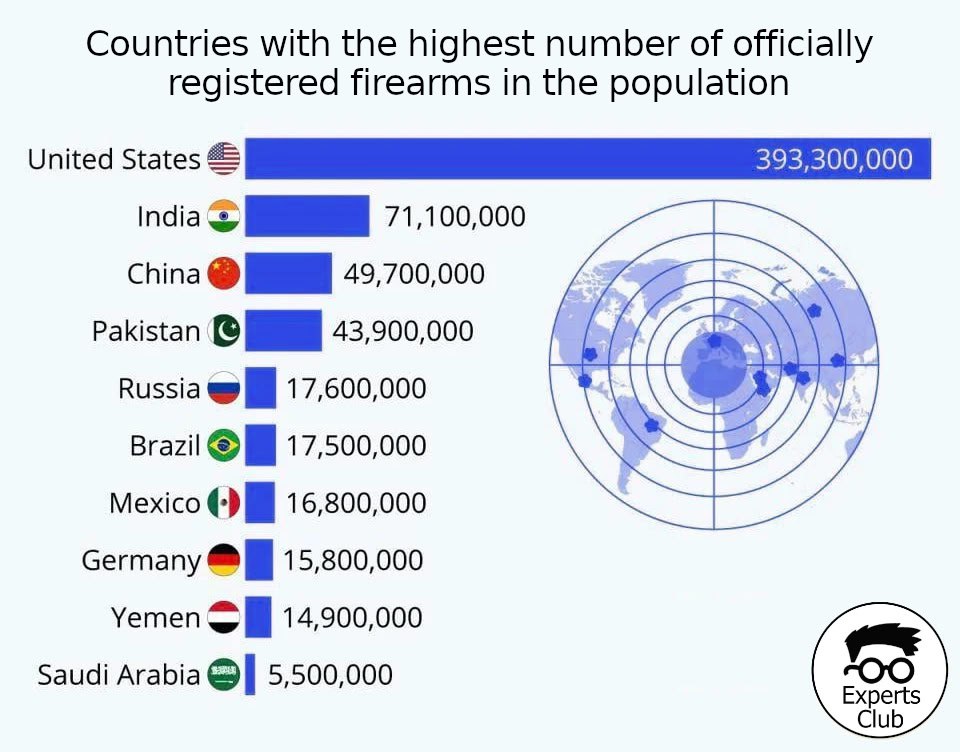
The full-scale war of 2022 dramatically changed the picture. Against the backdrop of the formation of territorial defense and volunteer units, the state massively transferred small arms to citizens; at the same time, a significant number of captured and illegal firearms ended up in the hands of the population. Estimates today vary widely: according to Interior Minister Ihor Klymenko, Ukrainians may have between 1 and 5 million weapons, while a number of think tanks put the figure at 4–5 million, of which 2–3 million may be in illegal circulation.
Research by Small Arms Survey using sociological surveys shows that up to 11% of Ukrainian households may have at least one weapon, which on a national scale gives a range of 865,000 to 1.42 million armed households. At the same time, the share of households that openly report the presence of weapons in 2023–2024 remains at 5–6%, which indicates both a high level of distrust and the sensitivity of the issue in wartime.
To bring order, Ukraine has launched a Unified Weapons Register. By July 2024, 63% of households that own weapons stated that some or all of their weapons were registered; among those who are aware of the system, 74% claim to have registered all their weapons, but about 10% continue to keep unregistered weapons.
Thus, while before the war there were approximately 1.3 million registered weapons in Ukraine and several times more illegal firearms, now, against the backdrop of full-scale hostilities, there are millions of weapons, a significant portion of which must gradually be registered or confiscated.
This makes the issue of civilian weapons control one of the key issues for post-war security, law enforcement reform, and Ukraine’s negotiations with the EU on the harmonization of weapons legislation.
Source: https://expertsclub.eu/ukrayina-na-tli-svitovogo-rynku-czyvilnoyi-zbroyi/



