
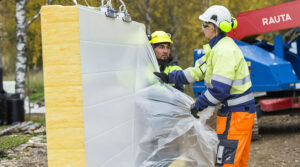
The engineering and construction company Rauta has published a guide titled “Fastening Cantilevered Structures to Sandwich Panels,” intended for designers and specialists working with building envelopes.
According to the company’s website, the guide will be useful when calculating loads on Ruukki sandwich panel cladding caused by suspended elements. The guide contains recommendations on the level of utilization of the panels’ load-bearing capacity, requirements for calculating fasteners for suspended elements, as well as specifics for determining loads from vertically installed U- and Ω-profiles or cantilever supports for cable ladders.
The document also specifically addresses point loads from through-fasteners. This is important for industrial, warehouse, logistics, and commercial facilities where engineering components, cable trays, additional structures, cladding, or auxiliary equipment may be attached to facades or wall panels.
For the construction market, these guidelines are of practical importance, as sandwich panels are widely used in prefabricated buildings, industrial facilities, cold storage warehouses, agricultural infrastructure, and retail and logistics complexes. Errors in the design of fasteners can lead to improper load distribution, damage to the cladding, compromised airtightness, or reduced durability of the building envelope.
Rauta operates in the engineering and construction solutions sector and offers building design, the supply of frames, sandwich panels, ventilated facades, and prefabricated buildings, as well as structural installation, general contracting, client services, building commissioning, and maintenance.
The company positions itself as a provider of reliable construction solutions in Ukraine and European Union countries. Rauta uses certified European-manufactured products and is the exclusive supplier in Ukraine of commercial products from the Finnish Ruukki Group.
One of Rauta’s key areas of activity is Ruukki sandwich panels. According to the company, these panels are manufactured using Finnish technologies at Ruukki’s European plants and comply with the European standard EN 14509. The supply of panels is accompanied by consultations on selection, the design of building envelopes, technical solutions, components, panel layout on facades and roofs, as well as calculations of the structures’ load-bearing capacity.
Rauta also develops its own engineering solutions. These include a patented frameless building design using sandwich panels, a construction technology for multi-story buildings that uses sandwich panels as walls, solutions to improve building airtightness, and technologies for renovating structures using energy-efficient sandwich panels.
In 2024, the company received a patent from the Ukrainian National Office of Intellectual Property and Innovation for a technical solution for a frameless building made of sandwich panels. According to Rauta, this technology can be applied to single-family homes, cottage communities, cold storage rooms, refrigerated warehouses, and other single-story residential or commercial buildings.
In addition, Rauta is a member of relevant business and industry associations. The company is part of the Ukrainian Center for Steel Construction, the Finnish Business Group, the Finnish-Ukrainian association UkraineOffice, and the German-Ukrainian Chamber of Industry and Commerce (AHK Ukraine).
The release of the new guidelines indicates that the company is focusing not only on the supply of materials but also on providing engineering support for projects. For clients, this can reduce risks during the design and operation phases of buildings, and for the market, it can raise standards for working with sandwich panels and cantilevered structures.
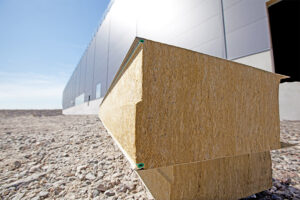
Rauta has said that Ruukki sandwich panels can last over 100 years. This conclusion is backed up by test reports on the filler and polymer-coated steel, the company said.
According to Rauta, the key factors affecting the durability of sandwich panels are the correct selection of the polymer coating for steel cladding in accordance with the corrosion aggressiveness category of the environment, as well as the accurate calculation of the panels to ensure the proper load-bearing capacity of the enclosing structures.
Rauta is a Ukrainian company specializing in the supply and implementation of modern construction solutions using sandwich panels, steel structures, and energy-efficient technologies.
As the official representative of Ruukki in Ukraine, the company implements projects in industrial, commercial, and civil construction.

The use of Ukrainian-made sandwich panels increased by 15% in the first half of 2024, while sales of imported products decreased by 12%, Andriy Ozeychuk, director of the engineering and construction company Rauta, told Interfax-Ukraine.
“In the first half of 2024, the volume of the Ukrainian sandwich panel market in absolute terms amounted to just over 1 million square meters, which is similar to the figures for 2023. At the same time, the use of Ukrainian-made panels increased by 15%, while sales of imported products decreased by 12%,” he said.
Ozeychuk also emphasized the change in the structure of sandwich panels: their share of mineral wool is decreasing, while the demand for panels with PIR (polyurethane foam – a fire-resistant insulating material based on polyurethane) filler is growing, which has the highest thermal insulation properties and a lower price.
“From 2021 to 2024, the price in euros of PIR-filled sandwich panels decreased by 18%, while mineral wool-filled panels increased in price by 37%,” he said.
At the same time, the Rauta director stated that today the construction of new facilities is actively developing only in western Ukraine, while in other regions it is limited to spot projects and the reconstruction of destroyed buildings.
According to him, the main problem of the construction market, in particular the sandwich panel segment, is a large market decline of 60-70% compared to 2021. Most investors take a wait-and-see attitude and do not risk investing in new projects.
At the same time, despite the war risks, the owners of most of the destroyed commercial and industrial facilities have invested in their restoration to quickly restart their businesses, allowing them to continue to operate efficiently.
In particular, Rauta has implemented a number of large-scale restoration projects, including the Retroville shopping mall in Kyiv, the production shop of the Chernihiv Automobile Plant, and the Novus supermarket in Bucha (Kyiv region).
According to Ozeychuk, the industry’s acute problems are a shortage of personnel, especially among skilled laborers, as well as blackouts.
“For some positions, we have to look for specialists for several months, and sometimes train employees ourselves. That’s why salaries and, accordingly, the cost of construction are rising. Blackouts, which last from two to six hours a day, reduce the productivity of builders, increase the time and cost of construction by 20-40%,” he said.
According to his observations, the program for the restoration and protection of critical infrastructure facilities has the greatest impact among government programs.
“In general, by the end of 2024, we expect the sandwich panel market to remain at the level of 2023 with a possible growth of up to 10%,” Ozeychuk summarized.
Founded in 2014, Rauta Group LLC (Rauta) is an engineering and construction company engaged in the design, supply and installation of sandwich panels, ventilated facades and prefabricated buildings. It is the exclusive importer of commercial products from the Finnish concern Ruukki to Ukraine, as well as the developer of a number of innovations that reduce the cost and time of construction.
Source: https://interfax.com.ua/

The new technology of prefabricated one-story residential buildings makes it possible to provide people with high-quality houses as quickly as possible.
Ruukki sandwich panels are used as load-bearing and envelope structures of houses, which allows to reduce the cost of construction due to the absence of the need to build a frame. At the same time, cottages become highly energy efficient (heat transfer resistance R = 7.43 m2K / W) and durable (lifetime is more than 50 years).
Rauta has developed several practical layouts for sandwich panel cottages ranging from 26 m2 to 139 m2. At the same time, layouts with an area of 26 m2 and 49 m2 can be placed in blocks with common partitions. This solution allows to further reduce the cost of construction, as well as to build settlements for people in dire need of housing as quickly as possible.
“The key goal of this project was to create reliable, functional and energy-efficient houses with the shortest possible construction time,” said Andriy Ozeychuk, Rauta director. “The ergonomics of the layouts are deliberate so that even in a house with an area of only 26 m2, a family of 3-4 people can live comfortably.”
BUILD, CONSTRUCTION, DEVELOPED, HOUSE, RAUTA, SANDWICH PANEL, TECHNOLOGY



