
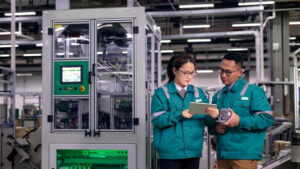
Schneider Electric, the global leader in energy technologies, today announced that its plant in Wuhan (China) has been recognized by the World Economic Forum (WEF) as a Global Lighthouse for Talent—one of only three sites worldwide to receive this designation.
The Global Lighthouse Network is a World Economic Forum initiative that recognizes advanced manufacturing sites and value chains that have achieved exceptional results in productivity, supply chain resilience, customer centricity, sustainability, and talent development. The initiative was co-founded with McKinsey & Company and is supported by an advisory board of industry leaders who collectively shape the future of global manufacturing.
A new award category—Talent Lighthouse—identifies manufacturing sites that achieve a transformational impact on the workforce through advanced solutions in work process and safety design, talent planning, engagement and onboarding, development, and workforce effectiveness.
The Wuhan plant became Schneider Electric’s ninth Lighthouse site globally and the first recognized for talent development, complementing the company’s eight other Lighthouse factories and distribution centers, including five Sustainability Lighthouses.
As Schneider Electric’s strategic supply chain hub in China and a model of digital manufacturing transformation, the Wuhan plant faced significant workforce challenges driven by rapid automation and a 239% expansion of its product portfolio. Initially, only 20% of employees had automation skills, onboarding new employees took 75 days, and technical staff turnover reached 48%.
Over the past five years, the plant increased its automation level by 55% and expanded its product portfolio by 239%, creating a critical shortage of qualified personnel. To address these challenges, Schneider Electric implemented a people-centered “workforce of the future” model that combines technology, partnerships, and continuous learning.
“The Fourth Industrial Revolution is as much about people as it is about technology,” said Mourad Tamoud, Chief Supply Chain Officer at Schneider Electric. “With our Wuhan plant, we have demonstrated that when AI and human potential work together, organizations can build resilient, agile, and future-ready teams—while ensuring that technology serves its ultimate purpose: delivering more value to customers.”
“Today, competitiveness is no longer determined solely by efficiency, but by the ability to sense, adapt, and respond quickly,” said Kiva Allgood, Managing Director at the World Economic Forum. “This year’s industrial transformation examples show how intelligently driven operations scale, placing resilience and sustainability at the heart of manufacturing companies’ activities.”
This achievement underscores Schneider Electric’s commitment to developing future-ready talent, building an agile organization, and fostering a culture that unlocks people’s potential and drives innovation.
Related resources:
About Schneider Electric
Schneider Electric is a global leader in energy technologies that delivers efficiency and sustainability through electrification, automation, and digitalization of industry, business, and homes. The company’s technologies enable buildings, data centers, factories, infrastructure, and power grids to operate as open, interconnected ecosystems, improving productivity, resilience, and environmental performance. Schneider Electric’s portfolio includes smart devices, software-oriented architectures, AI-based systems, digital services, and expert consulting. With 160,000 employees and 1 million partners in more than 100 countries, Schneider Electric consistently ranks among the world’s most sustainable companies.
Discover the latest energy technology insights on Schneider Electric Insights

SE Advisory Services, Schneider Electric’s global consulting practice, today announced the launch of Resource Advisor+, a next-generation intelligent energy and sustainability management platform.
The Resource Advisor+ platform and its suite of products are powered by AI-driven workflows and transform how organizations turn energy and sustainability data into practical action. A single platform and set of specialized products replace fragmented tools and disconnected data with a unified, multi-product experience in one intelligent ecosystem, enabling seamless product integration for emissions and energy management, sustainable supply chains, climate risk, and sustainability reporting. The Resource Advisor+ ecosystem serves as an intelligent command center that allows companies to unify data, accelerate decision-making, and rapidly deploy energy and sustainability initiatives across the business.
Sera: The Advantages of Resource Advisor+
Sera is the leading AI agent within Resource Advisor+, acting as a proactive digital partner that interprets user needs and coordinates a team of specialized agents operating in the background. This coordination sets Resource Advisor+ apart, as it leverages SE Advisory Intelligence—an proprietary knowledge layer that codifies two decades of Schneider Electric’s consulting experience into proven methods and real-world operational constraints. Sera and its team apply this embedded expertise to turn complex data into clear, actionable recommendations, enabling users to navigate energy and sustainability with unprecedented speed and confidence. Resource Advisor+ and Sera deliver three distinct advantages to companies:
“Today we mark an exciting milestone as we realize our vision for an AI-first strategy,” said Steve Wilhite, Executive Vice President of the global Energy & Sustainability practice at SE Advisory Services. “Resource Advisor+ offers companies an entirely new way to manage energy and sustainability, built on SE Advisory Intelligence and a network of agentic AI capabilities. By automating complexity and turning data into practical action, Resource Advisor+ enables users to accelerate both energy optimization and decarbonization, and reflects a fundamental shift in how we help clients achieve meaningful, enterprise-wide outcomes.”
The Resource Advisor+ ecosystem debuts with two new products—Carbon Performance and Supply Chain—and later this year will be expanded with two additional sustainability products: Climate Risk and Reporting and Compliance, as well as products for energy management and efficiency. The EcoStruxure™ Resource Advisor cloud platform, which helps businesses track and optimize energy and sustainability performance, remains available for customer use and purchase.
The new Carbon Performance product turns emissions tracking into actionable enterprise-wide decarbonization. It provides auditable calculations aligned with the GHG Protocol for Scope 1, 2, and 3 emissions, enables companies to set targets, model emissions-reduction scenarios, and manage initiatives through Sera, which delivers decision-ready carbon analytics.
The Supply Chain product (formerly Zeigo Hub) helps reduce Scope 3 emissions in global supply chains while engaging suppliers in decarbonization at scale. The product offers flexible data collection, a personalized supplier experience, and structured recommendations that drive adoption and deliver measurable progress in emissions reduction for both corporate sponsors and suppliers.
“As organizations face increasing pressure to turn sustainability ambitions into measurable action, platforms that unify data, intelligence, and execution are becoming essential,” said Amy Cravens, Research Director for Sustainability and ESG Software at IDC. “Resource Advisor+ from Schneider Electric reflects a significant evolution in sustainability management, combining deep domain expertise with AI-driven workflows. With embedded advisory intelligence, Schneider Electric is helping enterprises move beyond reporting to faster, more confident decisions that connect energy, emissions, and supply-chain sustainability to real business outcomes.”
About SE Advisory Services
SE Advisory Services helps organizations turn ambitious sustainability, energy, and digitalization goals into measurable outcomes. Backed by Schneider Electric—one of the world’s most sustainable companies—the service combines deep expertise, global delivery, and AI-powered software to drive transformation across energy and risk management, decarbonization, nature-based solutions, operational efficiency, and digital transformation. Operating in more than 100 countries, SE Advisory Services turns complex challenges into competitive advantage for its clients.
About Schneider Electric
Schneider Electric is a global leader in energy technologies that delivers efficiency and sustainability through electrification, automation, and digitalization of industry, businesses, and homes. Its technologies enable buildings, data centers, factories, infrastructure, and power grids to operate as open, interconnected ecosystems, improving productivity, resilience, and environmental performance. The company’s portfolio includes intelligent devices, software-centric architectures, AI-based systems, digital services, and expert consulting. With 160,000 employees and 1 million partners in more than 100 countries, Schneider Electric consistently ranks among the world’s most sustainable companies.

Schneider Electric, a global leader in energy technologies, announces its participation in the Annual Meeting of the World Economic Forum in Davos, Switzerland. The company delegation is led by CEO Olivier Blum, who will advocate for cross-industry cooperation to advance energy technologies.
“It is clear that we have entered a new era where artificial intelligence and energy are inseparable, and together they will transform every business,” said Olivier Blum, CEO of Schneider Electric. “AI requires computing power, and computing requires energy. That is why the world needs greater energy intelligence. Customers across all sectors face the same challenge—using energy efficiently. As your partner in energy technologies, we electrify, automate, and digitize every industry, business, and home, improving efficiency and sustainability for all. And we are not just connecting systems—we are creating ecosystems in which AI, data, and people work in harmony. Let’s use the opportunity in Davos to advance energy technologies together.”
During this year’s meeting, the company will make a number of important announcements, including those listed below. The full list of Schneider Electric delegates and the format of the company’s participation can be viewed at se.com.
AI applications delivering real results
Schneider Electric was recognized in the 1st and 2nd cohorts of the MINDS program (Meaningful, Intelligent, Novel, Deployable Solutions), the Forum’s global program highlighting high-impact real-world applications of artificial intelligence. CEO Olivier Blum will receive awards for EcoStruxure Microgrid Advisor and Snaplogic Touchscreen Room Controller at the winners’ award ceremony during the Annual Meeting of the World Economic Forum on January 20, 2026.
Ninth recognition of a Schneider Electric plant as a flagship smart factory
The Forum’s Global Lighthouse Network, which identifies and recognizes the most advanced manufacturing sites in the world, honored Schneider Electric’s plant in Wuhan. It became one of only three plants worldwide to receive recognition for work with talent—a new category introduced this year. This recognition became the ninth in Schneider Electric’s series of Lighthouse awards. The plant was recognized for implementing an innovative, people-centered workforce-of-the-future model that bridges the skills gap and sets a new standard for manufacturing resilience.
Gathering of C-level executives from different industries
Frederic Godemel, Executive Vice President for Energy Management at Schneider Electric, will convene a cross-industry group of global leaders and influencers on behalf of the Forum’s Bloomberg New Economy Energy Technology Coalition. This will be the Coalition’s first significant meeting, aimed at accelerating the adoption of technologies that make energy consumption more efficient, sustainable, and flexible amid growing global demand for electricity.
Driving change for underserved communities
Schneider Electric and EDP jointly launched the EDGE Transition program—a global accelerator that will support social entrepreneurs offering clean and affordable energy solutions and creating inclusive economic opportunities for underserved communities.
The program helps early-stage startups through mentorship, technical expertise, strategic partnerships, and access to long-term, high-risk-tolerant capital, inviting solutions that serve underserved communities and promote equitable access to energy. The initiative aims to accelerate the energy transition and drive global electrification for sustainable impact.
The organizations will announce their partnership in Davos on January 21.
More information about Schneider Electric’s participation in the Annual Meeting can be found at https://www.se.com/ww/en/about-us/events/davos/.
About Schneider Electric
Schneider Electric is a global leader in energy technologies that improves efficiency and sustainability by electrifying, automating, and digitizing industry, businesses, and households. The company’s technologies enable buildings, data centers, factories, infrastructure, and power grids to operate as open, interconnected ecosystems, increasing productivity, resilience, and environmental performance. Its portfolio includes intelligent devices, software-based architectures, AI-enabled systems, digital services, and expert consulting. The company has 160,000 employees and 1 million partners in more than 100 countries and consistently ranks among the world’s most sustainable companies.
www.se.com
Learn about the latest trends shaping sustainability, Electricity 4.0, and next-generation automation at Schneider Electric Insights.

France’s Schneider Electric plans to buy back €2.5-3.5 billion worth of its own shares by the end of 2030.
The company expects to increase the profitability of its operations amid the development of the artificial intelligence market and growing demand for electrification solutions.
According to a press release from Schneider Electric, the company aims to increase its adjusted EBITA margin by 250 basis points in 2026-2030. Its previous target was to increase this figure by 50 basis points in 2024-2027.
Schneider Electric will seek to “capitalize on opportunities in the areas of electrification, automation, and digitalization,” said its CEO Olivier Blume, whose words are quoted in a press release published ahead of an investor event.
The company forecasts average annual revenue growth of 7-10% through 2030. In addition, it plans to sell assets with proceeds of €1 billion to €1.5 billion during this period.
Schneider Electric is a manufacturer of distribution and protection equipment, automation devices for the energy sector, and other equipment.
Its solutions play an important role in ensuring the operation of data centers.
Schneider Electric shares added 2.5% in price on Thursday trading in Paris. Since the beginning of this year, their value has fallen by less than 1%.

The National Technical University “Kharkiv Polytechnic Institute” has received modern industrial equipment from Schneider Electric for the creation of multifunctional stands that simulate the operation of technological process automation systems. The complexes are designed to train students in the fields of automation, computer-integrated technologies, and robotics, according to KPI.
According to the university, the delivery includes new-generation programmable logic controllers, operator panels, relay devices, indicators, and other industrial automation tools, which will allow students to practice their skills in designing and testing control systems in conditions close to real production.
In addition, teachers and students are provided with academic access to the SEE Electrical Expert software package from IGE+XAO for the development of electrical diagrams and documentation. KPI reports that specialized training in working with the software will take place in September 2025.
As Mikhail Bubnov, CEO of Schneider Electric in Ukraine, said: “It is important for us that Ukrainian students work with the same equipment and software as engineers in modern factories. These stands allow students to practice the full cycle of training as an automation engineer — from circuit design and PLC programming to commissioning and diagnostics. We will continue to support university laboratories and educational programs because this is a direct investment in the human resources needed to rebuild the industry.”
Schneider Electric is a global provider of energy management and industrial automation solutions with approximately 160,000 employees and a partner network in more than 100 countries. In 2024, the group’s revenue was approximately €38 billion, and in the third quarter of 2025, it was €10 billion, with organic growth of 9%. The company notes sustained demand from data centers and industrial automation.
SEE Electrical Expert is professional software for electrical design developed by the IGE+XAO Group, which provides training and academic programs for universities.
NTU “KhPI” is one of the oldest technical universities in Ukraine, founded in 1885. According to the university, it has 10 educational and scientific institutes, 103 departments, and over 15,000 students. The university is consistently ranked among the top five Ukrainian universities in the QS rankings.

EU countries could save EUR250 billion annually by 2040 by accelerating the transition to electricity, according to a press release from France’s Schneider Electric.
“The so-called ‘energy trinity’ – the balance between affordability, security, and sustainability – remains a challenge, as high dependence on fossil fuel imports keeps prices high and delays the achievement of climate goals,” the company said.
According to a press release based on Schneider Electric’s report “Europe’s Energy Security and Competitiveness – Accelerating Electrification,” the current level of electrification in Europe is only 21% — a figure that has remained unchanged over the past decade and is 10% lower than in China, where rapid electrification is taking place. At the same time, the cost of energy for domestic consumers in the EU is EUR0.27 per kWh, in the US — EUR0.15/kWh, and in China — EUR0.08/kWh.
“This means that daily energy consumption for each EU citizen is three times more expensive than for Chinese residents,” the report’s authors concluded.
According to the document, the pace and level of electrification in different European countries vary significantly due to differences in infrastructure, policy, market maturity, and consumer behavior. In particular, some countries, such as the Scandinavian countries, have made significant progress in the electrification of transport and buildings, while others are only beginning to scale up their efforts. At the same time, Southern Europe shows higher rates of building electrification, while Western and Central Europe focus on industrial electrification and the development of prosumer initiatives.
“To remain competitive on the world stage, Europe needs to accelerate the transition to a more electrified economy,” according to Schneider Electric analysts.
The report identifies several key policy areas that need to be implemented to achieve this goal.
First and foremost, according to the authors of the document, governments need to reduce the price difference between electricity and natural gas by gradually phasing out fossil fuel subsidies and reforming the tax system to encourage the use of clean energy.
Equally important is accelerating financing — simplifying access to investment, introducing targeted incentives, especially for small and medium-sized businesses, and directing revenues from emissions trading and innovation funds to electrification projects.
The report also highlights the need to develop local markets, which involves mandatory electrification of new buildings and industrial processes, support for the rapid introduction of heat pumps and electric vehicles, and encouragement of prosumer initiatives.
In addition, an important direction is to promote local development through sustainable public procurement, accelerate standardization, and support European innovation and manufacturing—this will allow the economic and social benefits of electrification to be fully realized across the continent.
“This study is one of the most thorough analyses of Europe’s electrification potential and the policy actions needed to realise it. It emphasizes that electrification is vital — not only for achieving climate goals, but also for stimulating economic growth, energy independence, and industrial competitiveness,” said Laurent Bataille, Executive Vice President of Schneider Electric in Europe.
In his opinion, Europe must urgently overcome the stagnation of electrification, for which the relevant technologies already exist and are ready for implementation. At the same time, appropriate policy incentives and decisive business action are also needed to unlock the economic and environmental potential that EU countries need.



