
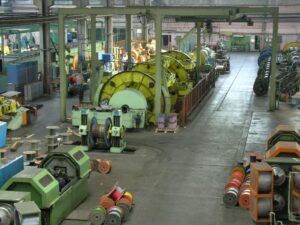
According to Serbian Economist, China’s CCSC Technology International Holdings Limited has announced that construction of a cable factory and logistics center in the Serbian municipality of Merosina is scheduled to begin in January 2026.
The company had previously expected work to start in November 2025, but has postponed the deadline. The new schedule was announced during the presentation of financial results for the first half of fiscal year 2026, which ended on September 30, 2025.
As noted in the announcement, the project in Merosina is scheduled for completion at the end of 2026. Once completed, the facility is expected to become the company’s logistics and manufacturing hub for its European operations.
The investment has been discussed with local authorities before: it was reported that the Chinese partners’ enterprise in Merosina could provide about 200 jobs.
CCSC specializes in the production of cables, connectors, and cable harnesses, which are used, in particular, in the automotive industry, robotics, and medical equipment.

According to Serbian Economist, the first Belgrade Film Festival (Beograd Film Festival, BFF) will be held in the Serbian capital from January 30 to February 6, 2026, which the organizers are positioning as a new platform for screening notable world premieres and festival films. The main venue will be the mts Dvorana cinema in the center of Belgrade.
The festival will open with a special screening of Jim Jarmusch’s new film Father Mother Sister Brother, and the program also includes other high-profile works, such as Fatih Akin’s Amrum and François Ozon’s Stranac (The Stranger) by François Ozon, which will be presented to the Belgrade audience as part of the BFF.
The concept of the festival is to combine auteur cinema, festival hits, and new works by masters in one program, making Belgrade one of the stops on the European festival calendar.
According to published information, festival films are being screened at mts Dvorana in the usual cinema format, with tickets sold at the cinema box office and online (including eFinity).
https://t.me/relocationrs/2010

According to Serbian Economist, Ukrainian berry producers and processors conducted a technological business tour to Serbia in December 2025, where they studied practices of growing and industrial freezing of berries, primarily raspberries, according to the Berry Growers Association of Ukraine (BGAU).
The trip was organized by the association with the support of the SIPPO program in Ukraine. Five Ukrainian companies and representatives of the association took part in the tour, visiting Serbian berry growing and freezing enterprises and familiarizing themselves with the cold processing chain – from small refrigerators to facilities capable of freezing up to 30% of the national raspberry harvest.
The UBA noted that despite competition between Ukraine and Serbia on the global raspberry market, the Serbian side demonstrated a willingness to share practical experience and technological solutions. The second day of the visit was devoted to professional training at the Institute of Horticulture in Čačak.
Serbian experience also revealed a number of problems that are also characteristic of Ukraine: the industry’s dependence on manual harvesting, labor shortages, and pressure from weather factors. In Serbia, almost all raspberries are harvested by hand, and the average wage for harvesters in the 2025 season was around €50 per day; small farms with an average area of about 0.1 hectares remain the main suppliers of raw materials for processing.
Context: the role of Serbia and Ukraine in raspberries and exports
Serbia maintains its position as the largest exporter of frozen raspberries and related berry crops in world trade: in 2024, it became the top exporter for commodity item HS 081120 (frozen raspberries, blackberries, etc.) – $313.2 million and 99.0 thousand tons. In 2024, Ukraine ranked 4th among exporters under the same heading – $115.4 million and 61.3 thousand tons.
The main destinations for Ukraine’s exports under HS 081120 in 2024 were Poland and Germany (followed by the Czech Republic, France, and Italy), reflecting the orientation of Ukrainian frozen products towards the EU market and the processing chains of Central Europe.

The Serbian Economist reports that Prindon Sadrija, the husband of Kosovo President Vjosa Osmani, called on Trump’s son-in-law Jared Kushner to move the Trump Hotel project to Pristina, which his organization had previously rejected in Belgrade.
Sadrija wrote on social network X that the withdrawal from the Belgrade project confirms the thesis that “significant projects should unite, not divide,” and suggested “moving this idea to Pristina” with the transformation of the capital’s Grand Hotel into Trump Hotel.
The statement came amid reports that Affinity Global Development, linked to Kushner, has withdrawn from plans to build a hotel and residential complex on the site of the former General Staff building in downtown Belgrade, which was damaged during the 1999 NATO bombing and has been the subject of public controversy over memory preservation and cultural heritage status.
The company notified the decision to withdraw from the project after months of protests and amid a legal scandal surrounding the removal of the site’s protected status, for which the Serbian prosecutor’s office sought to prosecute a number of officials.
In Serbian statements, the losses are estimated at “at least 750 million euros” – a figure that Serbian President Aleksandar Vucic and representatives of the ruling party have voiced, linking the investor’s withdrawal to the pressure of protesters.
At the same time, earlier publications on the parameters of the project estimated the investment at about $500 million.
https://t.me/relocationrs/1999

According to Serbian Economist, the first international Nikola Tesla Film Festival, dedicated to the life and legacy of Serbian-American inventor Nikola Tesla, will be held on January 7, 2026, in Las Vegas (USA) at the Palms Casino Resort.
According to the festival organizers, the goal of the event is to use film to show Tesla’s lasting influence on modern civilization—from electric power to wireless communications—while strengthening the cultural bridge between Serbia and the US.
According to their data, 120 applications have already been submitted from around the world, including the USA, Canada, Japan, India, European countries, Ukraine, Latin America, and Africa.
The program will include feature films and documentaries that explore the themes of science, innovation, and “visions of the future.” In addition to screenings, there will be cash prizes and a special prize—a Tesla statuette—as well as a separate award for projects created using artificial intelligence technologies, which, according to the organizers, will set a precedent for the US festival landscape.
The festival remains open to international submissions, with participation free for students to encourage young filmmakers to explore scientific and technological themes and the legacy of Nikola Tesla.
https://t.me/relocationrs/1972

According to the Serbian Economist, the investment company of Jared Kushner, son-in-law of US President Donald Trump, Affinity Partners, has withdrawn from the project to build a hotel and business complex on the site of the former building of the General Staff of the Yugoslav Army in the center of Belgrade.
According to Radio Liberty (Balkan service), the company has withdrawn its application for the project, which envisioned the construction of a luxury complex on the site of the General Staff buildings destroyed during NATO bombing raids in 1999.
According to a spokesman for Affinity Partners, the decision was made “out of respect for the citizens of Serbia and Belgrade,” as large projects “should unite, not divide” society.
The announcement of the company’s withdrawal from the project came against the background of the fact that on the same day, the Serbian Prosecutor’s Office for Combating Organized Crime filed an indictment against Culture Minister Nikola Selakovic and a number of officials. They are accused of abuse of power and falsification of documentation when the General Staff complex was stripped of its status of protected cultural heritage, which opened the way for commercial development of the site.
Kushner’s project during the year caused mass protests of the opposition, student and urban protection initiatives, which insisted on the preservation and restoration of the complex as an important monument of modernist architecture and a memorial site associated with the victims of the 1999 bombings. Activists called the investor’s rejection an “important victory,” but warned that the General Staff remains at risk of status changes and possible demolition in favor of other development projects.
The Serbian government and presidential administration had not commented on the information about Affinity Partners’ withdrawal from the project at the time of publication of the Radio Liberty piece.
Affinity Partners is a private investment company of Jared Kushner, created after his departure from Donald Trump’s administration and working with the capital of Middle Eastern and other institutional investors. In Serbia, the redevelopment project of the General Staff complex was realized through affiliated structures (including Atlantic Incubation Partners / Affinity Global Development) and envisioned an investment of about $500 million, a 99-year lease on the site and a profit share for the state of Serbia of about 22%, the New York Times and other media reported earlier.
https://t.me/relocationrs/1947



