
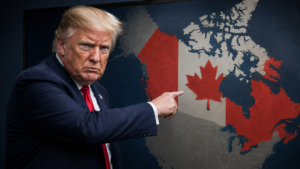
U.S. President Donald Trump has sharply stepped up pressure on Canada amid an escalating trade conflict between the two countries, calling Canadian leaders “clowns” and warning of significantly harsher economic consequences if Ottawa does not change its position.
Trump published the statement on Truth Social on August 24, 2026, following a new exchange of accusations with Canadian Prime Minister Mark Carney and Ontario Premier Doug Ford.
“America has carried Canada on its back for decades, but that will no longer happen,” the U.S. president wrote. At the end of his message, he called for the Canadian leadership to be made to “fall in line,” otherwise the consequences for the country would be “much worse.”
Trump spoke particularly harshly about Doug Ford, who had previously threatened to use electricity and critical mineral supplies to the United States as a retaliatory measure against U.S. tariffs.
The U.S. president also said that Canada was economically dependent on the United States and noted that a significant share of the electricity, oil and gas received by the country was transported through U.S. territory.
Official statistics, however, show a more complex picture. The two countries’ energy systems are indeed extremely closely interconnected, but Canada remains a major net exporter of energy resources to the United States.
According to the Canada Energy Regulator, in 2025 Canada exported CAD157.5 billion worth of oil, petroleum products, natural gas and gas condensate to the United States, while importing only CAD34.4 billion worth of similar products from the United States.
About 90.8% of Canadian hydrocarbon exports were sent specifically to the United States. In particular, Canada exported 4.3 million barrels of oil per day, of which about 3.9 million barrels went to the U.S. market.
In the opposite direction, Canada imported about 0.5 million barrels of oil per day, with approximately 76% of these supplies coming from the United States. Canada is also a major net exporter of natural gas: in 2025, it supplied about 8.6 billion cubic feet of gas per day, almost entirely to the United States, while simultaneously importing 2.5 billion cubic feet per day, predominantly from the United States.
The two countries’ electricity systems are also integrated. In 2025, Canada exported 32.7 TWh of electricity to the United States and imported 22.1 TWh. At the same time, all of Canada’s international electricity trade is conducted with the United States.
Thus, Trump’s statements have some basis in terms of the Canadian economy’s high dependence on U.S. transportation and energy infrastructure. At the same time, however, Canada is one of the most important suppliers of energy resources to the United States itself. In 2025, it accounted for 63.4% of U.S. crude oil imports, almost 100% of natural gas imports and 81.3% of electricity imported by the United States.
Trump’s statements followed the collapse of U.S.-Canadian trade negotiations.
The United States has already imposed 50% tariffs on approximately $20 billion worth of Canadian goods, while on August 24 Trump additionally threatened to raise tariffs on all cars, trucks and automotive components imported from Canada to 50% beginning January 1, 2027.
Washington had previously proposed reducing duties on Canadian passenger cars and light trucks from 25% to 15% and on steel and aluminum from 50% to 25% as part of an agreement. The negotiations collapsed, however, because of several disagreements.
Canada is preparing retaliatory measures. Ottawa announced that it would impose retaliatory tariffs on U.S. goods beginning September 8, while provincial authorities have not ruled out using energy and critical minerals as additional instruments of pressure.
Ontario Premier Doug Ford said that, in the event of further escalation, “everything is on the table,” including restrictions on supplies of electricity and strategic raw materials. According to him, electricity from Ontario supplies about 1.5 million homes and businesses in the United States.
Canadian Prime Minister Mark Carney, in turn, said that Ottawa was prepared to return to negotiations only if Canada was treated as a sovereign partner rather than as a territory dependent on the United States.
Trade relations between the two countries remain among the largest in the world. In 2025, trade in goods and services between the United States and Canada amounted to approximately $872.3 billion, with about three-quarters of Canadian merchandise exports going to the U.S. market.
Another claim made in Trump’s message is not supported by official statistics. The U.S. president said that unemployment in Canada had reached 10%, while the latest data from Statistics Canada showed that it stood at 6.4% in July 2026 — its lowest level in two years.
JSC NAEK “Energoatom” has fully fulfilled its special obligations to ensure the availability of electricity for residential consumers (PSO), aimed at making it more affordable, by covering 100% of the cost of the service for January–July 2026, totaling 141.448 billion UAH (including VAT), the company reported on Tuesday.
“The company continues to bear the key financial burden within the social tariff support system. Thanks to NAEK’s contributions, the state maintains the electricity tariff for millions of Ukrainian families at a level below the market rate,” Energoatom noted.
Currently, Energoatom has no outstanding debt to JSC “Guaranteed Buyer” for the PSO service.
In total, during the years of Russia’s full-scale war against Ukraine—from 2022 to 2025—Energoatom paid over 528.900 billion UAH (including VAT) for the PSO service.
As previously reported, in 2025, “Energoatom” paid 168.546 billion UAH for the PSO and transferred over 44.5 billion UAH to the state budget.
The Cabinet of Ministers of Ukraine, by Decree No. 399-r dated April 29, 2026, “On the Annual General Meeting of JSC NAEK ‘Energoatom,’” approved a net profit of 18,688,306,075 UAH, in accordance with the company’s consolidated financial statements for 2025. The government allocated 50% of the profit, amounting to 9,344,153,037.5 UAH, for the payment of dividends to the state budget.

The cost of water supply in Ukraine in July 2026 rose by 31.9% compared to June, while the cost of sewer services rose by 29.8%, according to data from the State Statistics Service. On a year-over-year basis, water supply prices rose by 52.1%, and sewerage services by 48.8%. A similar increase was recorded compared to December 2025.
As a result, the entire “housing, water, electricity, gas, and other fuels” group rose in price by 1.6% month-over-month in July and by 4.5% compared to July of last year.
The cost of garbage collection rose by 5.1% month-over-month and by 16.2% year-over-year. Maintenance of buildings and surrounding areas rose by 5.8% year-over-year.
At the same time, the statistical cost of electricity, natural gas, hot water, and heating in July remained unchanged both compared to June and year-over-year.
Thus, the July spike in the utility component was primarily due to a sharp increase in the cost of water supply and sewer services.
sewer services, State Statistics Service, TARIFF, utilities, WATER SUPPLY

In 2027, Ukraine may begin the process of gradually raising electricity and gas rates for households after developing appropriate protection programs.
This is stated in the updated memorandum on Ukraine’s economic and financial policies under the Extended Fund Facility (EFF) program with the International Monetary Fund (IMF), following the results of its first review.
“The government has committed to conducting an assessment by the end of February 2027 of utility support programs aimed at protecting vulnerable households. Once appropriate protection programs have been developed, household tariffs should be gradually increased—this process can begin in 2027,” the document’s authors state.
According to the text of the memorandum, the goal of this process is to meet the needs for recovery and debt reduction in the energy sector, while full price liberalization will eventually be necessary to attract post-war investment.
“The Ukrainian government (IF-U) emphasized that tariff increases should occur only after an assessment and, if necessary, reform of existing social protection systems,” the authors of the document noted, among other things.
It is noted that large-scale quasi-fiscal measures in the energy sector and the existing tariff structure pose serious risks to investment, reconstruction, and the development of a stable energy supply and power grid.
According to preliminary expert estimates—which will be refined during future technical assistance—fixed energy tariffs that are below market rates—in particular, due to moratoriums imposed since the start of the war—cost at least 2.2% of GDP annually in the form of off-target subsidies resulting from the quasi-fiscal activities of state-owned energy enterprises, while targeted transfers for public utilities account for about 0.6% of GDP in the budget.
“Significant fiscal risks arise from fixed utility rates for households, which currently amount to about 55% of comparable supply contracts,” the document states.
As a result, the energy sector is increasingly relying on in-kind contributions, grants, and preferential financing to meet its needs for repairs and imports. For example, Naftogaz took on additional debt to finance repairs and imports, causing its debt to rise by 63% year-over-year in 2025. The government is currently seeking donor support to ensure the timely completion of necessary repair work and the implementation of plans to strengthen resilience, the authors of the document noted.

JSC “NAEK “Energoatom” has fully fulfilled its special obligations to ensure the availability of electricity for residential consumers (PSO), aimed at making it more affordable, by covering 100% of the cost of the service for the first half of 2026, amounting to 131.116 billion UAH (including VAT), the company reported on Tuesday.
“The company continues to bear the main financial burden of ensuring the PSO mechanism. Thanks to Energoatom’s contributions, the state maintains electricity rates for millions of Ukrainian families at a level below market rates,” NAEK noted.
Currently, Energoatom has no outstanding debt to JSC “Guaranteed Buyer” for the PSO service.
In total, during the years of Russia’s full-scale war against Ukraine—from 2022 to 2025—Energoatom paid over 528.900 billion UAH (including VAT) for the PSO service.
As previously reported, in 2025, Energoatom paid 168.546 billion UAH for the PSO and transferred over 44.5 billion UAH to the state budget.
The Cabinet of Ministers of Ukraine, by Order No. 399-r dated April 29, 2026, “On the Annual General Meeting of JSC NAEK ‘Energoatom,’” approved a net profit of 18,688,306,075 UAH, in accordance with the company’s consolidated financial statements for 2025. The government allocated 50% of the profit, amounting to 9,344,153,037.5 UAH, to the payment of dividends to the state budget.
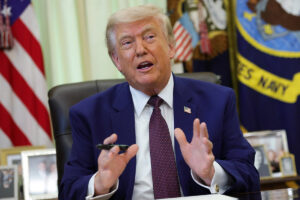
U.S. President Donald Trump said Friday that he is prepared to impose 100% tariffs on any country that imposes a digital services tax on American companies.
“Many European countries are discussing the immediate implementation of a digital services tax on American companies. Some of these countries are close to putting their words into action,” the U.S. leader wrote on the social media platform Truth Social.
“Please let this statement serve to make it clear that any country that imposes such a tax will immediately face 100% tariffs on any goods exported to the U.S.,” he emphasized.



