

Moldova is preparing proposals regarding the possible transfer of 20 locomotives to Ukraine; the parties are also working on opening a new joint border crossing and ensuring the unimpeded transit of Ukrainian cargo, said Mykola Kalashnyk, Ukraine’s Minister of Recovery, Infrastructure, and Transport.
“Our priority is unimpeded traffic from Odesa to the Danube region,” Kalashnik wrote following a working meeting in the Odesa region with Moldova’s Deputy Prime Minister and Minister of Infrastructure and Regional Development, Vladimir Bolea.
According to him, to ensure transit, it is necessary to guarantee free and safe passage along a 7-kilometer section of the M-15 highway near Palanka. The parties are also preparing to open a new joint border crossing point.
In the field of rail transport, Moldova is preparing proposals regarding the possibility of providing Ukraine with 20 locomotives. The parties are also working to ensure competitive freight rates and additional routes for Ukrainian cargo through Moldova to the Romanian port of Constanța.
Kalashnik noted that the agreements are expected to result in an increase in the number of routes, faster border crossings, and strengthened logistics links between Ukraine, Moldova, and the European Union.
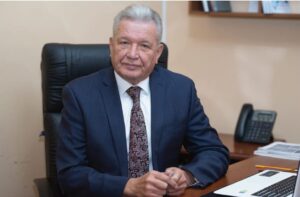
The “Ukrcement” Association advocates for a measured increase in rail freight rates, which, on the one hand, will help JSC “Ukrzaliznytsia” (UZ) maintain its capacity to transport cargo, and on the other hand, will not lead to the closure of operating enterprises.
“As business representatives for whom rail transport accounts for more than half of all shipments, we have no interest in a scenario where transport collapses, just as we have no interest in the collapse of any industrial sector. Therefore, we are ready to cooperate to find a realistic solution to today’s complex situation. By agreeing to the tariff increase, we want to see where the additional payments from businesses will go and understand how delivery times to consumers and the turnaround time for empty railcars will be reduced,” said Pavlo Kachur, chairman of the “Ukrcement” Association.
He emphasized that UZ deserves respect and support for its work in transporting cargo for the front lines and national defense, but the situation with the freight transportation of products manufactured in Ukraine—both for the domestic market and for export—is becoming critical and requires joint, and possibly even emergency, measures and actions at the level of the Cabinet of Ministers. “This is not about a single industry or a specific plant, but about Ukraine’s economy as a whole. Therefore, it is the duty of manufacturers and Ukrainian Railways to work together to achieve a positive outcome,” noted the head of the cement manufacturers’ association.
The expert pointed out that, according to Ukrainian Railways, freight transportation remains profitable, businesses pay market rates for transportation, and an additional increase in tariffs is needed to cover losses from passenger transportation.
He highlighted the pressing problems facing the domestic railway: a lack of traction, an exodus of skilled personnel due to low wages, and the (chronic) unprofitability of passenger (especially commuter) transportation. In particular, the situation with traction is critical. According to Ukrzaliznytsia’s estimates, the current average speed of freight car transport is 37 km per day, compared to the standard of 200 km for single-car shipments and 300 km for scheduled services. The average daily number of scheduled locomotives not assigned to formed trains reaches 50.
“The top priority for improving transportation is to secure backup traction. The market expects Ukrzaliznytsia to present a program for modernizing its locomotive fleet as soon as possible. For our part, we see the most realistic and expedient solution to this problem as opening access for the transport of products using our own traction to the nearest marshalling yards. Ukrzaliznytsia’s experience with such transport operations, successfully tested by PJSC “Ivano-Frankivskcement,” has demonstrated its effectiveness and economic benefits for both the manufacturer and Ukrzaliznytsia, and could significantly free up Ukrzaliznytsia’s locomotives for more profitable operations,” Kachur believes.
He emphasized the staffing issue, noting that low wages are causing an exodus of skilled personnel (primarily locomotive engineers, assistant engineers, loaders, and station workers). “As a result of the tariff increase, competitive wages for employees involved in the transportation system—locomotive engineers, assistant engineers, train dispatchers, and station workers—must become a priority,” says the head of “Ukrcement.”
Regarding passenger transportation, he drew attention to the negative trend of increasing volumes of unprofitable passenger service against the backdrop of declining freight volumes. “The financial pressure on operating businesses due to the cross-subsidization mechanism is exceeding reasonable limits,” Kachur stated. In his view, before raising freight rates, Ukrainian Railways should propose a model for optimizing passenger transportation.
The business community expects Ukrainian Railways to take systematic and responsible steps—such as developing programs to modernize the locomotive and railcar fleets and establishing a model for commuter transportation. As soon as possible, the procedure for admitting private traction must finally be adopted (as provided for in regulatory documents), indicators for freight delivery and the circulation of empty railcars must be approved, and the issue of decommissioning railcars must be revised (based on technical condition rather than a calendar schedule).
“We need extraordinary measures, at least for the duration of the war, which will include a measured increase in freight rates, full transparency toward businesses and the public regarding the allocation of funds received from the rate increases—in particular, raising the salaries of locomotive engineers, assistant engineers, freight handlers, and station employees to market levels,” Kachur noted.
In his opinion, given the scale of the problems, the consideration and adoption of anti-crisis measures should take place at the level of the Cabinet of Ministers.
As previously reported, on Monday, the Ministry of Community and Territorial Development of Ukraine published a draft order providing for a 30% indexation of rail freight tariffs effective August 1, 2026, and the standardization of tariffs for the transportation of empty railcars. Ukrzaliznytsia plans to make a separate decision regarding the next stage of freight rate indexation, which could take effect on January 1, 2027.
According to the Ministry of Development, in 2025, freight volumes decreased by 12.5% compared to the previous year, and Ukrzaliznytsia’s net loss amounted to 7.6 billion UAH. In the first four months of 2026, the loss reached 9.3 billion UAH.
CEMENT, locomotive, TARIFF, UKRCEMENT, UKRZALIZNYTSIA, качур
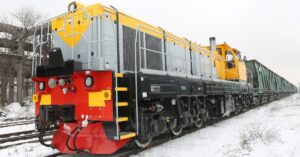
The Kryvyi Rih Mining and Metallurgical Plant PJSC ArcelorMittal Kryvyi Rih (AMKR, Dnipropetrovsk region) continues to restore the operational capacity of locomotives in railway workshop (RW) No. 2 under the GAP-III high-risk equipment repair program.
According to materials in the corporate publication Metallurg, the TEM2U-8679 diesel locomotive was recently repaired, becoming the fifth locomotive to be restored under the GAP-III repair program. The repaired diesel locomotive was put back on the rails at the end of 2025.
It is specified that five locomotives were repaired at Repair Center No. 2 under this program during the full-scale war. The purpose of these repairs is to improve the technical condition, accident-free operation, and ensure the stable operation of locomotives used for the company’s rail transportation.
The first locomotive repaired under this program was the TEM2-2203, manufactured in 1970, and the last of the five repaired locomotives was the TEM2U-8679. Specialists from ZC No. 2 and a contractor replaced the diesel engine parts, cooling sections, and wheel sets on the TEM2U-8679 locomotive, repaired the electrical equipment and cable and wire parts, installed a new battery, and worked on restoring the compressor to working order, etc.
In the future, it is planned to install modern equipment, American engines, control systems, and crew compartments on the locomotives.
ArcelorMittal Kryvyi Rih is the largest producer of rolled steel in Ukraine. It specializes in the production of long products, in particular, rebar and wire rod.
ArcelorMittal owns Ukraine’s largest mining and metallurgical complex, ArcelorMittal Kryvyi Rih, and a number of small companies, including ArcelorMittal Beryslav.
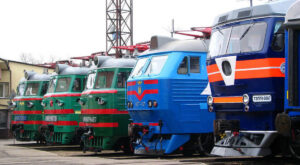
In January-March 2025, Ukrzaliznytsia JSC (UZ) tripled the number of repaired locomotives and repaired 50% more electric trains than in the same period last year, the company’s press service reports.
“Ukrzaliznytsia has increased the volume of rolling stock repairs and component manufacturing. Due to this, in the first quarter of 2025, we record a positive trend in the volume of rolling stock repairs and production of major railway components,” the company’s press service posted on Facebook on Thursday.
In January-March 2025, 12 electric trains were repaired, which is 50% more than in the same period in 2024. The number of repaired locomotives during this period tripled to 29 units.
In addition, the number of repaired line equipment units (infrastructure elements located along the railways that ensure uninterrupted, safe and efficient operation of rolling stock – IF-U) increased by 70% (to 1173).
Ukrzaliznytsia reported that the production of sleepers in the first quarter doubled to 79 thousand units, the production of rail connectors and other components increased by 20%, and the production of reinforced concrete structures increased by 18%.
Earlier it was reported that in 2025 Ukrzaliznytsia will complete the creation of the Locomotive Company, which will centrally coordinate the existing locomotive depots. UZ has about 50 locomotive depots: repair depots that carry out major repairs and modernization of the locomotive fleet and operational depots that service locomotives between flights.
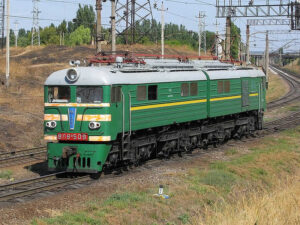
Lviv Locomotive Repair Plant (LRP), a part of Ukrzaliznytsia, plans to repair 21 locomotives in 2024, compared to 12 in 2023, according to the company’s financial report for the previous year.
According to LLRZ, it is also planned to increase the repair of traction engines and their anchors by 14% or 34 units to 274 units.
At the same time, the production plan for the repair of wheelsets is 445 units, compared to 549 units repaired last year, and auxiliary electric machines – 99 units (103 in 2023).
According to LLRZ, in 2023, the share of locomotive repairs in total production was 54%, wheelsets – 22%, traction motors – 15%, and electric motor armatures – 3%.
In 2023, the plant earned UAH 15.47 million in net profit against a loss of UAH 17.22 million a year earlier, with net income growing by 28.2% to UAH 595.5 million.
The company sold 13 repaired locomotives (58% of sales), 501 wheelsets (21%), 158 traction engines (13%) and 48 anchors (2%).
Founded in 1861, LLRZ is now a major Ukrainian enterprise for the repair of electric locomotives, traction engines, and wheelsets.



