

On July 1, the “Register of Destruction” is launched in Ukraine. With its help, homeowners whose houses and apartments were damaged as a result of hostilities and enemy shelling will be able to apply for compensation using the Diya application.
At the same time, the question of what the restored houses of Ukrainians will be like, taking into account the new realities and requirements for the housing stock after the war, remains no less important. The Open4business portal discussed these issues with Igor Stakovichenko, an expert in the field of construction and real estate.
“The introduction of the “Register of Destruction” will greatly simplify the procedure for compensating for damages for affected citizens. In fact, such a registry will bring together all the data on the destruction in the country. This will be very useful both for the state of Ukraine and for individual citizens when receiving compensation from the aggressor through international legal institutions,” the expert noted.
As for the new technologies that will be used in the construction of housing, here Stakovichenko recommends first of all to focus on the needs of society.
“What most people want from a new home, whose homes have been destroyed by the war, is reliability and security. The presence of equipped bomb shelters, convenient evacuation routes, autonomy – these are the criteria without which it is difficult to imagine post-war architecture,” Igor Stakovichenko stressed.
In his opinion, a good option would be the restoration and development of numerous recreational areas, some of which were abandoned even before the war. Stakovichenko believes that many Soviet-built sanatoriums and boarding houses, which have been practically not used for all the years of independence, can become a good platform for building eco-friendly settlements with autonomous service, since most of the communications have already been connected to them.
“Environmental friendliness and high technologies during construction will also become the hallmark of post-war architecture in Ukraine. Projects such as “zero energy houses”, or even “mini-power houses”, which are now being widely implemented in the EU, will also be popular after the war,” the expert added.
At the same time, Igor Stakovichenko sees no special prospects for aggressive development in the central areas of large cities, which was practiced before the war.
“Multi-apartment residential complexes in large cities will certainly continue to be built, but whether there is a buyer for such housing is already a question. I think many have already revised or will reconsider their views on comfortable housing as a result of the war,” the expert concluded.
CONSTRUCTION, EXPERT, FINANCY, IGOR STAKOVYCHENKO, MARKETS, REAL ESTATE, TECHNOLOGY, СТАКОВИЧЕНКО

The UK will supply Ukraine with technology and know-how to ensure that Ukraine is never blackmailed or threatened, Prime Minister Boris Johnson said after meeting with the Ukrainian president in Kyiv.
“We – the UK and other partners will supply equipment, technology, know-how, intelligence, so that Ukraine will never be subjected to the horrors of invasion, so that Ukraine will never be blackmailed or threatened in any way,” Johnson said at a briefing with the President of Ukraine in Kyiv on Saturday.

The new technology of prefabricated one-story residential buildings makes it possible to provide people with high-quality houses as quickly as possible.
Ruukki sandwich panels are used as load-bearing and envelope structures of houses, which allows to reduce the cost of construction due to the absence of the need to build a frame. At the same time, cottages become highly energy efficient (heat transfer resistance R = 7.43 m2K / W) and durable (lifetime is more than 50 years).
Rauta has developed several practical layouts for sandwich panel cottages ranging from 26 m2 to 139 m2. At the same time, layouts with an area of 26 m2 and 49 m2 can be placed in blocks with common partitions. This solution allows to further reduce the cost of construction, as well as to build settlements for people in dire need of housing as quickly as possible.
“The key goal of this project was to create reliable, functional and energy-efficient houses with the shortest possible construction time,” said Andriy Ozeychuk, Rauta director. “The ergonomics of the layouts are deliberate so that even in a house with an area of only 26 m2, a family of 3-4 people can live comfortably.”
BUILD, CONSTRUCTION, DEVELOPED, HOUSE, RAUTA, SANDWICH PANEL, TECHNOLOGY
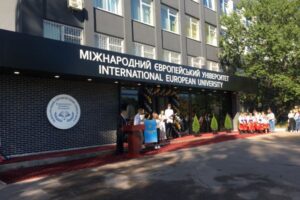
International European University presented a VR room
Virtual reality starts evolving in education while an increasing number of universities is adopting this technology.
The analysis of global experience indicates the efficiency and potential of sensor nets and advanced technologies. International European University is always in tune with the times and improves its educational programs, helping students learn chosen disciplines using cutting-edge technological solutions.
Therefore, the university has introduced the VR room allowing students to explore places of destination worldwide without leaving a classroom. The multi-award-winning program platform encourages faster learning and teaching of medical sciences and anatomy on desktop, mobile and virtual devices.
Virtual reality technologies enhance the efficiency of study, making classes more exciting, which results in better educational motivation and students’ activity.
According to Nataliia Litvinova, Director of European Medical School, the implementation of different VR-based educational programs sparks greater interest of students in this form of classes and increases their enthusiasm while preparing for each class, learning theoretical materials that will be elaborated in the virtual environment.
“It is the best model among the existing ones. This VR headset is equipped with a manipulator that enables working without a computer, as it has its own device inside. Actually, this headset is used for games, fitness and other activities, but we apply it in education. Each license allows holding classes in a group consisting of 10 and more people, as well as conducting questioning, excluding a possibility to peep a correct answer and manipulate. Due to another license, we will be able to train 200 students at the same time and learn anatomy using any device. I’m so glad that in autumn, during license update, we could see the process on computer tomography, X-ray, ultrasound investigation. We can use it in clinical subjects and show students certain organs in virtual reality,” Nataliia Litvinova says.
Besides, educational programs based on virtual reality technologies are multi-purpose (similar programs for different subject areas require almost the same firmware kit) and easily integrated into the conventional teaching process. They allow replacing real objects with their simulating models and interactive simulators so that students can model different situations and find the best possible solutions.
To sum up, we can state that virtual reality is a perfect learning environment. Perception of a virtual model with high authenticity allows training future professionals in different specialties in a high-quality and quick manner. VR-based education allows teachers to give lectures, seminars and training sessions visually, show all aspects of real items or processes to students, which produces a great effect, improves the quality and speed of educational processes, as well as reduces their cost. Virtual reality technologies allow us to comprehensively use the fact that people obtain 80% of information from the world around by vision. Meanwhile, people remember 20% of what they see, 40% of what they see and hear, and 70% of what they see, hear and make. Thus, students are totally immersed into the educational process, receiving better motivation and succeeding in their study.
EDUCATION, IEU, INTERNATIONAL EUROPEAN UNIVERSITY, TECHNOLOGY, VIRTUAL REALITY, VR, НАВОЛОКІНА

The Kyivstar mobile communications operator in January-March 2019 connected 968 localities in 24 regions of Ukraine to the 4G communications (LTE) network, the press service of the company has told Interfax-Ukraine.
“In the first quarter of 2019, Kyivstar connected 968 localities to the 4G communications network, connecting 10 new localities per day. This happened in all regions,” the company said.
According to Kyivstar’s press service, today the operator’s 4G communications network is available in 4,587 localities in the territory where 24.1 million people live (58% of the population of Ukraine).
At the same time, 43% of all mobile data traffic of Kyivstar is generated in the 4G network.
In March 2019, Kyivstar subscribers used the volume of mobile Internet equal to the consumption for the entire 2016 (40 petabytes).
In the first quarter, most of all localities in Ivano-Frankivsk (120), Lviv (108) and Rivne (103) regions were connected. Also among the leading regions in the number of localities connected to the 4G network are Kyiv and Vinnytsia regions: 73 and 69 respectively.
Kyivstar is a Ukrainian mobile communications operator. VEON international group (earlier VimpelCom) is the shareholder in Kyivstar. The group’s shares are listed on NASDAQ (New York).

Ukrainian enterprises gradually have started introducing the Internet of Things (IoT) technology: today 2% of equipment suppliers use it in Ukraine, according to a study of Microsoft.
“47% did not envisage the possibility of joiningo the IoT system, and 51% of equipment suppliers do not even know about the possibilities of IoT for enterprises,” Microsoft said in a report presented at the Manufacture Talks. IoT & Other Technologies conference held in Kyiv this week.
Microsoft said that in the world, such technologies are being implemented much faster: by 2020, 40% of operational processes in enterprises can be adjusted without human participation.
“By 2019, 90% of manufacturers consider that they will make the most of cloud technologies to optimize supply processes, and by 2020 40% of operational processes in the enterprise will be able to improve and train without human participation,” Specialist in Cloud Solutions from Microsoft Vladimir Dmitrenko said.
Among other technological trends that will help enterprises develop, according to Microsoft experts, is the maximum use of cloud technologies to optimize the supply process, the mandatory connection of machines to the manufacturer’s network or the Internet, and in three or five years building digital satellite equipment or processes.



