
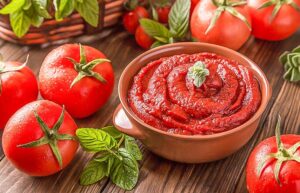
According to Experts Club, consuming a small amount of concentrated tomato paste daily for three months may have a positive effect on certain measures of memory and attention in healthy middle-aged people, according to the results of a clinical study by Spanish researchers.
According to the New York Post, participants in the experiment consumed about 35 grams of concentrated tomato paste daily—roughly two tablespoons. The study was published in the scientific journal Antioxidants.
The randomized crossover study involved 47 healthy adults aged 40–55, 42 of whom completed the experiment. Participants went through two three-month periods: during one, they consumed concentrated tomato paste daily at a rate of 0.5 g per kilogram of body weight; during the other, they followed a diet low in lycopene. There was a one-month break between periods.
According to the results of neuropsychological tests, the participants’ selective attention scores improved after the period of tomato paste consumption. Concentration scores increased by an average of 7.2 points, and information processing speed scores increased by 8.3 points. Improvements in associative memory were also observed, particularly the ability to match faces with names.
The researchers also noted a trend toward increased levels of the brain-derived neurotrophic factor (BDNF)—a protein involved in supporting neurons, neuroplasticity, and memory processes. However, this increase was on the borderline of statistical significance.
Functional MRI scans of some participants revealed changes in the connections between neural networks associated with attention and cognitive functions. The study authors suggest that tomato consumption may contribute to the functional reorganization of brain networks.
Scientists cite lycopene—a carotenoid antioxidant found in abundance in tomatoes and tomato products—as one possible factor behind this effect. Lycopene is capable of crossing the blood-brain barrier and possesses antioxidant and anti-inflammatory properties. At the same time, the researchers emphasize that tomatoes contain many other biologically active substances, so it is currently impossible to determine whether the observed effect is linked exclusively to lycopene.
The authors also caution against overinterpreting the results. The study was small, lasted only a few months, and was conducted among healthy middle-aged adults. It does not prove that tomato paste prevents dementia or can be used to treat cognitive impairment.
Original study: PubMed – Tomato Intake Improves Cognitive Performance and Modulates Functional Brain Networks in Healthy Adults.

Stodola (Mykolaiv region) has launched an organic tomato processing line that will reach full capacity next year, Organic Standard LLC, which specializes in certifying organic producers, reported on Facebook.
“This year we launched a new line with a capacity of 2 tons per hour. We plan to reach this volume of processing next year. This year, it is still difficult to say how much tomatoes we will process,” Stodola owner Yan Ostrovsky was quoted as saying.
According to Ostrovsky, Stodola will produce organic juices, sauces, pickled and dried tomatoes, and purees. These products will be presented on the domestic market, and test batches for export are also planned.
Stodola LLC was registered in 2018 in Mykolaiv region, where it operates an agricultural and gastronomic business. It specializes in growing certified organic vegetables, berries, fruits and their preservation. He has a registered trademark and a restaurant of the same name – Stodola.
According to Opendatabot, the company’s revenue in 2022 amounted to UAH 1.487 million, of which UAH 612.8 thousand was net profit. The company’s assets amounted to UAH 1.687 million, and its debt obligations amounted to UAH 240 thousand.



