Transmission system operators (TSOs) of Ukraine, Slovakia, Hungary, and Romania launched the first monthly auctions for the allocation of cross-border capacity on Monday, according to Ukrenergo.
They are being held on December 15-17 on the Joint Allocation Office (JAO) platform with delivery in January 2026. The final results of the auctions are to be announced on December 23. According to information on the JAO, the capacity of the interconnection with Hungary is 460 MW, with Romania and Slovakia – 172 MW each. No interconnection capacity is offered from Ukraine.
“Long-term auctions for the allocation of cross-border transmission capacity are definitely beneficial for the Ukrainian electricity market. In the context of massive Russian attacks on our energy system, we really need confidence in a stable supply of electricity imports every month,” commented Vitaliy Zaychenko, chairman of the board of Ukrenergo, whose words are quoted in the company’s Telegram message.
“We are grateful to our partners at ENTSO-E and the JAO auction platform, as well as our colleagues from the energy system operators of neighboring EU countries for their effective cooperation. We hope that it will continue and that annual auctions will also be introduced in the future,” said Zaychenko.
According to NEC, the introduction of such auctions was made possible thanks to cooperation with TSOs of neighboring countries and with the support of the European Network of Transmission System Operators (ENTSO-E). Work on the rules for long-term allocation for the EU’s external borders has been ongoing for the past two years.
“After these rules were approved by the national regulators of Ukraine, Slovakia, Hungary, and Romania, it became possible to allocate free capacity at inter-state crossings through monthly long-term auctions. For Ukraine, this means more effective price forecasting and, in the long term, a reduction in the cost of imported electricity,” Ukrenergo explained.
As noted in the report, on a global scale, monthly auctions contribute to closer integration of the Ukrainian and European energy markets and ensure greater stability of Ukraine’s integrated energy system.
As reported, with the start of a full-scale invasion, given the military risks, ENTSO-E agreed only to daily auctions for the distribution of inter-state cross-border capacity for import and export operations with electricity.
At the same time, traders and energy companies have repeatedly pointed out that the absence of long-term auctions, in particular monthly and annual ones, hinders the effective attraction of imported electricity.
In early December, Vitaliy Zaychenko, Chairman of the Board of NEC Ukrenergo, told Energorforma that he expects the first long-term (monthly) auctions for the distribution of inter-state crossings with Romania, Hungary, and Slovakia since the start of the war to be successful.
“I think these auctions will take place. The market is definitely waiting for long-term auctions. Therefore, I think that the entire proposed cross-border capacity will be sold,” he said.
“Unfortunately, there will be no auctions in Poland because the Polish transmission system operator does not give its consent,” added the head of Ukrenergo.
It should be noted that the auctions launched today are joint, i.e., they are held simultaneously by both operators. The TSO agreed on this mechanism in 2023, and so far, daily auctions have been held under it. Monthly auctions were previously held in Moldova and Poland (Dobrotvir-Zamosc crossing), where unilateral auctions are still in place instead of joint ones.
The European Bank for Reconstruction and Development (EBRD) plans to provide NEC Ukrenergo with a state-guaranteed loan of up to EUR90 million for the reconstruction of selected substations in the country.
“It is expected that the loan, if possible, will be co-financed by investment grants from international donors totaling up to EUR60 million for the purchase of reserve stocks of electrical equipment and equipment for inter-system connections,” the bank said in a statement on its website.
The project is currently awaiting approval by the bank’s board.
As explained by the EBRD, the goal of the project, with a total cost of EUR 150 million (EUR 90 million + EUR 60 million), is to increase the resilience of the power transmission system in the face of constant attacks to ensure uninterrupted power supply to the population and businesses throughout the country.
In particular, the current loan will be used to reconstruct three existing substations and complete the construction of one new substation in Ukraine, which was started as part of a project financed by the bank in 2014.
The reconstruction of the three existing substations and the completion of the new substation will be carried out in accordance with international best practice, using equipment that meets EU requirements. Some of the damaged or destroyed equipment will be replaced.
Currently, the new substation with 330 kV overhead power lines is being built at the stage of already laid foundations using EBRD loan funds saved as part of the project to build the 750 kV Zaporizhzhya NPP – Kakhovka power line.
As the EBRD recalled, since February 2022, the bank has provided Ukrenergo with three loans as part of its ongoing support, including emergency capital support and emergency investments aimed at restoring the power transmission network after serious damage caused by the Russian military invasion of Ukraine.
According to the EBRD, Ukrenergo has provided the bank with satisfactory reporting on these loans, as well as generally satisfactory reporting in the past. It has the national capacity to implement the bank’s environmental and social requirements (ESR), as well as national and European legislation. The company is strengthening its ESG management system, including inclusive measures, to help it report on sustainability issues in the future in accordance with the EU Corporate Sustainability Reporting Directive (CSRD).
As reported with reference to Maxim Khlapuk, a member of the Verkhovna Rada’s energy committee, as of June 2025, the total amount of credit funds under agreements between Ukrenergo and the EBRD, as well as the European Investment Bank (EIB), amounted to EUR1.22 billion, of which EUR 215.5 million remained unutilized, and with the International Bank for Reconstruction and Development (IBRD) – $509.74 million, of which $54.87 million remained unutilized.
In addition, under two grant agreements between Ukraine and the IBRD for EUR 37.7 million and $200 million, EUR 18.9 million and $134.5 million remained unutilized, respectively.
EBRD, LOAN, POWER GRID, RECONSTRUCTION, SUBSTATION, UKRENERGO
Employees of the State Bureau of Investigations (SBI) notified a Lviv businessman of their suspicions and detained the former chairman of the board of Ukrenergo on suspicion of fraudulent appropriation of funds from the state-owned enterprise EK Ukrenergo.
“Under the procedural guidance of the Office of the Prosecutor General, the SBI notified a Lviv businessman of suspicion and detained the former chairman of the board of Ukrenergo on suspicion of fraudulent appropriation of funds from NEC Ukrenergo,” the SBI reported on its Telegram channel on Tuesday.
“The scheme was organized by a Lviv businessman who had previously been exposed by the SBI for purchasing low-quality clothing for the needs of the Armed Forces of Ukraine for more than UAH 1 billion,” the agency said.
According to the bureau, in 2018, during tenders for the reconstruction of the external fencing of substations of the Southern and Western power systems, the official colluded with representatives of a private company.
At that time, as specified by the SBI, he held the position of deputy director for investments at the state-owned enterprise “NPC Ukrenergo.”
“Two contracts were signed between the parties for a total amount of over UAH 68 million. After that, the state-owned enterprise transferred over UAH 13.7 million in advance payments to the contractor, which the perpetrators embezzled,” the bureau said.
The SBI report does not name the individuals involved. They are former Ukrenergo head Volodymyr Kudrytskyi and Lviv businessman Ihor Hrynkevych.
Earlier, a source in law enforcement agencies told Interfax-Ukraine that SBI employees had detained former Ukrenergo head Volodymyr Kudrytskyi in the Lviv region and were preparing to charge him with fraud on an especially large scale.
The agency’s source specified that the case concerns businessman Ihor Hrynkevych and the alleged misappropriation of state-owned company funds during tenders for the reconstruction of power system facilities back in 2018.
NPC Ukrenergo has fully completed the construction of the first phase of passive protection facilities for its substations (PS), and the second phase is scheduled for completion in the first quarter of 2026, according to Yuriy Boyko, a member of the NPC’s supervisory board.
“There are queues for the construction of protective structures because it requires the equipment to be de-energized. Accordingly, it is impossible to carry out work simultaneously throughout the entire substation or at all facilities because they must provide power. We have already completed the first phase. The second phase is now actively under construction. According to the plan, more than 80% of the second phase should be completed by the end of the year. Full completion is scheduled for the first quarter of 2026,” Boiko said during a briefing at the Media Center of Ukraine in Kyiv on Thursday.
He noted that in different regions, especially those near the front lines, due to unrest and military risks, “the work is accompanied by long pauses, and its speed cannot be the same for everyone.”
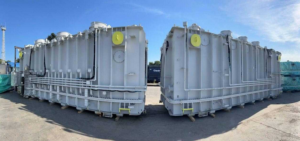
Boiko also explained that the PS territory covers 20-70 hectares, and it is impossible to cover it with a sarcophagus, so resources and efforts must be focused on the most critical elements, in particular, autotransformers, which, according to him, “the Russians actively knocked out in the first year of the war.” In order to preserve the substation equipment, a plan has been developed to build protection for its key elements, the member of the supervisory board noted.
As reported, at the Supreme Commander-in-Chief’s Headquarters, Ukrainian President Volodymyr Zelensky instructed NSDC Secretary Rustem Umerov to coordinate officials, regional administrations, and energy companies to purchase additional short- and medium-range air defense systems, as well as to increase funding for drone manufacturers. The priority is to shoot down “suicide drones.”
Source: Interfax-Ukraine
Ukrenergo’s contribution to the development of educational initiatives in 2022-2025 amounted to over UAH 65 million, the system operator announced on its Telegram channel on Monday.
“Our company actively cooperates with many higher and pre-higher education institutions. In particular, these are the Igor Sikorsky Kyiv Polytechnic Institute, Dnipro and Lviv Polytechnic Institutes, Vinnytsia National Technical University, and Kharkiv National Technical University of Municipal Economy named after O. Beketov,” the company said.
Together with these and other universities, Ukrenergo is improving its training programs for energy specialists in various fields and provides university teachers with opportunities for practical training at production facilities and in the company’s training center.
Ukrenergo also has an internship and employment program for senior students and graduates called Energy HUB.
“About 60% of participants in this program end up staying on to work full-time. Such initiatives help students start their careers immediately after graduation and help our company effectively build a qualified talent pool,” explained NEC.
Ukrenergo is among the largest business investors in Ukrainian education. The list of the top 51 companies that invest the most in education was compiled by Delo․ua and the Kyiv School of Economics.
The study took into account the volume of investments and educational initiatives of Ukrainian companies during 2022-2025. According to the organizers, this period was chosen for the ranking because investing in education during a full-scale war means believing in the future of both one’s own business and Ukraine as a whole.
On July 21, PJSC National Energy Company (NEC) Ukrenergo announced its intention to conclude a voluntary medical insurance agreement for its employees with the TAS insurance group (Kyiv). According to the Prozorro electronic public procurement system, SG TAS offered UAH 85.159 million against the expected cost of services of UAH 88.013 million. Another tender participant, SK VUSO, offered UAH 87.967 million.
As reported, the winner of a similar tender a year ago was also SG TAS, which offered UAH 58.793 million against almost the same expected cost.
Ukrenergo operates trunk and interstate power transmission lines and provides centralized dispatching of the country’s unified energy system. NEC is a state-owned enterprise under the authority of the Ministry of Energy and Coal Industry of Ukraine.