
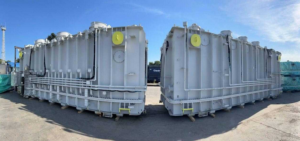
The Japan International Cooperation Agency (JICA) has donated three high-power autotransformers worth more than $20 million to Ukrenergo NEC as part of the “Emergency Recovery and Reconstruction Project,” the system operator said on Friday.
“It is not the first time we receive donor assistance with scarce and expensive high-voltage equipment from our Japanese partners. Given the consequences of Russia’s massive attacks, the powerful autotransformers delivered at the end of last year are extremely necessary for the Ukrainian energy system,” said Vitaliy Zaichenko, chairman of the board of NEC Ukrenergo.
For his part, Osamu Hattori, Head of the JICA office in Ukraine, expressed his respect for the Ukrenergo team for its technical excellence.
“We deeply admire the resilience and technical excellence of the Ukrenergo team. JICA is committed to continue helping to improve the reliability, security and long-term sustainability of Ukraine’s energy system,” he emphasized.
As Ukrenergo explained, the logistics of cargoes of such type as the above-mentioned autotransformers is a very complicated process due, first of all, to the dimensions of the cargo. The weight of each of the three transformers is almost 200 tons, with a height of 4.5 meters and a width of almost 4 meters.
“Taking into account the dimensions of the transportation platform and the weight of the tractor itself, the route is laid out in such a way as to bypass many bridges, over which or under which it is impossible to pass,” the NEC said.

Investments in the construction of new generation facilities will benefit both investors and Ukraine’s energy system, emphasized Vitaliy Zaychenko, head of NPC Ukrenergo, during his online participation in a meeting of the European Business Association’s board. During the meeting, he informed representatives of Ukraine’s largest financial and industrial groups about the current situation in the energy sector and prospects for the near future.
“Since October last year, the enemy has been carrying out comprehensive attacks on energy facilities, using a very wide arsenal of weapons: from rocket artillery to guided aerial bombs, strike drones, cruise missiles, and ballistic missiles. Many power generation, transmission, and distribution facilities in most regions of Ukraine have been damaged,” said Zaychenko.
According to him, there is an acute power shortage in the energy system, which cannot yet be covered by existing generation and imports of electricity. Under these conditions, it is very important for the Ukrainian energy sector to attract private investment in the construction of power generation facilities.
As the head of Ukrenergo recalled, thanks to special auctions held by the National Energy Company, 423 MW of new generating capacity appeared in the power system over the past year.
“We are grateful to businesses that invest in projects that strengthen the stability of the energy system in such difficult conditions,” he stressed.
In addition, Zaychenko noted the importance of connecting to the common grid those generating capacities that are currently used by businesses and industry exclusively as backup power sources in case of hourly or emergency outages.
“If they were operating on the electricity market, such facilities could cover part of the power deficit in the energy system and at the same time generate profits for their owners,” he said.
According to preliminary expert estimates, the total deficit of operational generating capacity in Ukraine currently exceeds 4 GW.

On Monday, NEC Ukrenergo will restrict electricity supply in all regions of Ukraine.
“Tomorrow, January 26, hourly power cuts and power restrictions (for industrial consumers) will be applied in all regions of Ukraine,” Ukrenergo said in a statement on Telegram.
The reason for the restrictive measures is the consequences of Russian missile and drone attacks on energy facilities, the NEC notes.
The press service of NEC Ukrenergo reports that the situation in the energy system may change.

PJSC “National Energy Company (NEC) ”Ukrenergo“” On January 7 announced a tender for voluntary motor insurance (CASCO) services.
As reported in the system of electronic public procurement Prozorro, the expected cost of purchasing services is UAH 4.065 million.
The last day for submitting applications for participation is January 15.
PJSC National Energy Company Ukrenergo on December 24 announced a tender for compulsory insurance of civil liability of owners of land vehicles (MTPL). As reported in the system of electronic public procurement ProZorro, the expected cost of the purchase of services – 6.551 million UAH. The last day for submitting applications for participation is January 5.
NEC Ukrenergo is a state-owned company, the operator of the electricity transmission system (TSO) of Ukraine. Ukrenergo is responsible for dispatch control of the unified energy system of Ukraine, operation and development of backbone power grids, balancing of the system and ensuring stability of electricity transmission, as well as for interstate overflows and access to grids at the transmission level.
Transmission system operators (TSOs) of Ukraine, Slovakia, Hungary, and Romania launched the first monthly auctions for the allocation of cross-border capacity on Monday, according to Ukrenergo.
They are being held on December 15-17 on the Joint Allocation Office (JAO) platform with delivery in January 2026. The final results of the auctions are to be announced on December 23. According to information on the JAO, the capacity of the interconnection with Hungary is 460 MW, with Romania and Slovakia – 172 MW each. No interconnection capacity is offered from Ukraine.
“Long-term auctions for the allocation of cross-border transmission capacity are definitely beneficial for the Ukrainian electricity market. In the context of massive Russian attacks on our energy system, we really need confidence in a stable supply of electricity imports every month,” commented Vitaliy Zaychenko, chairman of the board of Ukrenergo, whose words are quoted in the company’s Telegram message.
“We are grateful to our partners at ENTSO-E and the JAO auction platform, as well as our colleagues from the energy system operators of neighboring EU countries for their effective cooperation. We hope that it will continue and that annual auctions will also be introduced in the future,” said Zaychenko.
According to NEC, the introduction of such auctions was made possible thanks to cooperation with TSOs of neighboring countries and with the support of the European Network of Transmission System Operators (ENTSO-E). Work on the rules for long-term allocation for the EU’s external borders has been ongoing for the past two years.
“After these rules were approved by the national regulators of Ukraine, Slovakia, Hungary, and Romania, it became possible to allocate free capacity at inter-state crossings through monthly long-term auctions. For Ukraine, this means more effective price forecasting and, in the long term, a reduction in the cost of imported electricity,” Ukrenergo explained.
As noted in the report, on a global scale, monthly auctions contribute to closer integration of the Ukrainian and European energy markets and ensure greater stability of Ukraine’s integrated energy system.
As reported, with the start of a full-scale invasion, given the military risks, ENTSO-E agreed only to daily auctions for the distribution of inter-state cross-border capacity for import and export operations with electricity.
At the same time, traders and energy companies have repeatedly pointed out that the absence of long-term auctions, in particular monthly and annual ones, hinders the effective attraction of imported electricity.
In early December, Vitaliy Zaychenko, Chairman of the Board of NEC Ukrenergo, told Energorforma that he expects the first long-term (monthly) auctions for the distribution of inter-state crossings with Romania, Hungary, and Slovakia since the start of the war to be successful.
“I think these auctions will take place. The market is definitely waiting for long-term auctions. Therefore, I think that the entire proposed cross-border capacity will be sold,” he said.
“Unfortunately, there will be no auctions in Poland because the Polish transmission system operator does not give its consent,” added the head of Ukrenergo.
It should be noted that the auctions launched today are joint, i.e., they are held simultaneously by both operators. The TSO agreed on this mechanism in 2023, and so far, daily auctions have been held under it. Monthly auctions were previously held in Moldova and Poland (Dobrotvir-Zamosc crossing), where unilateral auctions are still in place instead of joint ones.



