

Ukraine’s construction market contracted by 5.1% in physical volume during January–September 2026 compared with the same period last year, although September recorded year-on-year growth of 23.2%. Construction output at current prices amounted to UAH 194.5 billion, reports the Experts Club information and analytical center, citing data from the State Statistics Service of Ukraine.
According to analysts, the market’s main characteristics were declining real construction volumes, rapidly rising costs, and uneven performance across individual segments. Non-residential construction recorded the sharpest decline over the nine months, while civil engineering construction demonstrated a significant recovery in September.
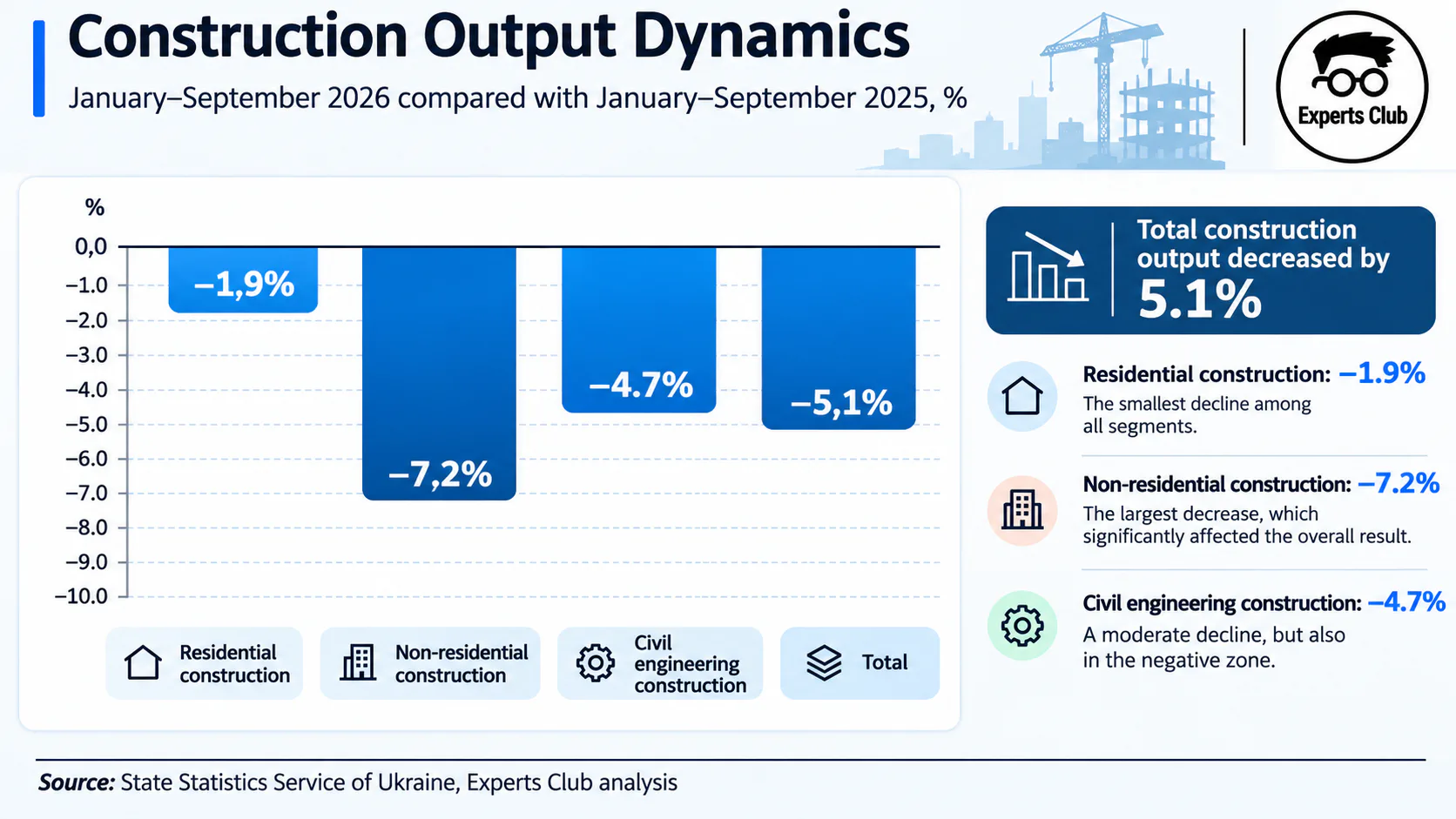
According to official statistics, residential construction volumes declined by 1.9% in January–September, non-residential construction fell by 7.2%, and civil engineering construction decreased by 4.7%. However, in September, civil engineering output increased by 51.9% compared with September 2025, residential construction grew by 5.7%, while non-residential construction contracted by 13.2%.
The September recovery significantly improved the industry’s overall performance. While the decline reached 9.9% in January–August, it narrowed to 5.1% after September’s results were included. Experts Club emphasizes that positive developments over several consecutive months are needed to confirm a sustainable recovery.
Analysts attribute the relative resilience of residential construction to the completion of previously launched housing projects, repairs to damaged buildings, and development activity in relatively safer regions. Non-residential construction, meanwhile, continues to face high capital costs, security risks, limited access to financing, and businesses’ reluctance to undertake long-term investments.
Rising construction costs remain a major challenge. In September, construction prices increased by 27.1% compared with the same month of 2025 and by 1.5% compared with August. The largest monthly increase was recorded in transport infrastructure construction, at 2.4%. These developments create additional risks of budget overruns and postponements of new investment projects.
The development of domestic building materials production is another important factor in future recovery. According to an industry study presented by the European Business Association with the participation of the Kyiv School of Economics, Ukraine’s pre-war building materials market was valued at approximately $16 billion. Ukrainian enterprises could potentially supply up to 90% of the materials required for reconstruction, but realizing this potential requires investment and industrial modernization.
The metallurgical industry also remains under significant pressure. During the first nine months of 2026, Ukrainian steel production declined by 19.8% to 4.46 million tonnes, while rolled metal output decreased by 23% to 3.73 million tonnes. Russian attacks on production facilities significantly disrupted operations. The cement industry faces additional challenges from weak domestic demand and new EU export conditions under the Carbon Border Adjustment Mechanism (CBAM).
According to the Experts Club forecast, potential growth areas in 2027 include housing restoration, modernization of energy networks, construction of industrial and logistics facilities, and reconstruction of roads and utility infrastructure.
Future market performance will depend on stable reconstruction financing, investment availability, security conditions, and domestic materials production. September’s rebound is a positive signal, but it has not yet offset the overall contraction recorded during the first nine months of 2026.