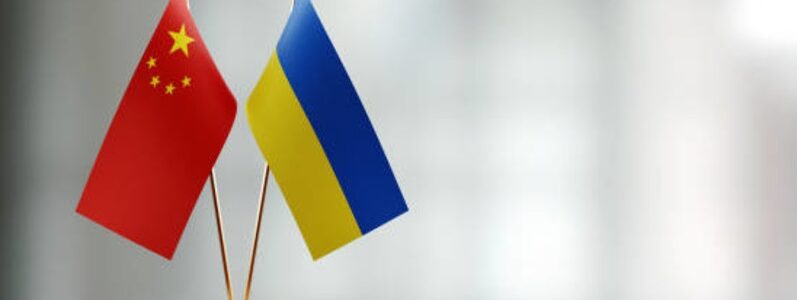
The results of a public opinion poll conducted in March 2026 by the research company Active Group in collaboration with the Experts Club information and analysis centre reveal a complex and contradictory pattern in Ukrainians’ attitudes towards China. Overall, 20.3% of respondents expressed a positive attitude, whilst 42.0% expressed a negative one. Compared to August 2025, positive assessments have risen (from 12.0%), but negative ones have also increased slightly (from 40.7%), indicating not a shift in the balance but a deepening of polarisation.
A more detailed breakdown of the responses shows that only 7.7% of those surveyed have a ‘completely positive’ attitude towards China, whilst 12.6% have a ‘mostly positive’ one. At the same time, the proportion of neutral assessments is significant — 34.3% — indicating a lack of a clear position among a significant proportion of respondents.
The negative segment is dominant and is predominantly moderate in nature: 33.1% chose the ‘mostly negative’ option, with a further 8.9% selecting ‘entirely negative’. This suggests that negative perceptions of China are not sharply radicalised, but remain persistent and widespread. The proportion of those who are undecided stands at 3.5%.

Comparative trends indicate a certain increase in interest in or reassessment of China, reflected in a rise in positive assessments. However, the parallel rise in negative sentiment suggests the absence of a single trend. Rather, it indicates the formation of more pronounced positions — both positive and critical.
“Ukrainians today quite clearly distinguish between a country’s economic weight and its perception in a political and social context. In the case of China, this is particularly evident: on the one hand, there is an awareness of its role in the global economy, and on the other, a reserved or negative attitude. This is precisely why we are seeing a simultaneous rise in both positive and negative assessments,” noted Oleksandr Pozniy, director of the research company Active Group.
The high proportion of neutral responses is also an important indicator. It may indicate a limited level of personal experience of interaction or a lack of awareness among some respondents. In such conditions, public opinion remains sensitive to changes in the information environment and the foreign policy context.
“The modern international economy is shaped not only by trade, but also by trust and the perception of partners. If a country is present in the market but is not associated with investment, technology or support, this affects its image in society. In the case of China, we see a clear example of such an asymmetry between economic presence and perception. Our people are guided by emotions and the picture presented by the media, rather than by concrete facts and statistics. It should be added that if Ukrainian citizens really did have such a negative attitude towards China, there would be a de facto self-imposed embargo on the purchase of Chinese technology, clothing and other goods, but this is not the case; China remains the number one trading partner, which would be difficult without a positive or neutral attitude towards the country. “Another issue is that China should also strengthen its presence in Ukraine in the fields of humanitarian aid, educational and scientific exchange, cultural diplomacy, and so on,” noted Maksym Urakin, founder of the Experts Club information and analytical centre.
Overall, the survey results indicate that China remains an important but ambiguous partner for Ukrainians. Positive assessments are on the rise, but they do not alter the overall balance, which is dominated by a cautiously negative perception. This points to the need for a deeper analysis of the factors shaping public opinion, as well as the potential for its further transformation depending on the development of economic and political relations.
According to a study conducted by the Experts Club information and analytical centre based on data from the State Customs Service, China is the leader in terms of total trade in goods with Ukraine, with a figure exceeding $21 billion. At the same time, imports from China significantly exceed exports of Ukrainian goods, resulting in a substantial trade deficit.
The study was presented at the Interfax-Ukraine press centre; the video can be viewed on the agency’s YouTube channel. The full version of the study can be found via this link on the Experts Club analytical centre’s website.
ACTIVE GROUP, CHINA, EXPERTS CLUB, Pozniy, SOCIOLOGY, SURVEYS, UKRAINE, URAKIN