

The European Bank for Reconstruction and Development (EBRD) is providing the city of Kyiv with a loan of 150 million euros to purchase new energy-efficient subway cars, spare parts, and maintenance and diagnostic equipment for the Kyiv Metro municipal enterprise, the bank’s press office announced on Wednesday.
The loan is backed by a partial guarantee from Spain and supplemented by grant funding from the bank’s internal resources.
“The new subway cars are expected to be up to 25% more energy-efficient than the outdated cars they will replace, ensuring a more environmentally friendly, safer, and more reliable subway service,” the statement said.
In addition to the purchase of rolling stock, the EBRD will fund an audit of the metro’s accessibility to develop an action plan for inclusive transportation throughout Kyiv, tailored to the needs of people with disabilities, veterans, elderly passengers, and parents with children. The bank will also support a three-year training program for female electric train drivers in partnership with UN Women’s “She Drives” initiative to address the labor shortage.
In total, since the start of Russia’s full-scale invasion in February 2022, the EBRD has allocated nearly 11 billion euros to support Ukraine’s real economy.
EBRD, KYIV, LOAN, METRO, TRANSPORTATION

The European Bank for Reconstruction and Development may provide EUR600 million to restore the electricity balancing market, said Ukraine’s First Deputy Prime Minister for Energy Denys Shmyhal after a meeting with EBRD President Odile Renaud-Basso.
“Ukrainian energy companies need EUR600 million in financing to revitalize the balancing market. We greatly appreciate the EBRD’s participation in this process and count on the bank’s support for this reform,” he wrote on his Telegram channel.
According to the First Deputy Prime Minister, the parties also discussed priorities for further cooperation across all areas. Currently, Ukraine, in partnership with the EBRD, is implementing 13 energy projects that cover virtually the entire energy chain—from gas production and supply to electricity generation and transmission—as well as projects in hydropower and renewable energy. The total value of the portfolio exceeds EUR3 billion.
In addition, Shmyhal and Reno-Basso coordinated further cooperation to attract new contributions for the reconstruction of the New Safe Confinement at the Chernobyl Nuclear Power Plant during the Donors’ Conference, which is scheduled to take place in Paris in November.

The European Bank for Reconstruction and Development (EBRD) is considering providing Kyiv with a loan of up to EUR 50 million to support the liquidity of the municipal utility “Kyivteploenergo” and ensure the uninterrupted provision of critical municipal services amid the war.
According to the bank’s materials, the project is scheduled to be approved on July 22, 2026.
The loan is intended to cover Kyivteploenergo’s critical liquidity needs, including operating and maintenance costs, as well as to offset temporary revenue losses and additional expenses caused by the war.
Due to war-related risks, the loan will be partially covered by a European Union (EU) guarantee for first-loss coverage under the Municipal, Infrastructure, and Industrial Resilience (MIIR) Program as part of the Investment Program for Ukraine (UIF).
The financing is intended to ensure uninterrupted heat supply to schools, kindergartens, hospitals, residential buildings, and businesses, as well as electricity generation for the city and the power grid.
The EBRD notes that the additional strain on Kyiv’s district heating system is linked, in particular, to the significant number of internally displaced persons.
The project is part of the EBRD’s “Resilience and Livelihoods” (RLF) program. It is also intended to support the development and expansion of municipal services for veterans and their families.
As previously reported, in June, Kyiv Mayor Vitali Klitschko stated that the Kyiv City Council must approve a EUR50 million EBRD loan for “Kyivteploenergo” to implement measures under the Capital’s Resilience Plan. He estimated the cost of Kyiv’s priority energy resilience measures at approximately 30 billion hryvnia.
The European Bank for Reconstruction and Development (EBRD) is considering providing a loan of up to 34 million euros to the municipal utility “Rivneoblvodokanal” for the construction of new wastewater treatment facilities with a capacity of 60,000 cubic meters per day, the reconstruction of three sewage pumping stations, and the implementation of energy-efficient technologies.
According to the bank’s materials, the project is scheduled to be approved on July 22, 2026, and its total cost is estimated at 53.1 million euros.
The loan is to be disbursed in two tranches. It will be supplemented by an investment grant of up to 10 million euros from the Eastern European Partnership for Energy Efficiency and the Environment (E5P) Fund.
Repayment of the loan is fully guaranteed by the Rivne region, and 25% of the loan amount will be covered by a European Union (EU) guarantee under the Municipal, Infrastructure, and Industrial Resilience Program (MIIR) as part of the Investment Program for Ukraine (UIF).
The funds will also be used to install energy-efficient equipment and SCADA automated control systems at Rivneoblvokanal facilities.
The project aims to improve wastewater collection and treatment for approximately 240,000 residents of Rivne and surrounding areas, including internally displaced persons.
According to EBRD estimates, the new treatment facilities will treat 22 million cubic meters of wastewater per year in accordance with EU standards. The project is expected to reduce greenhouse gas emissions by 50% and net energy consumption by 45%.
The project is part of the EBRD’s “Resilience and Livelihoods” (RLF) program, which aims to restore and enhance the resilience of Ukraine’s critical infrastructure. It also includes training company staff to operate the new equipment and establishing a dedicated project implementation team.
As previously reported, in February 2026, the EBRD approved a 12 million euro loan for Rivne to finance the energy-efficient modernization of at least 24 social infrastructure facilities. The project, with a total cost of 19 million euros, also includes a 6 million euro grant from the E5P program and 1 million euros in co-financing from the city.
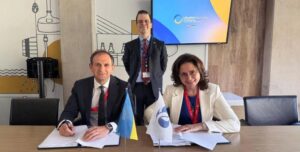
Raiffeisen Bank has granted the “Pan Kurchak” group a 350 million hryvnia loan to rebuild a factory destroyed by a fire in 2024; 50% of the loan risk is covered by a guarantee from the European Bank for Reconstruction and Development (EBRD) under the Extended Guarantee of the RSF Ukraine Investment Facility.
According to a correspondent for the “Interfax-Ukraine” news agency, the relevant documents were signed on the sidelines of the URC 2026 Conference on Ukraine’s Recovery, which took place in Gdańsk on June 25–26.
According to the report, the loan will be used to reconstruct the plant and install modern, energy-efficient equipment. The project is expected to strengthen the company’s position in the domestic market and enhance its operational resilience.
This is the first project to benefit from the new RSF Extended Guarantee.
As previously reported, the “Pan Kurchak” agro-industrial group was founded in 2001. It is engaged in crop cultivation, the production and sale of compound feed, broiler and pig breeding, and meat processing.
The agribusiness group includes “Western Agrarian Company” (which cultivates 16.7 thousand hectares), “Agrotechnika” LLC (which operates two compound feed mills, an oilseed processing plant, and four grain elevators), “Agidel” LLC (which maintains a parent flock of poultry with a production capacity of 32 million eggs and a broiler complex for 10,000 birds), VMP LLC (processes meat, produces sausage products and semi-finished meat products), Gubin Poultry Complex LLC (operates six farms with an annual capacity of 14 million head of poultry). All of the group’s production facilities are located in the Volyn region.
“Pan Kurchak” also operates a chain of branded stores called “M’yasna Tochka” and “Smarty” (Ukrainian Retail Networks LLC).
According to the Unified State Register of Legal Entities and Individual Entrepreneurs, the group is owned by Serhiy and Ivanna Martyniak.
Kredobank and the European Bank for Reconstruction and Development (EBRD) signed two risk-sharing agreements during the Ukraine Recovery Conference (URC 2026) in Gdańsk for new loan portfolios to Ukrainian businesses totaling EUR100 million, the Ukrainian bank’s press service reported.
“The additional EUR100 million from the EBRD will allow Kredobank to expand lending to Ukrainian companies not only in the small and medium-sized business sector but also in the corporate segment,” the press release quoted Jakub Karnowski, the bank’s chairman of the board, as saying.
One of the agreements covers a EUR60 million loan portfolio for small and medium-sized enterprises with annual revenue of up to EUR50 million and up to 250 employees.
It is being implemented under two programs: the EBRD’s “Resilience and Livelihoods Guarantee” (RLG) and the program to support the competitiveness and inclusion of small and medium-sized enterprises in the EU’s Eastern Partnership countries.
Under the RLG, the EBRD’s share of risk-sharing will be up to 70%, and the term of the guarantee coverage will be five years.
The program to support the competitiveness and inclusion of small and medium-sized enterprises in the EU’s Eastern Partnership countries enables Kredobank’s clients to receive grant support of up to 30% for investment projects that meet the EBRD’s requirements.
The EUR60 million agreement also provides for the use of the Enterprise Security Enhancement (ESE) mechanism, which will allow Kredobank to partially write off the debt of companies whose assets were damaged as a result of the war.
Under the second agreement, implemented through the RLG program, a EUR40 million loan portfolio is provided for large companies with no restrictions on revenue or number of employees. The EBRD’s share of risk-sharing will be up to 80%, the guarantee period will be five years, and the maximum amount of a single loan will be EUR4 million.
Both agreements provide for the possibility of lending without additional collateral.
According to Karnovski, the volume of financing for Ukrainian companies within Kredobank’s portfolio, which is covered by the EBRD’s limits and guarantees, has already reached EUR249 million. The funds were directed, in particular, to agriculture, the food industry, logistics, and retail.
As of the beginning of the year, according to information on the EBRD’s website, Kredobank served over 54,000 SME and corporate clients and over 550,000 retail clients.
According to the regulator, as of May 1, 2026, the bank ranked 14th (76.94 billion UAH) among Ukraine’s 58 solvent banks in terms of total assets.



