
The value of Ukraine’s exports of insulated wires and cables (including fiber-optic cables) in January–June 2026 increased by 2% compared to the same period in 2025, reaching $741.2 million.
According to statistics from the State Customs Service (SCS), Germany remained the largest importer of Ukrainian products, as it was last year; shipments to Germany decreased by 3% to $245.3 million, and its share of total exports of these products fell by 1.7 percentage points to 33%.
As in the first half of last year, the top three importers also included Hungary—$124.8 million (last year: $118.1 million)—and Poland—$121.8 million ($111.3 million).
According to statistics, exports of these products in June fell by 3% compared to June 2025 but rose by 3.3% compared to May of this year, reaching $128.3 million.
At the same time, according to the State Customs Service, imports of wires and cables into Ukraine increased by 24.5% in the first half of the year, reaching $354.2 million.
The largest suppliers of wires and cables to Ukraine were China ($101.6 million), Hungary ($87.8 million), and Poland ($47.3 million), whereas last year imports from Hungary totaled $78.9 million, from China – $55.6 million, and from Poland – $41.1 million.
As previously reported, according to the State Customs Service, in 2025 Ukraine increased its exports of insulated wires and cables by 10.6% compared to 2024—to $1.41 billion—and imports by 24.3%—to $590.7 million.
In the first half of 2026, Ukrainians purchased 111,500 used passenger cars imported from abroad, which is 2% less than in the same period of 2025, according to a report by “Ukravtoprom” on its Telegram channel.
Gasoline-powered cars accounted for the largest share of this segment of the auto market, increasing their share by 11 percentage points compared to January–June 2025, to 58%.
Next came diesel cars at 20% (22%), while the share of electric vehicles fell to 11% from 22%, though they still outpaced hybrids, which accounted for 8% (5%). The share of cars with LPG systems was 3% (4%).
The average age of imported used cars was 9.7 years.
The Volkswagen Golf confidently tops the list of the ten most popular imported used models with 5,143 units. Next are the VW Tiguan with 4,549 units, the Audi Q5 with 3,962 units, the Nissan Rogue—3,896 units, the Skoda Octavia—3,688 units, the Renault Megane—3,435 units, the Volkswagen Passat—2,477 units, the Ford Escape—2,446 units, the Nissan Qashqai—2,166 units, and the Audi A4—2,144 units.
As reported by “Ukravtoprom,” in 2025, Ukrainians purchased 274,300 used passenger cars imported from abroad, which is 24% more than in 2024; the top three most popular models after the Volkswagen Golf included two Tesla electric vehicles—the Model Y and Model 3.
This year, the market showed a 22% increase in January compared to January 2025, but began to decline starting in February.

In January-February 2026, imports of tin and tin products increased by 18.8% to $727 thousand (in February – $559 thousand).
Exports of tin and tin products in January-February 2026 amounted to $248,000 (in February – $23,000), while in January-February 2025 they amounted to $5,000.
In 2025, imports of tin and tin products increased by 36.5% to $4.352 million.
Exports of tin and tin products amounted to $241,000, compared to $389,000 in the 12 months of 2024.
Tin is mainly used as a safe, non-toxic, corrosion-resistant coating in its pure form or in alloys with other metals. The main industrial applications of tin are in white tinplate (tinned iron) for the manufacture of food containers, in solders for electronics, in domestic piping, in bearing alloys, and in coatings made of tin and its alloys. The most important tin alloy is bronze (with copper).

Imports of goods to Ukraine in January-February 2026 amounted to $14.8 billion in monetary terms, while in the same period last year they amounted to $11.3 billion, which is 31% less, according to data from the press service of the State Customs Service of Ukraine (SCS).
According to a publication on the agency’s Telegram channel, in the first two months of 2026, goods worth $6.5 billion were exported from Ukraine, which is almost unchanged compared to the same period in 2025 ($6.3 billion).
“At the same time, taxable imports amounted to $5.2 billion, which is 78% of the total volume of imported goods. The tax burden per 1 kg of taxable imports in January-February 2026 was $0.54/kg,” the report says.
The largest imports to Ukraine came from China ($4 billion), Poland ($1.4 billion), and Turkey ($1.1 billion).
The largest exports from Ukraine went to Poland ($713 million), Turkey ($563 million), and Italy ($428 million).
Of the total volume of goods imported in January-February 2026, 71% of the categories were machinery, equipment, and transport – $6 billion (with customs clearance, 32.9 billion UAH, or 26% of customs payments, was paid to the budget), fuel and energy products – $2.6 billion (49.7 billion hryvnia, or 39% of customs payments, paid to the budget), chemical industry products – $2 million (15.9 billion hryvnia, or 12% of revenues, paid).
The top three most exported goods from Ukraine were food products – $4 billion, metals and metal products – $589 million, and machinery, equipment, and transport – $532 million.
“In January-February 2026, during customs clearance of exports of goods subject to export duties, UAH 318.5 million was paid to the budget,” the State Customs Service summarized.

The European Union has officially allowed the import of planting material for common cherries (Prunus cerasus), blue cherries (Prunus canescens), and their hybrids from Ukraine, according to the State Service of Ukraine for Food Safety and Consumer Protection (Derzhprodspozhyvsluzhba).
According to the report, the decision was made by the European Commission (EU Executive Regulation 2025/1949) after reviewing the technical dossier prepared by the Ukrainian side. The document allows the import of unvaccinated plants up to two years old in a dormant state (without leaves) into the EU.
“The opening of the EU market for Ukrainian planting material is another step towards deeper integration into the European space and strengthening Ukraine’s reputation as a reliable trading partner,” the agency said.
The State Service of Ukraine for Food Safety and Consumer Protection emphasized that exporters must ensure unconditional compliance with the phytosanitary requirements of Regulation (EU) 2019/2072. Each shipment must be accompanied by a phytosanitary certificate, and non-compliance with the importing country’s standards is grounds for refusal to issue it.
The agency drew attention to the need to recognize the equivalence of Ukraine’s certification system for the full export of material covered by Council Directive 2008/90/EC. In this context, an important step was the Commission Implementing Decision (EU) 2026/75 of January 12, 2026, on the equivalence of material for the propagation of fruit plants grown in third countries.

The number of cars subject to luxury tax decreased threefold over the year
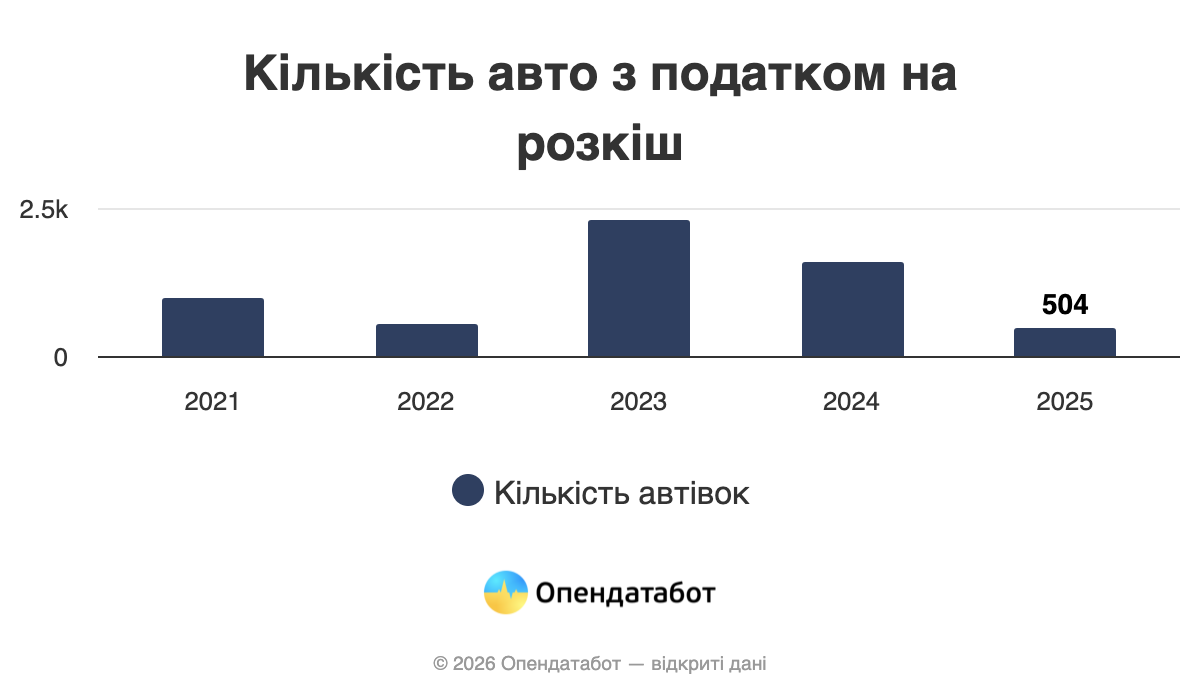
According to the Ministry of Internal Affairs, 504 vehicles subject to luxury tax were imported into the country last year.
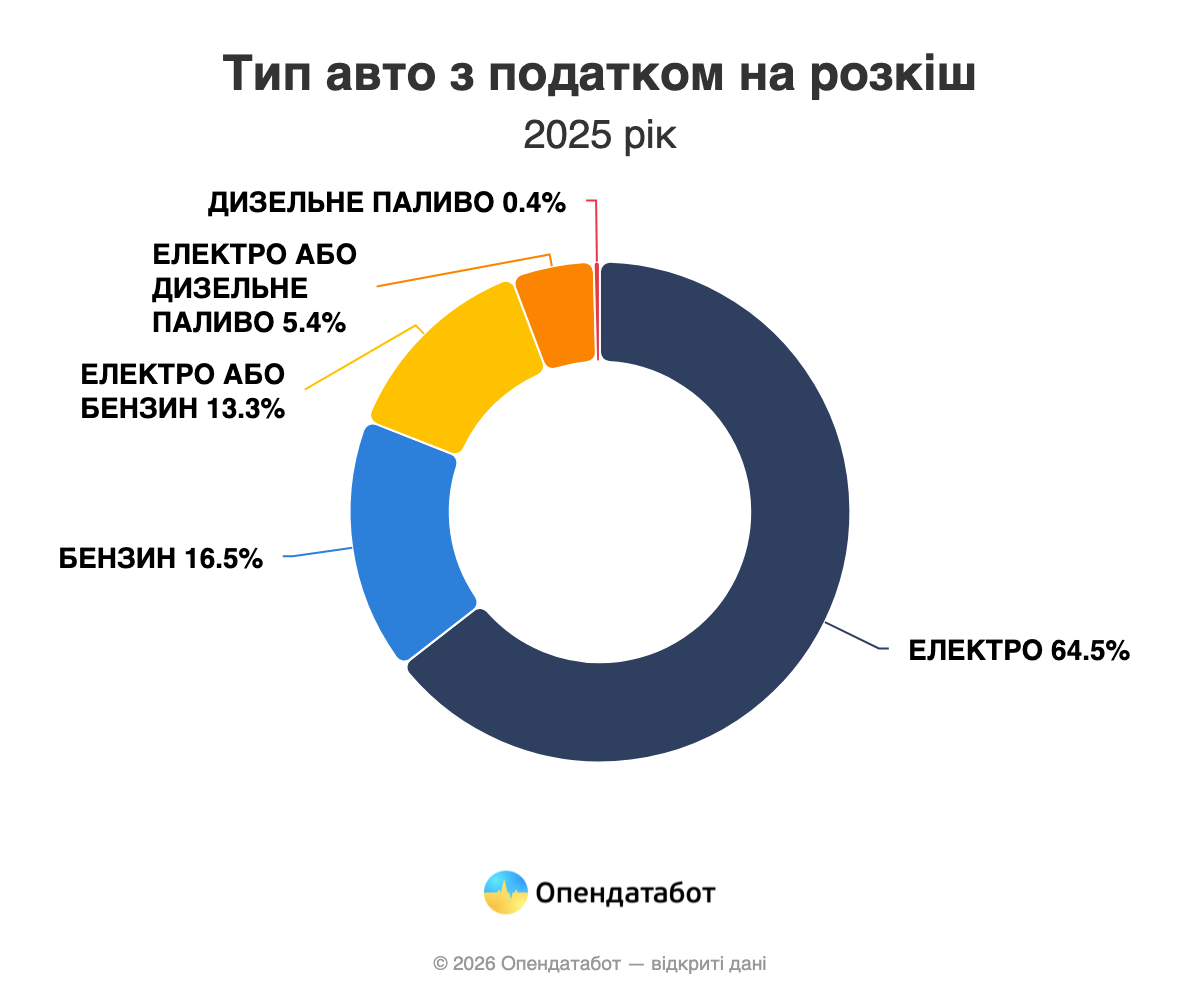
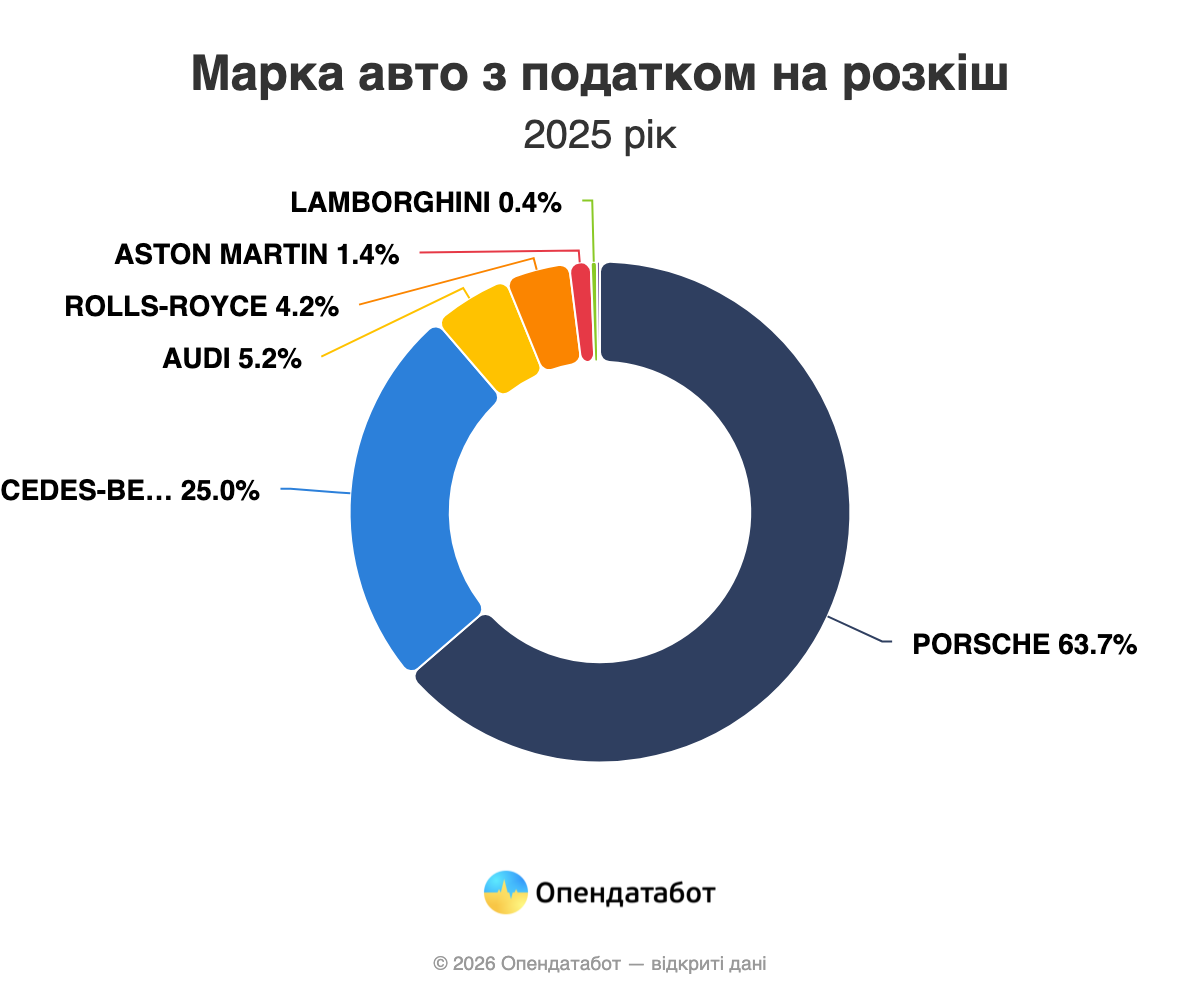
This is the lowest figure in the last five years. Porsche and Mercedes-Benz account for 89% of luxury vehicles, and every second such car is a Porsche Taycan. In total, electric cars account for 65% of all cars subject to luxury tax.
504 cars subject to the “luxury tax” were imported into Ukraine in 2025. This is 3.2 times less than in 2024. Overall, this is the lowest figure in the last five years.
Every second car on the “luxury” list is a Porsche Taycan: 232 cars. Overall, Porsche became the leader in the luxury segment with additional taxation: cars of this brand account for 64% of the total volume. Mercedes-Benz took another quarter of the market with 126 cars. The rest of the premium brands together account for 11% of the market: Audi, Rolls-Royce, Aston Martin, Lamborghini, Maserati, etc.
It is worth noting that, in contrast to overall imports, electric cars dominate the premium segment: 65% of imported luxury cars. Another 18% are hybrids that can run on electricity as well as gasoline or diesel. Pure gasoline cars, the leaders in overall imports, are at the bottom of the list with 17%. Diesel accounts for a symbolic 0.4%.
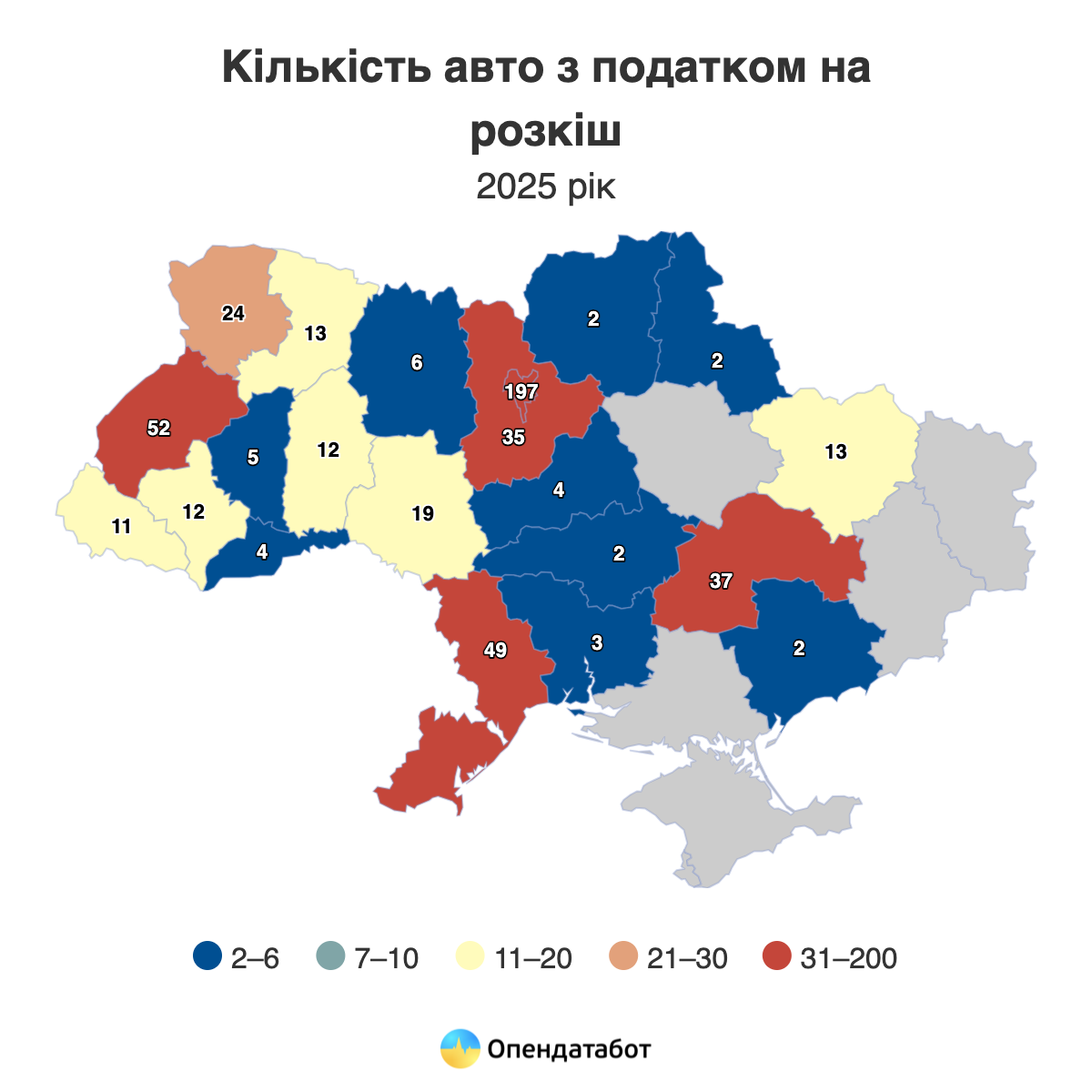
Almost half of all luxury cars are registered in Kyiv and the surrounding region: 236 cars. Another 52 cars are in Lviv region, 49 in Odesa region, and 37 in Dnipropetrovsk region.
Most of the cars in the luxury segment are registered to individuals — 82% or 413 cars. Only 18% of such cars are registered to businesses.
The ultra-premium segment deserves special attention. Last year, 21 Rolls-Royces were imported into Ukraine. Fifteen of them are the electric Spectre model, which costs about $600,000. The registry also includes seven Aston Martins and two Lamborghinis.
It should be noted that the “luxury tax” applies to cars costing more than UAH 3.2 million and less than 5 years old. The tax amount for one such car is UAH 25,000 per year.
https://opendatabot.ua/analytics/luxury-car-fee-2025
CAR, IMPORT, luxury, Porsche Taycan, TAX



