
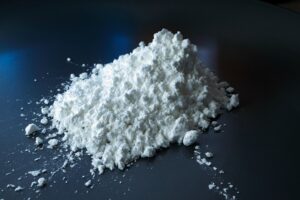
The Security Service of Ukraine dismantled an international drug smuggling ring operating out of Southern Europe and seized the largest shipment of cocaine since the start of the full-scale war, valued at approximately 70 million hryvnia. As part of a special operation in the Kyiv, Dnipropetrovsk, and Lviv regions, ten suspected members of an international drug syndicate were detained simultaneously, the SBU reported on August 12.
According to the security service, the group was involved in the distribution of wholesale shipments of cocaine, ecstasy, and other psychotropic substances imported from abroad. The SBU estimates the monthly revenue from these illegal activities at 15–20 million hryvnias.
Investigators believe a Kyiv resident was the organizer of the group’s activities in Ukraine. According to law enforcement, he recruited people to distribute drugs in various regions of the country.
During the first series of searches, SBU officers discovered approximately 2 kg of cocaine and other prohibited substances. Subsequently, more than 8 kg of cocaine and other potent substances were found in hiding places. The SBU estimated the total value of the seized substances at approximately 70 million hryvnias.
Thus, this amounts to approximately 10 kg of cocaine, not including the other seized substances. The SBU describes this shipment as the largest the agency has uncovered in Ukraine since the start of the full-scale war.
The ten detainees have been notified of charges under Part 3 of Article 307 of the Criminal Code of Ukraine—the illegal production, acquisition, storage, transportation, or sale of narcotic drugs and psychotropic substances committed by an organized group. They are currently in custody. The investigation has also established the possible involvement of three Ukrainian citizens currently in Spain in organizing the trafficking route. The issue of their extradition to Ukraine is currently being resolved.
The operation was carried out by SBU officers under the procedural supervision of the Dnipro District Prosecutor’s Office in Kyiv.
The SBU operation comes amid high cocaine supply in Europe. According to the 2026 European Drug Report, cocaine remains the second most prevalent illicit drug in Europe after cannabis. Approximately 4.3 million Europeans aged 15–64 have used it in the past year.
The EUDA notes that large shipments of cocaine continue to flow into Europe primarily from South America, with international criminal networks actively exploiting global commercial and maritime cargo flows. Large quantities of the drug are regularly seized at European ports.
Spain and the Western Balkans are a key component of the European system for combating international drug trafficking, primarily due to the activities of major organized crime groups in the region.
Europol notes that certain criminal networks linked to Montenegro are involved in organizing large-scale cocaine shipments from South America to European markets and have connections both within the EU and in Latin America.
In April 2026, Europol reported the arrest in Montenegro of one of the leading members of the so-called “Balkan Cartel.” Montenegrin law enforcement authorities charged a group of suspects in connection with the illicit trafficking of approximately 2,700 metric tons of cocaine between October 2024 and April 2026. The drugs had previously been seized during several operations in EU countries and South America.
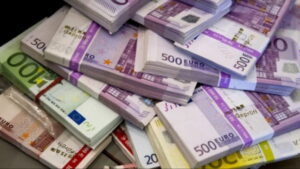
According to Serbian Economist, Croatian police at the Karasovici border crossing (border with Montenegro) found €500,000 in cash in a car with Czech license plates driven by a 24-year-old Ukrainian citizen, the Dubrovnik-Neretva County Police reported.
According to the police, the incident occurred while attempting to leave Croatia for Montenegro. During the inspection, law enforcement officers and customs officials noticed changes in the interior of the car, used special equipment to detect hidden packages, and requested a search warrant. After the search, by decision of the County Court in Dubrovnik, 13 packages containing a total of €500,000 in cash were found in the side panels of the rear of the car.
The money and the car were seized, and the driver was detained. Upon completion of the investigation, he was charged with money laundering and transferred to a detention center. The police also stated that the investigation had established that the money had been transported from Western European countries and that its final destination was one of the countries of Southeast Europe.
https://t.me/relocationrs/2287
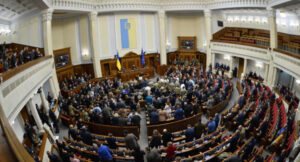
The Verkhovna Rada has amended the Criminal and Criminal Procedure Codes of Ukraine to criminalize smuggling of goods and excisable goods, which is one of the conditions for the last tranche of the EU’s EUR 1.5 billion macro-financial assistance to Ukraine.
According to MP Yaroslav Zheleznyak (Holos faction), the committee’s version of the draft law was adopted, which was amended in accordance with the letters from the Ministry of Finance that the business insisted on.
“1) It is proposed to raise the thresholds for smuggling 5 times. 2) The thresholds for excisable goods are to be raised by 2 times. 3) The entry into force (criminalization) of commodity smuggling is postponed until mid-2024. As I said, this is the deadline under the (memorandum with the) IMF on the BES reboot,” the MP listed the changes.
He added that the numerous wishes of the business community have also been taken into account, and that actions can only be classified as a crime if there is intent.
“Possible cases of prosecution under ‘smuggling’ articles for submitting documents with false information have been significantly limited – in the amended version, they must be the basis for the movement of goods, be subject to mandatory declaration under customs law, and have an impact on determining the amount of customs payments or compliance with non-tariff regulation measures,” Zheleznyak said.
During the voting, no amendments were made to the text submitted by the committee to the Rada for the second reading, but the text itself is not yet available on the parliament’s website.
According to the representative of the relevant committee, Oleksandr Bakumov (Servant of the People), the threshold for criminal liability for smuggling is set at UAH 6.71 million, which is 50 times higher than in the draft law adopted as a basis (UAH 113.5 thousand – IF-U). He added that the threshold for smuggling excisable goods (except for electricity) has been increased by “thirty-three and three and a half times” compared to the original draft (UAH 56.75 thousand).
Members of the European Solidarity and Batkivshchyna parties, who criticized the draft law, called the main problems of the law the presence of law enforcement agencies in the customs control zone with the addition of the Bureau of Economic Security (BES) and the unresolved problems that led to the adoption of the law on smuggling decriminalization in 2011.
“Ukraine is the only country in Europe and in the World Customs Organization whose customs authorities are not vested with pre-trial investigation functions… We could have left only what is transported outside the customs posts to be considered smuggling,” says MP Nina Yuzhanina (European Union). According to the current legislation, only the illegal transportation of cultural property, poisonous, potent, explosive substances, radioactive materials, weapons or ammunition, parts of firearms, as well as special technical means of covertly obtaining information is considered smuggling.
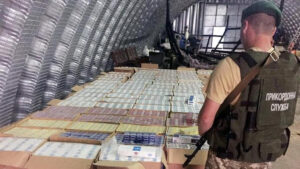
The Verkhovna Rada of Ukraine (hereinafter – the VRU) is considering Draft Law #5420 “On Amendments to the Criminal and Criminal Procedure Codes of Ukraine on Criminalization of Smuggling of Goods” dated 04/23/2021 (hereinafter – Draft Law #5420). The above draft law is currently being prepared for the second reading.
Adoption of the Draft Law No. 5420 without its finalization and without taking into account the comments expressed by the business community may harm law-abiding businesses, which today face significant problems when exporting and importing goods due to the blocking of Ukraine’s borders and the inability to carry out transportation by other means than land.
During the previous stages of consideration of Draft Law #5420 in the Parliament, Chamber Member Companies’ experts repeatedly provided comments and suggestions to the text of the document. The Chamber Member Companies’ experts are grateful to MPs and members of the relevant VRU Committees for taking into account some of the proposals of the business community (in particular, removing the article on “False Declaration of Goods” from the Draft Law #5420). At the same time, the business community reiterated its proposal to supplement the sanction of the proposed article of the Criminal Code of Ukraine (hereinafter – the CCU) with provisions on mandatory confiscation and destruction of alcoholic beverages and tobacco products that are smuggled. In addition, the Chamber Member Companies’ experts strongly oppose the wording of Article 201-3 of the CCU “Smuggling of Goods” (regarding non-taxable goods) contained in Draft Law #5420.
The Chamber Member Companies unequivocally support the government’s intentions to combat illegal schemes in customs clearance of goods, in particular, if the subject of the offense is excisable goods. Since tax revenues from excisable goods, in particular, help to fill the State Budget during the ongoing war, it is crucial to effectively combat illegal import of such products into Ukraine. In addition, the illegal export of excisable goods from Ukraine damages the reputation of our country in relations with international partners. For example, according to a recent study by KPMG, Ukraine is the second largest supplier of illegal tobacco products to the European Union (EU) market. At the same time, criminal liability for smuggling excisable goods is enshrined in the EU legislation.
At the same time, the introduction of criminal liability for smuggling of non-excisable goods in the wording proposed by the draft law will not only not contribute to the effectiveness of combating the shadow economy, but will, on the contrary, lead to numerous corruption risks and prerequisites for abuse by regulatory and law enforcement agencies, as well as illegal pressure on legally operating businesses.
In particular, the legal construction of the objective side of the crime of “moving goods across the customs border of Ukraine outside customs control or concealed from customs control” is an outdated norm of the USSR, and is also extremely vague, in fact allowing the registration of criminal proceedings in any disputable situations arising during customs control (including in the absence of criminal intent, as the current version of the draft law does not provide for an intentional form of guilt in smuggling).
Representatives of the business community sent numerous letters to MPs and public authorities asking them to substantially revise Draft Law No. 5420 and hold thorough discussions with business and experts.
The American Chamber of Commerce calls on MPs to finalize Draft Law #5420 and remove the proposed wording of Article 201-3 of the CCU “Smuggling of Goods” or significantly change the wording of the description of the objective side of the crime, providing that criminal liability is incurred exclusively for intentional customs fraud committed with the purpose of evading customs duties or avoiding non-tariff regulation.

Ukrainian President Volodymyr Zelensky has proposed to punish for amber smuggling with imprisonment from three to seven years and introduce an article on illegal extraction of amber to the Criminal Code of Ukraine.
This is outlined in bill No. 2059 amending the Criminal Code of Ukraine on criminal liability for the illegal extraction of amber or its movement across the customs border of Ukraine registered by the head of state in parliament.
So, it is proposed to introduce Article 240-1 (illegal extraction of amber). This crime is punishable by a fine of 700 to 3,000 tax-free minimum incomes of citizens (1 minimum is UAH 17), or imprisonment for a term from one to three years.
“The sale, acquisition, storage, transfer, transportation, processing of illegally obtained amber shall be punishable by a fine of 3,000 to 10,000 tax-free minimum incomes of citizens, or by imprisonment for a term from three to six years,” the president said in the bill.
The same actions committed with prior conspiracy by a group of persons, either repeatedly or on a large scale, as well as illegal amber extraction committed on the territories or objects of the nature reserve fund, shall be punishable by imprisonment for a term from four to seven years.

Prime Minister of Ukraine Volodymyr Groysman has called on the leaders of foreign diplomatic institutions of Ukraine to contribute to the fight against smuggling. “Prime Minister of Ukraine Volodymyr Groysman has urged the heads of diplomatic institutions of Ukraine abroad to join the campaign announced by the government dubbed “Ukraine without smuggling” by prompt response to cases of illegal actions and by providing information on the movement of goods taking into account their present price,” the press service of the Cabinet of Ministers said on the results of the meeting of the premier with heads of foreign diplomatic institutions in Kyiv on Tuesday.
Groysman, in particular, asked the diplomats to respond to the requests of the State Fiscal Service, customs office, law enforcement system and facilitate the rapid receipt of information from international partners.



