
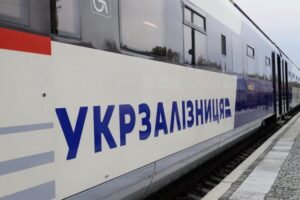
A number of Ukrzaliznytsia trains across the country are running with delays of 2 to 16 hours, according to train schedule information posted on the company’s website on Monday.
According to the latest updates as of 10:43 a.m., the train with the longest delay is train 121/122 Mykolaiv Pass. – Kyiv-Pass. – 16 hours 33 minutes, as well as train 109/110 Mykolaiv Pass. – Lviv – 12 hours 37 minutes, while trains 233/234 Kryvyi Rih-Holovnyi – Chernivtsi and 293/294 Kryvyi Rih-Holovnyi – Rakhiv are running with a delay of 11 hours 58 minutes.
As for other trains, the 3/4 Dnipro-Holovnyi–Uzhhorod is delayed by 10 hours 24 minutes, and the 285/286 Lviv–Dnipro-Holovnyi and 41/42 Truskavets–Dnipro-Holovnyi are running with a delay of 7 hours 36 minutes.
“Ukrzaliznytsia” notes that train delays are calculated automatically, so changes may occur. Among other things, it is noted that during emergencies, evacuations, and detours, train delays may increase, while they may decrease when a train accelerates.
The company’s website reports that, in total, approximately 50 trains are running with delays across Ukraine.
From July 13 to 19, JSC “Ukrzaliznytsia” (UZ) transported 647,100 passengers, and the most popular train last week was the Kyiv–Przemyśl route, which carried 13,800 people, according to a company announcement on its Telegram channel.
According to the published data, the average number of passengers per car during the reporting period was 378.
Meanwhile, the number of passengers in children’s groups that week totaled 21,600.
“The most popular destination is the Carpathians. The vast majority of children traveled to Tatariv, Vorokhta, and Yasinya. Ensuring seats for organized groups of children is a priority, so when tickets are issued for these trips, they are the first to receive them,” Ukrzaliznytsia emphasized.
It is noted that the number of military personnel transported via the special reserve from July 13 to 19 was 3,600.
According to data provided by Ukrzaliznytsia, from July 13 to 19, the highest demand was observed on the Kyiv–Lviv route, where 173,200 requests were recorded and 32,700 passengers were transported.
On the Kyiv–Odesa route, the figures were 107,900 and 23,500 passengers, respectively; on the Kyiv–Przemyśl route, 76,600 and 14,700; on the Kyiv–Kharkiv route, 66,900, with 20,200 passengers transported; and on the Kyiv–Dnipro route—57,100 and 15,600, respectively
Ukrzaliznytsia clarified that there were five passengers vying for each seat on the Kyiv–Lviv, Kyiv–Odesa, and Kyiv–Przemyśl routes; four on the Kyiv–Dnipro route; and three on the Kyiv–Kharkiv route.
Among other things, the company evacuated 243 people from the Donetsk and Dnipropetrovsk regions that week and operated trains for representatives of 15 diplomatic delegations.
In early June, Ukrzaliznytsia told the Interfax-Ukraine news agency that this year’s summer passenger travel season would be more challenging than last year’s due to rising demand and a reduction in the number of railcars.
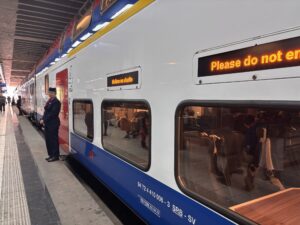
According to Serbian Economist, passenger service on the high-speed rail line between Belgrade and Budapest is scheduled to begin within the next one to two months, Hungarian Prime Minister Péter Magyar announced at a press conference on July 16. Thus, provided the new deadlines are met, the first trains could begin running in August or September. However, Hungarian authorities have not yet specified an exact launch date.
In the coming days, Hungarian Minister of Transport and Investment David Vitézi is scheduled to visit Serbia. During talks with representatives of the Serbian government, the parties plan to coordinate the operation of signaling systems and equipment that ensure traffic safety on the cross-border section.
The launch of passenger trains has already been postponed several times. The main issue has been the certification of the European Train Control System (ETCS) installed on the Hungarian section of the line. Inspections conducted in the spring revealed malfunctions that could have compromised train safety at speeds of up to 160 km/h.
The reconstruction of the railway line has already been completed, and on February 27, 2026, freight traffic began on the Hungarian section. The first cross-border freight train traveled from Budapest through Kelebia and Subotica toward Novi Sad. Passenger service has been postponed until the testing and certification of the signaling systems are completed.
The Belgrade–Budapest high-speed rail line is one of the largest joint infrastructure projects between Serbia, Hungary, and China. Once fully operational, it is expected to significantly reduce travel time between the two capitals and strengthen Serbia’s transport links with Central Europe.
https://t.me/relocationrs/3252

“Ukrzaliznytsia” continues to modernize its rolling stock; new passenger cars manufactured in Ukraine have already been added to the train set for Train No. 29/30 Kyiv–Uzhhorod, Ukrzaliznytsia announced on Saturday.
These cars will immediately begin service today on Train No. 4/3 from Uzhhorod to Dnipro, and taking into account the cars received a month earlier, there are now six new cars operating on the Kyiv–Uzhhorod–Dnipro route, according to a Telegram post.
The cars are equipped with high-capacity rechargeable batteries, which allow the air conditioners to operate even during prolonged stops in hot weather. The compartments also feature power outlets, tables for passengers in the upper berths, buttons to call the conductor, and modern lighting. The restrooms are equipped with changing tables and child seats.
As noted, Ukrzaliznytsia has received a total of 18 new passenger cars since the beginning of the year.
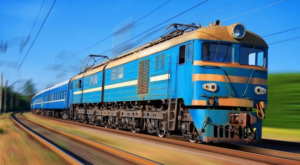
JSC “Ukrzaliznytsia” (UZ) transported over 1 million passengers between June 8 and 21, with the Kyiv-Lviv route (in both directions) proving to be the most popular among Ukrainians, where demand for tickets was three times higher than supply.
“To give more people the opportunity to travel, we scheduled additional trains,” UZ reported on Telegram on Wednesday.
According to the company’s statistics, the shortage on the Kyiv–Odesa route is 4.5 times the supply. Meanwhile, on the Kyiv–Kharkiv, Kyiv–Dnipro, and Kyiv–Vinnytsia routes, demand is twice the supply.
It is noted that the most popular train that departed last week was No. 705/706 Kyiv–Przemyśl, which carried 26,800 passengers.
In addition, from June 8 to 21, the average number of passengers per car was 692.
The number of passengers in children’s groups totaled 43,500, while 7,700 military personnel traveled via the special reserve.
“We understand the scale of the seat shortage, so we are trying to add trains to popular weekend getaway destinations whenever possible,” Ukrzaliznytsia emphasized.
As previously reported, Ukrzaliznytsia transported 472,900 passengers during the first week of June (June 1–7). At that time, it was noted that Ukrzaliznytsia plans to transport a total of 7 million passengers over the three summer months.
In early June, Ukrzaliznytsia told the Interfax-Ukraine news agency that this year’s summer passenger travel season would be more challenging than last year’s due to rising demand and a reduction in the number of railcars.

Ukrzaliznytsia JSC announced a reduction in the number of passenger cars on trains serving routes with lower demand and their redeployment to routes with the highest demand.
“This allows us, given the shortage of rolling stock, to schedule additional trains and increase the number of cars on the most in-demand routes,” Ukrzaliznytsia stated in a Telegram post on Friday.
It is noted that seven train pairs will soon be transferred to daily service. Specifically, these include train No. 4/3 Uzhhorod – Dnipro, No. 86/85 Lviv – Zaporizhzhia, No. 128/127 Lviv – Kryvyi Rih, Zaporizhzhia, No. 78/77 Kovel – Odesa, No. 88/87 Kovel – Dnipro, as well as trains No. 7/8 Kharkiv – Odesa and No. 121/122 Mykolaiv – Kyiv.
Among other things, the company is resuming service on train No. 143/144 Sumy–Rakhiv. Thus, the route will connect northern Slobozhanshchyna and Sivershchyna with the western part of the country and provide direct service between Sumy, Bilopillia, and Konotop and Vinnytsia, Khmelnytskyi, Ternopil, Lviv, Ivano-Frankivsk, Yaremche, and Vorokhta.
In addition, Ukrzaliznytsia has scheduled an additional train No. 227/228 Kyiv–Chernivtsi between the capital and Bukovina, which will run every other day via Vinnytsia, Khmelnytskyi, Ternopil, Lviv, Ivano-Frankivsk, and Kolomyia. The train will consist of open-seating, compartment, and SV (first-class) cars.
“Ticket sales for these scheduled trains will open in accordance with the trains’ running dates. The advance booking period depends on the specific route and ranges from 20 to 5 days prior to the departure date,” the company explained.



