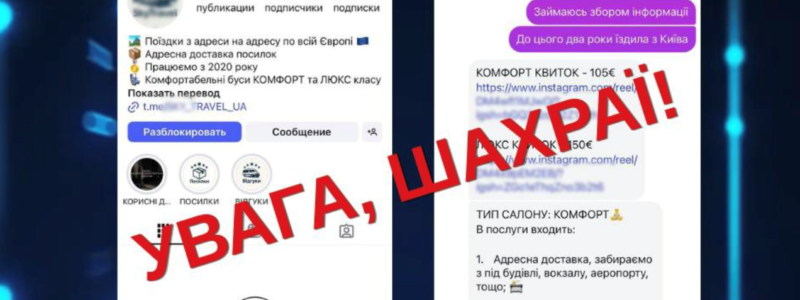
Scammers in Ukraine use ads for passenger and freight transportation to obtain advance payments by creating fake pages for private carriers and logistics companies.
To build trust, the scammers use photos of real buses and trucks, logos of well-known companies, reviews from other people, and other copied materials. Potential customers are usually lured in by lower travel or delivery costs compared to market rates.
Once a customer contacts them, the scammers try to get the money as quickly as possible. In particular, they may claim that there are almost no seats left or that an advance payment must be made immediately to confirm the reservation.
When arranging freight transportation, scammers may demand full payment in advance via a credit card or to an individual’s bank account. After receiving the money, the fake carrier stops responding, and the ad or page is deleted. In some cases, after the first transfer, the customer is asked to make additional payments supposedly for insurance, documents, customs clearance, or other services.
Experts cite the following as signs of potential fraud: a significantly low price, a demand for an urgent prepayment, communication exclusively via messaging apps, recently created carrier pages, and a lack of operational history. The risk also increases if the carrier refuses to provide detailed information about the route, vehicle, and terms of transport, or demands new payments after an agreement has been reached.
Links for booking and payment pose a particular danger. They may lead to phishing sites that mimic the appearance of banking and payment services. Their purpose is to obtain bank card details and other payment information.
Users are advised to verify the company name and phone number through several independent sources before making a payment, review the carrier’s reviews and track record, and avoid sharing CVV codes, passwords, or one-time transaction confirmation codes.
If money has already been transferred to scammers, it is recommended to save the correspondence, screenshots of the ad, and payment confirmation. If you have disclosed your banking information, you should contact your bank as soon as possible. You can also report cases of fraud to the Cyber Police or by calling 102 or 112.
You can learn more about current fraud schemes and ways to protect yourself on the StopFraud platform.