Turkey continues to enjoy a predominantly positive perception among Ukrainians: in August 2026, a total of 52.3% of respondents expressed a positive attitude toward the country, while about 7.5% expressed a negative one. At the same time, compared to the previous survey in March, the share of positive assessments has decreased slightly. This is evidenced by the results of the third wave of the Active Group and Experts Club survey, according to the Experts Club Information and Analytical Center.
According to the results of the August survey, 11.2% of Ukrainians have a completely positive attitude toward Turkey, and 41.1% have a mostly positive attitude. A neutral stance is held by 37.6% of respondents. 6.7% view the country mostly negatively, 0.8% view it entirely negatively, and another 2.7% were undecided.
The balance between positive and negative attitudes stands at approximately plus 44.9 percentage points and is the highest among the Middle Eastern countries included in the study. Thus, despite a slight decline in the indicator, Turkey remains a country where positive assessments clearly outweigh negative ones.
Compared to March 2026, positive attitudes have weakened moderately. At that time, 14.5% of respondents viewed Turkey entirely positively, and 40.6% viewed it mostly positively—meaning the combined positive rating stood at 55%. Negative responses accounted for 5.6%, and neutral responses for 36.4%.
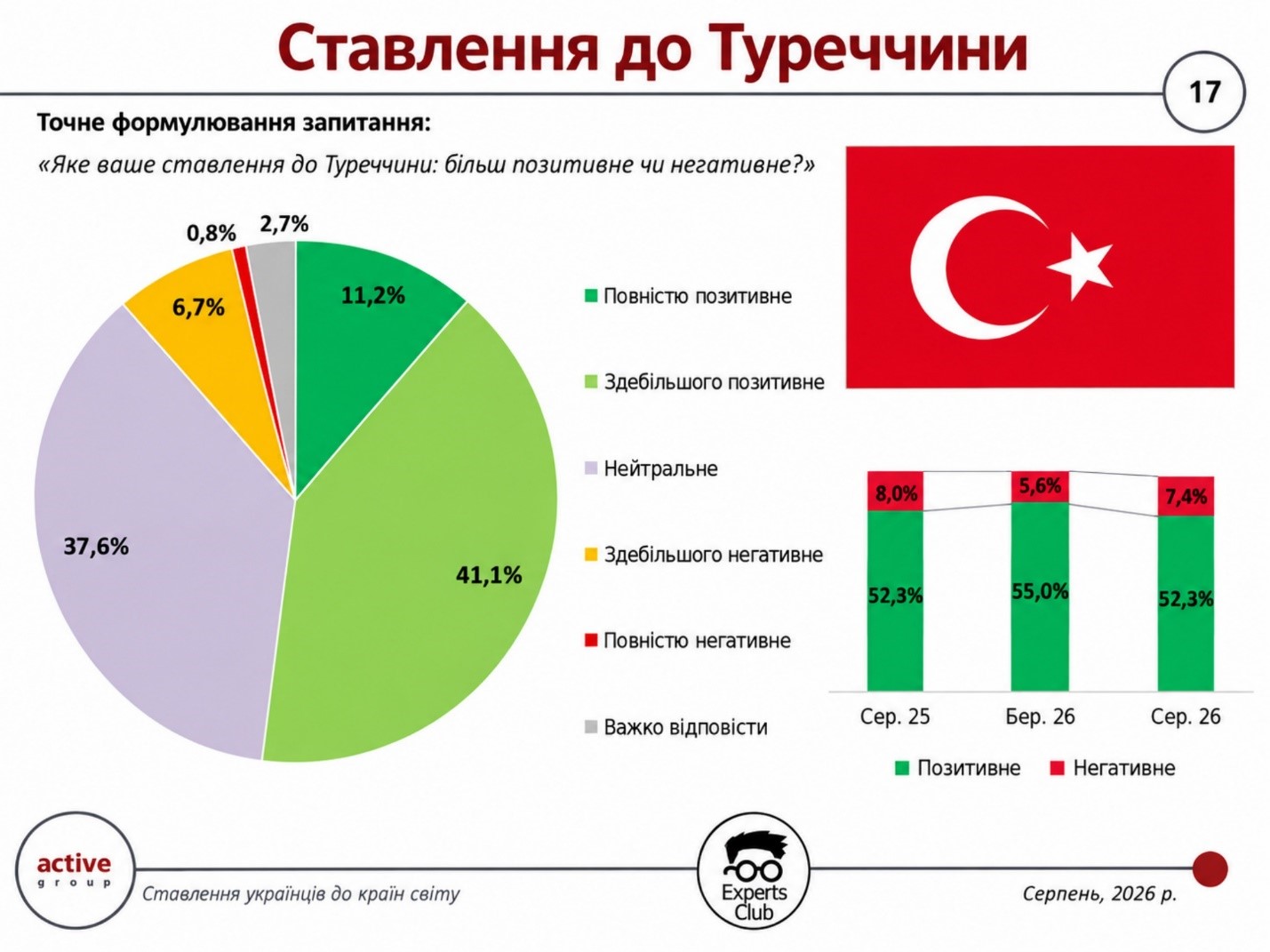
Thus, over the course of five months, the total share of positive assessments decreased by 2.7 percentage points—from 55% to 52.3%. Negative attitudes, on the other hand, increased by approximately 1.9 percentage points, while the share of neutral responses rose by 1.2 percentage points. The balance between positive and negative responses fell from 49.4 percentage points in March to about 44.9 percentage points in August. This indicates a moderate cooling of assessments rather than a fundamental shift in attitude.
Turkey remains one of Ukraine’s largest trading partners. In the first half of 2026, bilateral trade volume approached $4.9 billion: Ukrainian exports totaled about $1.78 billion, while imports amounted to $3.12 billion. Turkey was the second-largest single market for Ukrainian goods after Poland, and Ukraine’s bilateral trade deficit stood at about $1.34 billion.
Maksym Urakin, Ph.D. in Economics and founder of the Experts Club information and analytical center, commenting on the relationship between the economy and public perception of trading partners, noted:
“If society sees a massive flow of imports coming into the country but does not see a corresponding flow of investment, technology, or localized production, a sense of imbalance arises. And this directly affects the emotional perception of the partner. That is precisely why countries with a large trade surplus with Ukraine should pay particular attention to the reputational aspect of their presence in the Ukrainian market,” Urakin noted.
In the case of Turkey, the survey results show that a significant trade imbalance is currently combined with a predominantly positive public perception. At the same time, trends between March and August indicate a gradual decline in the predominance of positive assessments.
The survey, conducted in August 2026, used self-administered online questionnaires from the SunFlowerSociology panel among 800 Ukrainian citizens aged 18 and older. The sample is representative by age, gender, and region; the maximum theoretical margin of error is ±3.5 percentage points.
ACTIVE GROUP, EXPERTS CLUB, FOREIGN TRADE, international relations, PUBLIC OPINION, SOCIOLOGY, TURKEY, UKRAINE, URAKIN