Norway continues to enjoy one of the highest levels of positive perception among Ukrainians: in August 2026, 72% of respondents viewed the country positively, while only 2.7% viewed it negatively. Compared to March, the positive rating has declined slightly, but the overall pattern of assessments remains stable, according to the Experts Club Information and Analytical Center.
According to the results of the August survey, 35.8% of Ukrainians view Norway entirely positively, and 36.2% view it mostly positively. A neutral stance is held by 24.1% of respondents. 2.3% view the country mostly negatively, 0.4% view it entirely negatively, and another 1.2% were undecided.
The balance of positive and negative assessments stands at plus 69.3 percentage points. Thus, positive attitudes toward Norway outweigh negative ones by more than 26 times. According to the overall survey results, the country remains among the leaders in terms of public sentiment, alongside Canada, Sweden, the Netherlands, and Finland.
In March 2026, 72.7% of respondents had a positive attitude toward Norway. At that time, 37.1% of those surveyed described their attitude as entirely positive, and 35.7% as mostly positive. A neutral stance was held by 24.2%, a negative one by 1.9%, and another 1.2% were undecided.
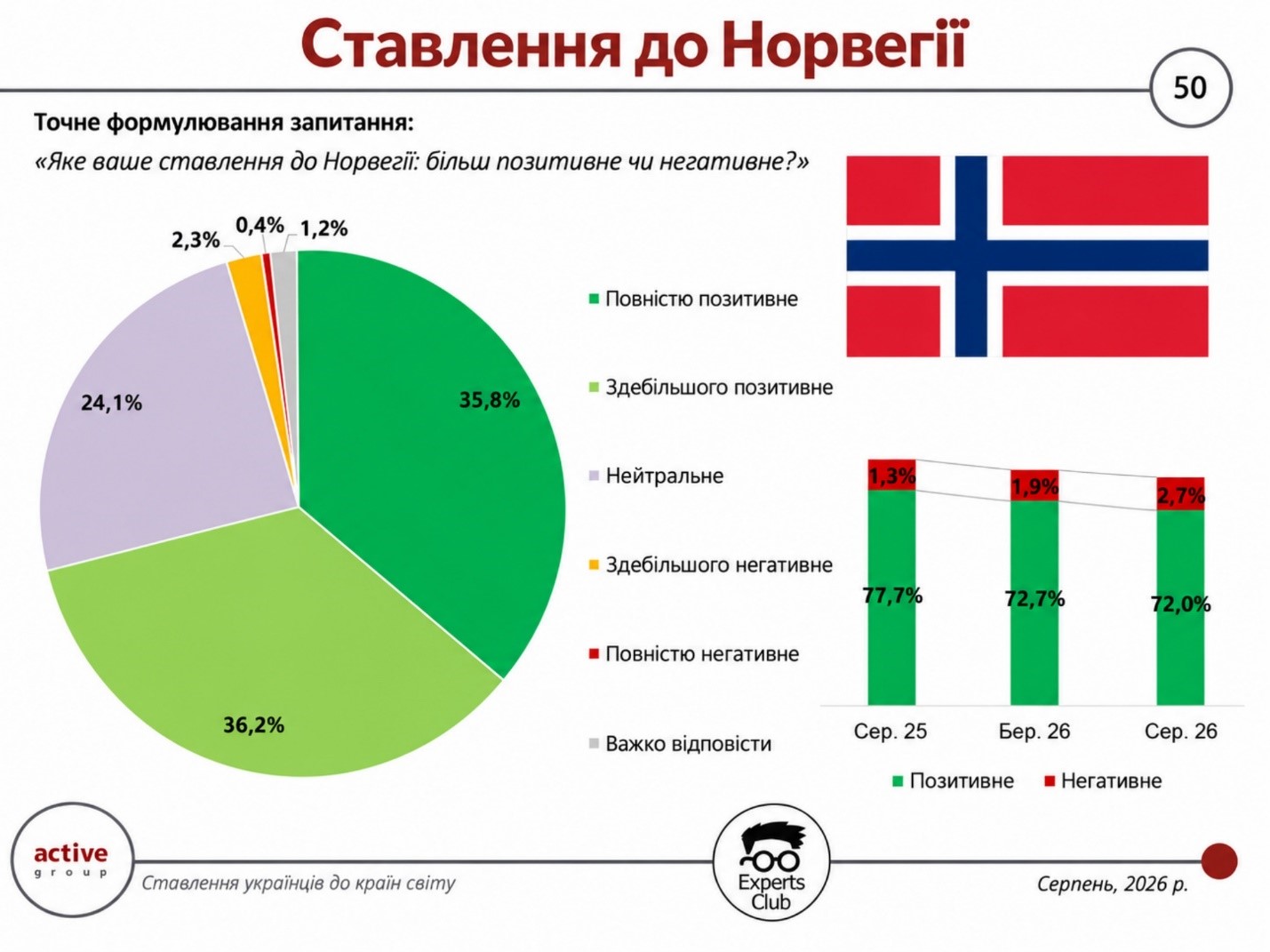
Thus, over the course of five months, the overall share of positive assessments decreased by only 0.7 percentage points—from 72.7% to 72%. The neutral segment remained virtually unchanged—24.2% in March versus 24.1% in August. At the same time, the share of negative responses increased by 0.8 percentage points—to 2.7%.
The balance between positive and negative attitudes decreased from approximately plus 70.8 to plus 69.3 percentage points. The changes remain insignificant and do not indicate a fundamental shift in attitudes toward the country: nearly three-quarters of Ukrainians continue to view Norway positively.
Oleksandr Pozniy, director of the research firm Active Group, commenting on the results of the previous wave, emphasized the stability of the established image of Norway.
“Ukrainians quite clearly differentiate between countries based on levels of trust and actual support. In the case of Norway, we see a consistently high level of positive sentiment, which is not shaped by current events but is based on a long-term perception of the country as a reliable partner. Even a slight decline in the figures does not change the overall picture—Norway remains one of the most positively viewed countries among all those surveyed,” Pozniy noted.
The results of the August wave effectively confirm this assessment. Despite a slight increase in the negative segment, it remains minimal, and the share of neutral responses has remained virtually unchanged. This distinguishes Norway from countries where public assessments have fluctuated significantly over the course of the year.
The previous survey wave was conducted in March 2026 among 800 Ukrainian citizens aged 18 and older using self-administered online questionnaires on the SunFlowerSociology panel. The sample was representative by age, gender, and region; the maximum theoretical margin of error for indicators at the 50% confidence level was ±3.5 percentage points.
ACTIVE GROUP, EXPERTS CLUB, international relations, NORTHERN EUROPE, NORWAY, Pozniy, PUBLIC OPINION, SOCIOLOGY, UKRAINE