Ukrainians’ attitudes toward Slovenia in August 2026 remain predominantly neutral, with a noticeable preponderance of positive assessments over negative ones. According to the Experts Club Information and Analytical Center, 40.3% of respondents view the country positively, 49.9% neutrally, and 6.7% negatively. The overall balance of positive and negative assessments stands at plus 33.6 percentage points.
According to the results of the August survey, 12.5% of Ukrainians view Slovenia entirely positively, while 27.8% view it mostly positively. 49.9% of respondents hold a neutral position. 6.1% view the country mostly negatively, only 0.6% view it entirely negatively, and another 3.1% were undecided.
Compared to March, the overall structure of public opinion has remained virtually unchanged. In the previous survey, 40.6% of respondents viewed Slovenia positively: 10.5% viewed it entirely positively and 30.1% viewed it mostly positively. At that time, 48% chose a neutral response, 7% a negative one, and another 4.4% were undecided.
Thus, over the course of five months, the positive segment decreased by only 0.3 percentage points—to 40.3%—while the negative segment also decreased by 0.3 percentage points—to 6.7%. The share of neutral responses increased by 1.9 percentage points, while the number of those who found it difficult to answer decreased by 1.3 percentage points. The balance of positive and negative assessments remained virtually unchanged and stood at approximately plus 33.6 percentage points in both survey waves.
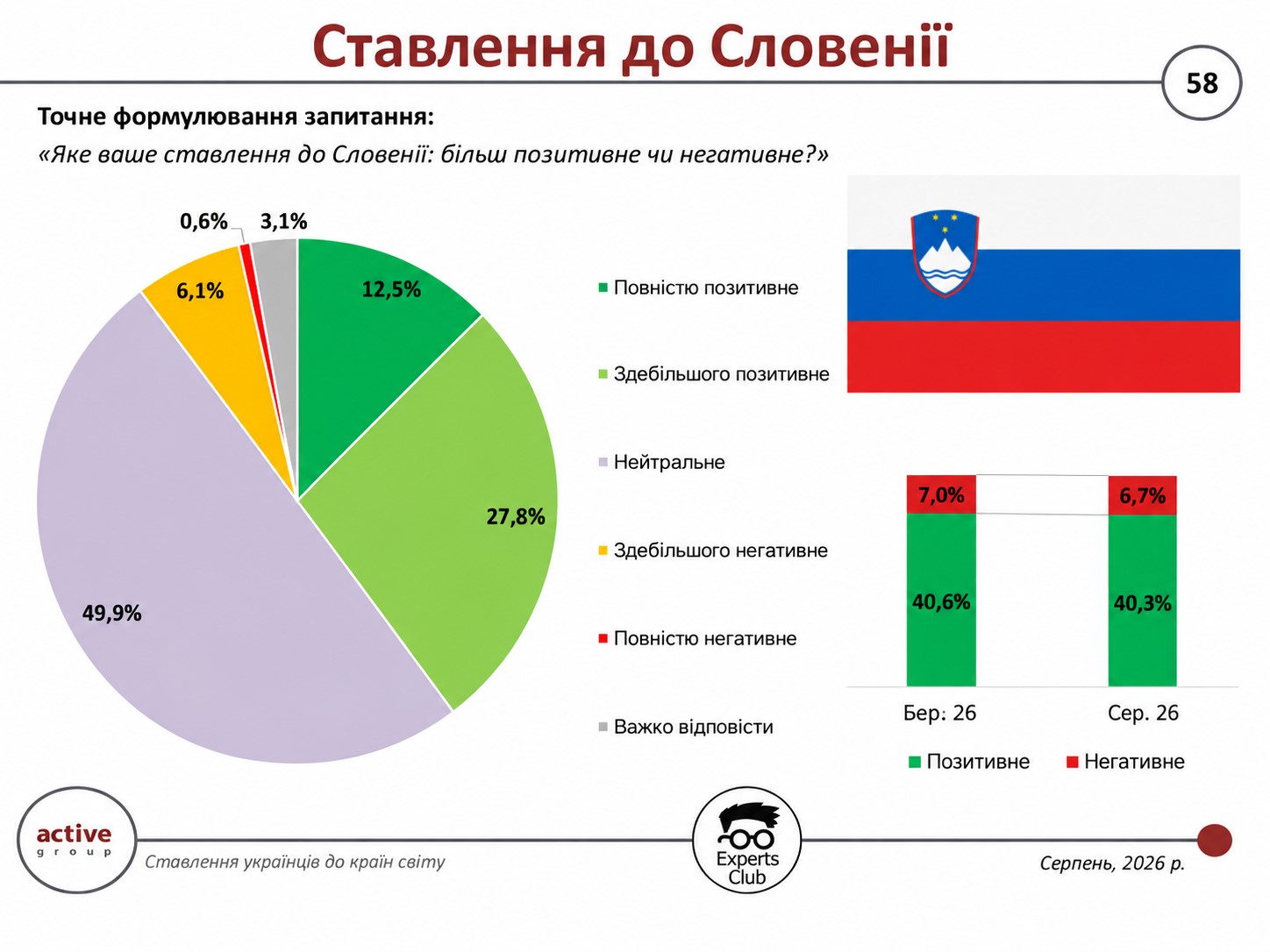
At the same time, there was a certain shift within the positive segment: the share of fully positive assessments rose from 10.5% to 12.5%, while the share of mostly positive assessments fell from 30.1% to 27.8%. Thus, the overall level of positive attitudes remained stable, but among respondents favorable toward Slovenia, the share of the most confident assessments increased slightly.
Maksym Urakin, founder of the Experts Club Information and Analytical Center, deputy director of the Interfax-Ukraine news agency, and candidate of economic sciences, believes that the results of sociological studies have practical significance for the development of international relations, particularly for the activities of diplomatic missions, business associations, and foreign companies.
Commenting on the results of a survey on Ukrainians’ attitudes toward Southern European countries, he emphasized the need for more active communication between international partners and Ukrainian society.
“The first recommendation is to regularly showcase concrete achievements and specific actions. The second is to be open to questions and inquiries from the media and the public,” Urakin noted.
In his view, sociological data can help diplomatic missions and businesses better understand public perceptions of the respective countries and build bilateral relations more effectively.
In the case of Slovenia, the survey results demonstrate significant potential for developing informational and economic communication. Nearly half of Ukrainians do not have a clearly defined positive or negative attitude toward the country, while the share of negative assessments remains relatively small.
This distribution may indicate that the further shaping of Slovenia’s image in Ukrainian society will depend, in particular, on providing information about its support for Ukraine, the development of trade and economic ties, humanitarian initiatives, and cooperation between businesses in the two countries.
At the same time, the stability of the positive balance over the past five months indicates that there have been no sharp changes in perceptions of Slovenia. Unlike countries toward which attitudes have fluctuated significantly, Slovenia maintains a predominantly neutral-to-positive image.
In a broader regional context, its indicators differ from those of Italy and Spain. According to the same August survey, 70.1% of Ukrainians view Italy positively, 65.2% view Spain positively, while 40.3% view Slovenia positively.
Thus, among the Southern European countries included in the survey, Slovenia has a lower level of positive ratings; however, the main difference stems from the high proportion of neutral responses rather than significant negative sentiment.
Key factors for the development of bilateral relations could include expanding the presence of Slovenian businesses in the Ukrainian market, investment cooperation, participation in Ukraine’s reconstruction projects, and an increase in the number of joint economic and cultural initiatives.
The March survey was conducted by Active Group using the SunFlower Sociology online panel among 800 Ukrainian citizens aged 18 and older. The sample was representative by age, gender, and region; the maximum theoretical margin of error for indicators at the 50% confidence level was ±3.5 percentage points.
The August survey also covered 800 adult Ukrainian citizens and constituted the third wave of the study, following those conducted in August 2025 and March 2026.
Sources: Experts Club and Active Group, survey dated September 18, 2026; Experts Club, commentary by Maksym Urakin on Southern European countries dated October 11, 2026.
ACTIVE GROUP, DIPLOMACY, EXPERTS CLUB, RESEARCH, SLOVENIA, SOCIOLOGY, UKRAINE, URAKIN