
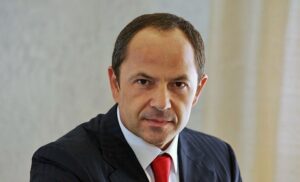
The TAS Group is considering investments in logistics and port infrastructure, but is taking a cautious approach to this sector for now, according to the group’s founder, Serhiy Tihipko.
He said he personally visited Chornomorsk to explore investment opportunities.
“I can say that I’m not particularly fond of this sector: in my view, it’s overvalued; everyone has gotten used to the abnormally high rates that were in place at the start of the war. That won’t happen again,” said Tigipko.
In his assessment, some assets in logistics and ports may be overvalued due to the high rates that emerged at the start of the full-scale war amid a capacity shortage and the restructuring of export routes.
At the same time, TAS’s interest in logistics seems logical given the group’s presence in the agricultural sector, industry, and other sectors where transportation, storage, export infrastructure, and access to ports are crucial.
Tigipko emphasized that the group is constantly analyzing new projects and waiting for suitable opportunities for deals.
“We’re sitting and waiting for a good, big catch,” he noted.

American researchers from New York University have concluded that the brains of bilinguals use a common neural system for grammatical transformations across different languages, rather than creating a separate set of rules for each language.
The study, titled “A Shared Neural Mechanism for Abstract Grammatical Computations Across Languages in Bilinguals,” was published in the journal JNeurosci.
The study involved highly proficient bilinguals who speak both Spanish and English. The researchers monitored brain activity using magnetoencephalography, which allows for the recording of neural activity with high temporal resolution.
Participants were asked to transform words into grammatically correct forms, such as converting nouns from singular to plural—for example, “boat” to “boats” in English or “barco” to “barcos” in Spanish.
The researchers found that such grammatical operations activate the left frontal-temporal network of the brain. At the same time, the neural patterns were common to both languages, despite differences in pronunciation, spelling, and grammatical forms of the words.
A key finding of the study is that the same mechanism also worked with pseudowords—artificially created words that the participants had never encountered before. This suggests that the brain can apply grammatical rules not only to familiar words but also to new linguistic units.
The study’s authors believe that the results support the hypothesis of a universal “grammatical engine” in the brain. In other words, the bilingual brain does not maintain completely separate grammatical systems for each language but instead uses a more universal mechanism for processing grammatical transformations.
This may have practical implications for language learning and teaching. If grammatical operations do indeed rely on a common neural mechanism, knowledge of one language may aid in learning another, especially if a person is already able to quickly apply abstract grammatical rules.
At the same time, the study does not imply that all languages are processed by the brain in the same way at all levels. Differences in vocabulary, pronunciation, writing, language proficiency, and age at which a language is learned remain important factors. The focus is specifically on the grammatical transformations of words, which, according to the authors, may be based on a common neural foundation.
This topic is also relevant for Ukraine due to widespread multilingualism, migration, children studying abroad, and the prevalence of Ukrainian-Russian, Ukrainian-Polish, Ukrainian-English, and other language combinations.
New data show that bilingualism should be viewed not as a burden on the brain, but as a complex and flexible system in which different languages can share cognitive resources.
The study was supported by grants from the U.S. National Science Foundation and the U.S. National Institutes of Health.

On June 17, the European Bank for Reconstruction and Development (EBRD) approved a decision to provide a long-term loan of up to EUR50 million to Volyn West Wind-2 LLC and Volyn West Wind-3 LLC, both majority-owned by VI.AN Holding, a member of the OKKO Group, to finance the construction and operation of a 189 MW wind farm in Ukraine.
According to the bank’s materials, the EBRD loan will be part of the project’s secured debt financing, with participation from the International Finance Corporation (IFC) and the Black Sea Trade and Development Bank (BSTDB).
The project will also receive guarantee support and grant funds for technical assistance from the European Union under the Ukraine Investment Framework through the HI-BAR program, which reduces risks for investors and helps attract funding to renewable energy and climate technology projects.
Against the backdrop of significant losses in power generation capacity due to the war, this investment is expected to help reduce the electricity shortage, support decarbonization, and strengthen the private sector’s role in the development of renewable energy.
According to the bank’s estimates, the new wind farm will generate approximately 467 GWh of electricity annually and reduce CO2 emissions by about 300,000 metric tons per year. The total cost of the project is estimated at EUR262 million.
OKKO Group brings together more than 10 diverse businesses in the fields of manufacturing, trade, construction, insurance, services, and other sectors. The group’s flagship company is the “Galnaftogaz” concern, which operates one of Ukraine’s largest gas station networks under the “OKKO” brand, comprising approximately 400 gas stations.
The founder and ultimate beneficiary of the group is Vitaliy Antonov.
As previously reported, in April 2025, the EBRD, IFC, and the Black Sea Trade and Development Bank (BSTDB) announced a EUR157 million loan to the “Galnaftogaz” Group for a 147 MW wind farm in the Volyn region.

The TAS Group plans to invest $250–300 million in the authorized capital of banks, insurance companies, and other assets it holds in the financial sector, It also aims to expand its land bank and strengthen its grain storage operations in the agricultural sector, is actively investing in real estate development, and is exploring opportunities in logistics and port infrastructure, according to the group’s founder and head, Serhiy Tihipko.
“We are currently the largest private owner in the Ukrainian financial sector. And we are accelerating our pace here. Therefore, whether we want to or not, we will have to invest in authorized capital. “I think we’ll invest somewhere between $250 million and $300 million just to increase authorized capital,” said Tigipko at the Concorde Capital investment conference, which the investment firm held for the first time since 2019 last week in Kyiv.
“As for everything else, we’ll explore options. We’re interested in agriculture. We’d be happy to buy 20–25 thousand hectares right now. We’re expanding our grain storage facilities,” the founder added.
He noted that the group has now begun actively investing in real estate development.
“We’ve started a 220,000-square-meter project in Obolon. We’ve purchased an additional 5 hectares for the same project. In 2027, we’ll start a 350,000 (square meters) project on the Left Bank. These are fairly large investments,” the businessman clarified.
According to him, the group is also looking into logistics and port infrastructure, and Tigipko himself has personally visited Chornomorsk.
“I can say that I don’t really like the sector: in my opinion, it’s overvalued; everyone has gotten used to some kind of abnormal rate that existed at the start of the war. That won’t happen again,” the group’s owner noted.
He emphasized that the group constantly analyzes projects “every year, every day.”
“We’re sitting and waiting for a good, juicy deal to come along. We wanted to buy an insurance company (MetLife), but the Poles (PZU) beat us to it. That’s okay, we’ll wait. I told (Richard) Branson that deals are like a rail bus: one leaves, another will arrive. We’ll wait for the next one,” said Tihipko.
The TAS Group is one of the largest financial and industrial groups in Ukraine, operating in the banking sector, insurance, railcar manufacturing, metallurgy, logistics, the agricultural sector, the food industry, the production of packaging materials, and real estate. Among others, it includes TAScombank, Universal Bank (mono), and Idea Bank.
Oleg Zapletnyuk, CEO of the agricultural holding “TAS Agro,” reported earlier this year that the strategic plan calls for expanding the land bank from the current 80,000 hectares to 100,000 hectares by the end of 2026. “The next step is to increase it to 120,000 hectares, but that will be by 2028,” he said.
agricultural sector, DEVELOPMENT, financial sector, TAS, TIGIPKO

Ukrainian libraries are experiencing a systemic crisis that encompasses four dimensions: salaries at subsistence levels, a rapidly aging workforce, chronic underfunding of collections and facilities, and an outdated evaluation system, according to the analytical report “The Systemic Crisis in the Ukrainian Library Sector and Ways to Overcome It” by the Network for the Protection of National Interests “ANTS.”
“Ukraine’s libraries are now on the brink of survival. Librarians’ salaries in 2026 range from 5,691 to 7,356 UAH; young people are hardly entering the profession, and nearly half of the staff are already in the 45–60 age group. If the situation does not change, many libraries risk being left without the staff needed to keep them running. But the problem goes far beyond low salaries. It concerns the loss of institutions that preserve our memory, support education, digital literacy, and community resilience,” the ANTS statement reads.
According to the analytical report, Ukrainian libraries are experiencing a systemic crisis that encompasses four dimensions: salaries at the subsistence level (in 2026, salaries range from 5,691 UAH to 7,356 UAH); the rapid aging of the workforce (as of the end of 2025, approximately 46.7% of library staff were in the 45–60 age group, while young people accounted for 9.3%); chronic underfunding of collections and facilities; and an outdated evaluation system that fails to recognize libraries’ real contribution to societal development.
The report also proposes a three-stage action plan, the first stage of which calls for reviewing librarians’ salary scales, conducting an audit of the staffing situation, and identifying a list of frontline libraries for priority support within the first 6 months.
In the second phase—from 6 to 18 months—the plan is to launch pilot projects for new funding models that grant institutions greater autonomy, update collections and equipment, and shift to evaluating libraries based on indicators of social and educational impact—rather than solely on the number of visits and books checked out.
In the final stage, over a 3-year horizon, the proposal is to scale up successful models and integrate libraries into broader programs for reading, digital literacy, and adult education.
“Raising salaries is a necessary first step, but it is not enough. Without institutional reform, greater financial autonomy for libraries, and new performance criteria, the system will remain stagnant. Ukraine can develop a modern library network. Implementing this strategy will transform libraries from loss-making budgetary institutions into an effective public service and infrastructure for the development of the entire country,” the ANTS emphasized.
As previously reported, in late May, Deputy Prime Minister for Humanitarian Policy and Minister of Culture of Ukraine Tetiana Berezhna stated that the replenishment of library collections through co-financing with local communities could begin on July 1.
On June 22, Deputy Minister of Culture of Ukraine Bohdana Laiuk stated that she does not like the idea of transforming libraries into cultural hubs or cultural centers, and that she is also opposed to simply talking about closing libraries. At the same time, the deputy minister noted that there is currently no final decision on what the model for co-financing the replenishment of library collections with local communities will look like.
According to a study by the Ukrainian Book Institute (UBI), only 47% of local communities purchased books to replenish the collections of public libraries in 2025.
In April, a petition on the Cabinet of Ministers’ website calling for a review of librarians’ salaries did not receive the number of votes required for consideration.

Ukrainian IT has long since ceased to be a local phenomenon. Our developers, QA specialists, DevOps engineers, designers, analysts, and managers work with clients from the U.S., the U.K., Europe, and Scandinavia. We know how to build complex systems, handle heavy workloads, understand architecture, meet deadlines, and find solutions where others see only a red error log.
But in the Western market, strong code alone is no longer enough.
A client isn’t just buying development hours. They’re buying peace of mind. It’s important for them to understand that the team isn’t just “doing something in Jira,” but truly understands the business problem, can explain the risks, propose a better solution, and say in a timely manner: “This is where we might lose time, money, or quality.”
And this is exactly where English ceases to be just an “additional skill.” It becomes part of a specialist’s professional standing.
For a long time, there was a convenient notion in IT: it’s enough for a developer to be able to read documentation. After all, you can open Stack Overflow, read GitHub, and technical articles are somehow understandable. So, everything’s fine.
In reality, that’s just the tip of the iceberg.
Modern development has long since ceased to resemble sitting alone in a dark room with coffee, code, and heroic silence. It’s constant communication: daily stand-ups, planning, code reviews, demos, discussing requirements, clarifying details, calls with clients, troubleshooting issues, and defending technical decisions.
You can read English perfectly well and still get lost when you need to quickly explain why a task will take a week instead of two days. You can understand the documentation but remain silent during a meeting when a client asks, “What are the risks here?”
And in business, silence is rarely interpreted as modesty. More often than not, it comes across as a lack of confidence, a lack of initiative, or a failure to understand the situation.
The good news: No one expects you to speak with a BBC news anchor’s accent. Western teams have long been accustomed to different accents, varying speaking speeds, and imperfect grammar. In the international IT world, something else is more important: whether your point is understood.
Professional English for IT isn’t needed just to talk elegantly about the weather. It’s needed to:
● explain a technical solution without a ten-minute chaotic introduction;
● clarify requirements before the team rushes off to do the wrong thing;
● calmly mention a blocker;
● reasonably request more time;
● give a demo;
● write a clear comment in Jira;
● provide feedback during a code review in a way that sounds professional, not like an attack.
And this is where the difference between “I know a little English” and “I can work in English” becomes very apparent.
At the start of a career, technical skills can carry a specialist forward almost on their own. Junior and Middle-level engineers often advance thanks to their code, learning speed, and attention to detail.
But then a different game begins.
To advance to the level of Senior, Tech Lead, Solution Architect, or Engineering Manager, it’s no longer enough to simply perform tasks well. You need to explain solutions, lead discussions, work with stakeholders, understand the business context, and take responsibility for communication.
And this is where English often becomes an invisible ceiling.
A person may be technically very strong, but if they can’t confidently present their idea to a client, they’re less likely to be included in strategic calls. If they can’t explain an architectural solution, someone else will do it. If they remain silent in meetings, their expertise stays within the team rather than being visible to the client.
As a result, their career seems to be moving forward, but at a slower pace. Not because they lack intelligence, but because they lack a voice.
For an IT company, the team’s level of English directly impacts client trust—especially if the company wants to work with the Western market not as “cheap labor,” but as a technology partner.
When only the PM or Business Analyst speaks English confidently, a “broken telephone” effect occurs. The client explains the task to the manager, the manager relays it to the developer, the developer clarifies something through the manager, the client responds, and the response passes through several filters again. Nuances are lost at every stage.
And nuances in IT often come at a high cost.
Western clients want to work with teams where an engineer can ask questions, explain risks, and suggest alternatives on their own. This creates a sense of partnership. The client sees not just contractors, but people who think alongside them.
This is exactly what builds trust. And trust leads to longer contracts, more complex tasks, and higher pay.
When an IT professional decides to improve their language skills, the first obvious option is to take a regular English course. And that’s better than nothing. But there’s a problem.
In General English, you can discuss travel, food, hobbies, movies, the environment, or a hypothetical vacation by the sea. This is useful for building a general foundation, but it doesn’t always translate to the workplace.
In the real world of IT, you need to talk about entirely different things.
How do you explain that a task is blocked because it depends on another team? How do you tell a client that their idea is technically feasible but very expensive to maintain? How do you run a demo without panicking? How do you politely disagree with a decision? How do you describe a bug so that it’s understood without needing three follow-up messages?
That’s exactly why English for IT should be built around real-world scenarios: daily stand-ups, Jira, Git, code reviews, demos, technical interviews, email correspondence, calls with clients, and discussions about deadlines, risks, and priorities.
Here, you learn the language not “in general,” but for specific professional tasks.
You can get started without a grand plan to start a new life on Monday.
Translate your work interfaces into English: your IDE, task tracker, phone, and the services you use every day. Write commit messages in English. Formulate tasks in English, even if your team is Ukrainian.
Watch technical talks in their original language. After a stand-up meeting, try to briefly summarize what was discussed in English.
And most importantly: practice not just your knowledge, but your ability to respond in the language. Because during a call, you won’t have time to recall all the grammar from a textbook. You’ll need to think, listen, respond, and stay on track with the conversation.
English in IT today isn’t just a resume booster or a “nice-to-have.” It’s a working tool that influences a specialist’s career, client trust, and a company’s opportunities in the Western market.
Your code shows what you can do.
English shows that you can be entrusted with more.
And it is precisely this difference that often separates a merely good performer from a specialist who is invited to join more complex projects, take on more senior roles, and participate in discussions where real decisions are made.



