

Ukrainian clinics have signed more than 100 memorandums of understanding as part of the international medical partnership program launched under the patronage of Ukraine’s First Lady Olena Zelenska.
According to the Ministry of Health, 26 of these memorandums were signed with medical institutions in France and are being implemented with the support of Expertise France, the French interministerial agency for international cooperation and development.
For example, as part of the partnership, the Chernihiv Regional Children’s Hospital is collaborating with the University Hospital of Lille, and the Chernihiv Regional Psychoneurological Hospital is collaborating with the University Hospital of Nîmes.
The Ministry of Health notes that in June 2024, the governments of Ukraine and France signed an intergovernmental grant agreement totaling 200 million euros, part of which is allocated to the healthcare sector and critical infrastructure: seven agreements in the healthcare sector have been signed, totaling 51 million euros. In addition, in 2024, the Verkhovna Rada of Ukraine ratified framework agreements between Ukraine and France on cooperation in the reconstruction and modernization of hospitals and in oncology diagnostics.
FRANCE, international partnership, MEDICINE, Ministry of Health

According to the Interfax-Ukraine Culture project, the winners of the fifth “Mykolaychuk OPEN” audience film festival, which took place from June 13 to 20, were announced in Chernivtsi.
This was reported by the State Agency of Ukraine for Cinema, citing its Facebook page.
As part of the festival, the jury selected the winners of three competition programs: the national short film competition, the international feature film competition, and the music video competition.
The winner of the national short film competition was the film “Natural Balance” by director Oleksandr Myronyuk. The film “The Inaccessibles” by Kirill Zemlyanoy received a Special Jury Mention; the Jury Prize went to “A Brief Guide to Breaking Up” by Varvara Zaritskaya; and the AMO Pictures Special Mention was awarded to “Tell Me a Fairy Tale” by Diana Anikeeva.
In the international feature-length competition, the top prize went to the film “About People and Meat” by director Jan Jong-hyun. The same film also received the Jury Prize. The jury’s special mention was awarded to the film “Queen at Sea” by director Lance Hammer, while the special prize for second place went to “Rock, Grass, and Cars” by director H. M. Kravioto.
In the music video competition, the Audience Choice Award went to “Limb” by the band Small Depo and the Third Assault Brigade, directed by Sofiko. The jury selected “Mad Dog” by the band Oi FUSK, directed by Illia Dutsyk, as the winner.
The Mykolaychuk OPEN Festival is an international audience-driven film festival held annually in Chernivtsi in honor of Ukrainian actor, director, and screenwriter Ivan Mykolaychuk.
https://interfax.com.ua/news/culture/1178492.html
The cow herd in Ukraine will continue to shrink and, as of January 1, 2028, could fall to 917,000 head, compared to an estimated 1.055 million head at the beginning of 2026, while milk production, after many years of decline, will stabilize at around 6.7 million metric tons per year, according to the study “The Dairy Industry of Ukraine in the Context of European Integration.”
Vadym Chagarovsky, Chairman of the Ukrainian Dairy Enterprises Association, noted during the study’s presentation at Agro Ukraine Week 2026 that despite the steady decline in the cow herd in Ukraine, productivity is rising and the volume of milk sent for processing is increasing.
According to the study, the total dairy cow herd across all farm categories decreased from 2.018 million head in 2018 to 1.055 million head in 2026, a decline of 48%.
The largest decline is occurring on private farms, where the herd size decreased by 55% between 2018 and 2026—to 660 thousand head—and may fall to 500 thousand head by 2028.
At the same time, following a prolonged decline, the herd size at agricultural enterprises is projected to grow from 395 thousand head in 2026 to 417 thousand head in 2028.
Milk production in Ukraine has also declined in recent years—from 10.2 million metric tons in 2017 to 6.9 million metric tons in 2025, or by 33%.
At the same time, the study’s authors predict that the long-standing decline in milk production will come to an end and that production will stabilize at 6.7 million metric tons in 2026–2027.
Milk production at agricultural enterprises will continue to grow—from 3.4 million metric tons in 2026 to 3.7 million metric tons in 2027—while production on private farms will decrease from 3.3 million metric tons to 3 million metric tons, respectively. The share of industrial milk production is forecast to increase from 46% in 2025 to 55% in 2027.
Chagarovsky also emphasized that the Ukrainian dairy industry retains its potential for growth thanks to industrial production and the modernization of enterprises.
According to the study, Ukraine’s dairy industry currently produces 6.9 million metric tons of milk per year, accounts for about 0.25% of GDP, and generates 124 billion hryvnia in output. Ukraine’s share of global milk production stands at 0.7%.
To transition to an industrial model of sector development and increase production to 10 million metric tons of milk per year, investments totaling EUR9 billion are needed to establish a raw material base. Specifically, this includes increasing the herd by 750,000 cows and constructing approximately 700 industrial dairy farms. According to the study’s authors, an additional EUR6 billion needs to be allocated to modernizing and expanding processing capacities.
The study “Ukraine’s Dairy Industry in the Context of European Integration” was prepared by the Ukrainian Dairy Industry Association.
Cow, dairy industry, EUROPEAN INTEGRATION, INVESTMENTS, MILK, PRODUCTION

The Ministry of Community and Territorial Development of Ukraine has published a draft order that provides for a 30% increase in rail freight rates effective August 1, 2026, and the standardization of rates for the transportation of empty railcars.
According to the explanatory note accompanying the document, the need to revise the rates stems from the deteriorating financial condition of JSC “Ukrzaliznytsia,” whose revenues are insufficient to cover current expenses. The ministry noted that the last tariff revision took place nearly four years ago, while between July 2022 and April 2026, the industrial producer price index rose by 252.1%.
According to the Ministry of Development, in 2025, freight volumes decreased by 12.5% compared to the previous year, and Ukrzaliznytsia’s net loss amounted to 7.6 billion UAH. In the first four months of 2026, the loss reached 9.3 billion UAH.
The ministry noted that without tariff indexation, the company’s projected net loss for 2026 will exceed 13 billion hryvnias, and the funding shortfall will reach over 26 billion hryvnias.
The draft order also provides for the completion of the unification of tariffs for the transportation of empty railcars. For railcars used for unloading cargo in tariff classes 1 and 2, tariffs will increase by approximately 60%, while for railcars used for cargo in tariff class 3, they will remain unchanged.
The Ministry of Development expects that the proposed changes will allow Ukrzaliznytsia to partially cover its funding shortfall in 2026 and secure additional financial resources amounting to approximately 8.6 billion UAH.
Turkey’s residential real estate market continues to show nominal price growth, but taking inflation into account, housing is in fact continuing to become cheaper, according to market data.
According to analysts, the average price per square meter of housing across the country has reached 40.486 thousand Turkish lira, or about $872. The average cost of a residential real estate property is estimated at approximately 5.02 million lira, or about $108.1 thousand.
In nominal terms, housing prices increased by 23.8% year-on-year. However, after adjustment for inflation, the real dynamics moved into negative territory and amounted to about 6.5%.
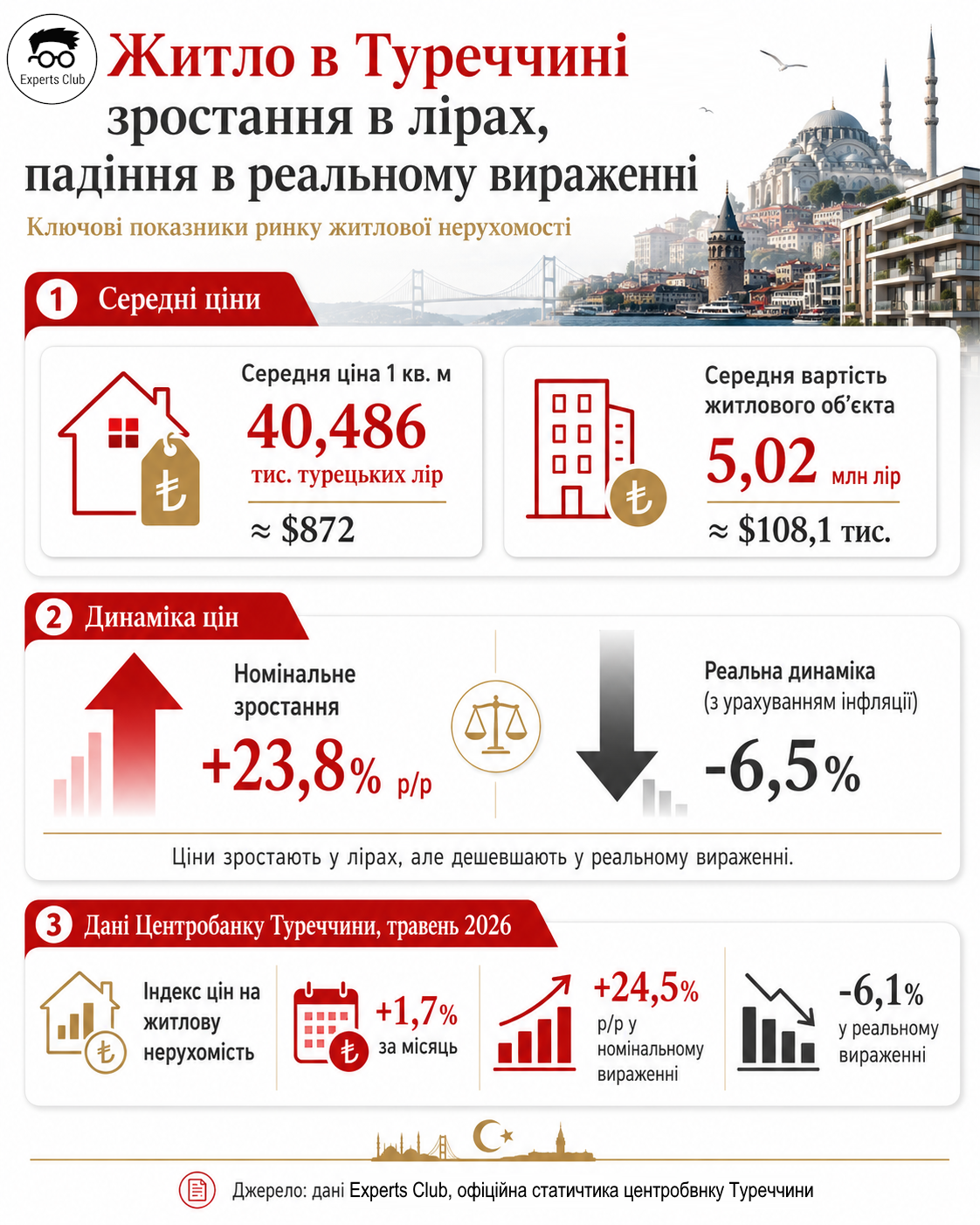
Official statistics from the Central Bank of Turkey confirm this trend. In May 2026, the residential real estate price index increased by 1.7% month-on-month and by 24.5% year-on-year in nominal terms, but declined by 6.1% in real terms.
This means that, for buyers and investors, price growth in lira is not the same as growth in the value of the asset. Against the background of high inflation, real estate may look more expensive in the national currency, but lose purchasing value in real terms.
The average payback period for housing through rental income in Turkey is currently estimated at approximately 13 years. However, the situation differs significantly by region. In large cities and resort locations, housing prices have often grown faster than rental rates, so the yield of such properties is becoming lower.
This gap is especially noticeable in popular tourist regions, including Muğla and parts of the coast, where the cost of land and housing remains high, while rent does not always keep pace with sale prices. In such locations, buying real estate increasingly requires not only calculating potential income, but also assessing the liquidity of the property, maintenance costs and currency risks.
For foreign buyers, the situation has become less clear-cut. After the boom of 2021-2023, the Turkish market no longer looks like a market of guaranteed rapid growth. High interest rates, inflation, the weakening of the lira, changes in residence permit rules and cooling demand from foreigners are making investment decisions more complex.
At the same time, Turkey remains one of the largest real estate markets in the region. Demand is supported by domestic buyers, tenants in large cities, tourist regions, as well as interest in housing as a way to protect savings from inflation. However, the market is becoming more selective: liquidity is being maintained primarily by quality properties in strong locations.
For investors, the main conclusion is that Turkish real estate can no longer be assessed only by nominal growth in lira. It is more important to look at dynamics in foreign currency, real yield adjusted for inflation, maintenance costs, rental demand and resale prospects.
The existence of two value-added tax (VAT) exemption thresholds within a single VAT system is an anomaly that must be eliminated, but this decision will have to be made immediately after martial law ends, according to Danylo Getmantsev, head of the parliamentary committee on finance, tax, and customs policy.
“I promised the people that I would not change the single tax system until the end of the war. And I am keeping that promise. As you can see, the law has not been adopted. You have not heard me support it in the version proposed by the Ministry of Finance,” he said in an interview with the “Interfax-Ukraine” news agency.
According to the committee chair, the next session of the Verkhovna Rada will decide on a single tax limit, and for them, there will be no alternative.
Getmantsev emphasized that, overall, Ukraine needs to implement a reform of personal income taxation, part of which is the reform of the single tax, and noted that this is provided for in the National Revenue Strategy for 2024–2030.
“We must implement the Polish flat-rate tax model: cash registers from the start, turnover limits of up to EUR2 million, and a single VAT threshold for both sole proprietors and others. The specific amount can be discussed, but it must be uniform. And within the framework of the flat-rate tax, there should be different rates for different types of activities,” the committee chair noted.
In Poland, the VAT exemption threshold was raised this year from 200,000 to 240,000 zlotys, which is approximately EUR56,600, or nearly 3 million hryvnias.
According to Getmantsev, the rate is 3% for retail trade and 10% or higher for services.
“We simply need to follow Poland’s example and make such a serious, correct decision once and for all. But that will have to wait until after the war,” he added.
The committee chair also believes that all these changes must be implemented at once, rather than gradually “chipping away at the problem piece by piece,” because that is an entirely unproductive approach.
“I cannot support any half-measures, because in reality they generate just as much negativity and backlash as major decisions and reforms, but with far less impact. Therefore, after the war, there must be a major reform of personal income taxation, including the flat tax. Incidentally, a progressive tax scale is also provided for there. This is the right decision, and I strongly support it,” Getmantsev noted.
At the same time, he supported the adoption this year of a law to simplify VAT administration, the text of which is currently expected from the Ministry of Finance.
“I believe that until the threshold for sole proprietors is reached—for example, EUR2 million based on the Polish model—tax invoices should not be blocked at all, even if VAT is paid. In other words, the rules for blocking tax invoices should not apply to sole proprietors until they reach the single tax threshold. And there are many other measures that simplify administration,” said the head of the relevant parliamentary committee, among other things.
As previously reported, the adoption by the end of March of this year of a law abolishing the VAT exemption under the simplified tax system was a condition of the new program with the International Monetary Fund (IMF), launched at the end of February of this year. It was later reported that the deadline for fulfilling this requirement had been postponed by approximately one year.
In addition, at the end of May, the Verkhovna Rada ratified the terms for providing Ukraine with macro-financial assistance as part of a loan from the European Union to support Ukraine. Under these terms, a bill containing measures to reform the preferential tax regime must be submitted to parliament by the end of the year, which will generate additional revenue of at least 70 billion hryvnia per year.
Getmantsev, TAX, WAR



