

Insurance group “TAS” (Kiev) for January-March 2024 paid out under the concluded insurance contracts indemnities in the amount of UAH 465,89 mln, which is 50,8% more than in the same period of the previous year.
According to the insurer’s website, more than a quarter of its payments (27,54% or UAH 128,31 mln) following the results of the first quarter fell on CASCO, which is 33% higher than the corresponding indicator for the same period of the last year, 35,46% or UAH 165,21 mln – on MTPL insurance (+ 40,1%), 18,91% or UAH 88,12 mln – on voluntary medical insurance (+62,6%)
At the same time, the company has paid UAH 2,8 mln of indemnities under property insurance contracts during the reporting period – by 38,3% more than in the first three months of the last year.
The volume of payments under other insurance contracts amounted to UAH 10.92 mln, which is 30.9% higher than in the same period of 2023.
SG “TAS” was registered in 1998. It is a universal company offering its clients more than 80 types of insurance products on various types of voluntary and compulsory insurance. It has an extensive regional network: 28 regional directorates and branches and 450 sales offices throughout Ukraine.

According to the Unified State Register (USR), there are 1,286 addresses for mass registration of companies in Ukraine. Most of them are located in Kyiv, Kharkiv and Odesa regions. The largest number of businesses at one address is recorded in the capital – more than 2 thousand companies.
More than 140 thousand companies are registered at mass registration addresses in Ukraine. These addresses are used by Opendatabot to identify locations where more than 50 different businesses are registered. Checking the address for mass registration will help to avoid fraud and potentially unreliable businessmen.
Follow the information on the page of the Register of places of mass registration of legal entities

The largest number of companies registered at such addresses was recorded in Kyiv – more than 101 thousand, or 71.8% of the total. Kharkiv and Odesa regions are also in the top three, with more than 8 thousand (6.3%) and 5 thousand (4.1%) respectively.
The same regions are also leading in terms of the number of addresses. In Kyiv, companies are massively registered at 815 addresses (63.4%), in Kharkiv and Odesa regions – 105 (8.2%) and 65 (5.1%) respectively.
Most companies are registered at one location in the capital: 12 Melnykova Street. This is the legal address of 2,363 companies, including 1,978 active and 385 inactive.

The registration of a company’s location at the addresses of mass registration can be attributed to its negative characteristics when planning cooperation with such a company, says insolvency receiver Denys Lykhopiok.
“In my practice, I have encountered a frequent phenomenon that the location of a bankrupt company is the place of mass registration.
In particular, such re-registration is most often initiated by managers and business owners who are trying to avoid financial liability on the eve of bankruptcy proceedings. Sometimes, such developments can be planned even from the very beginning of the company’s activities,” comments Denys Lykhopiok, attorney at law, insolvency receiver, member of the Qualification Commission of Insolvency Receivers, bankruptcy specialist.
The international rating agency S&P Global Ratings has upgraded Turkey’s long-term foreign and local currency ratings to “B+” from “B”.
The ratings outlook is “positive,” according to a press release from S&P.
“We expect that following the municipal elections held in the country, the Turkish authorities will continue to fight inflation aggressively through tightening monetary policy and gradual fiscal consolidation,” the agency’s experts say.
S&P predicts a decline in Turkey’s current account deficit over the next two years, along with weakening inflation and slowing dollarization of the economy. At the same time, the agency’s analysts believe that the country’s inflation rate will remain double-digit until early 2028.
The Central Bank of Turkey is likely to keep the key interest rate at the current level of 50% until the end of 2024, according to S&P.
“We could upgrade Turkey’s rating again if the country’s balance of payments continues to improve, inflation slows, and domestic savings in Turkish lira increase, allowing the country to rebuild its foreign exchange reserves,” the agency said in a press release.
S&P may change the outlook on Turkey’s ratings to stable if pressure on the country’s financial stability or state budget increases, for example, if the lira’s depreciation fails to stop, or if the authorities abandon inflation control measures.
Earlier, Experts Club and Maksim Urakin released a detailed video analysis of how economic and political life is developing in Turkey, more detailed video analysis is available here – https://youtu.be/SUqOMFI5HbI?si=uEIZZOORj65VElUQ
You can subscribe to the Experts Club YouTube channel here – https://www.youtube.com/@ExpertsClub
The National Bank of Ukraine (NBU), taking into account Russia’s recent terrorist attacks on energy infrastructure, has included in its macroeconomic forecast an average electricity deficit of about 5% in 2024-2025, while estimating electricity imports at $0.8 billion in 2024 and $0.6 billion in 2025.
“If there are no new significant destructions, the NBU estimates that the electricity deficit, even taking into account imports and partial restoration/installation of new generating capacities, will be 5-7% on average in the second to fourth quarters of 2024,” the NBU said in its April inflation report, which was recently released.
This means restrictions on consumption for both households and industry. Due to uneven consumption throughout the day during peak hours, the deficit may reach 25-30% and be higher in energy-deficient regions, the National Bank explained.
“The deficit will persist in 2025 (an average of 7% in the first quarter and 3% by the end of the year),” its experts believe.
According to the report, a significant electricity deficit is likely to occur in the second quarter of 2024 due to a decrease in floods and the need to repair nuclear power units. In the future, the electricity deficit may increase with increased consumption in the summer and during the heating season.
The NBU reminded that the integration of Ukraine’s power system with the European one allows for the import of 1.7 GW of capacity (as authorized by ENTSO-E), which is used to compensate for temporary shortages of generating capacity during peak consumption hours and to balance the power system. However, due to significant fluctuations in consumption, in particular in neighboring countries, the import capacity is likely to be less than the maximum volume. In addition, import coverage is limited due to imbalances in the grid, including low transmission capacity in some regions due to significant damage.
It is pointed out that the risk of increased Russian attacks on energy infrastructure remains high for both production and distribution capacities. In the event of further damage, GDP growth will be lower than in the baseline scenario (3% in 2024 and 5.3% in 2025), and price increases will be higher due to higher costs resulting from the use of more expensive energy sources.
“However, the level of readiness of businesses and households for potential electricity outages is higher than in 2022-2023, which will limit the negative impact of the electricity shortage on the economy,” the NBU said.
Oil prices are rising on Monday after the biggest drop since February in the previous week.
The cost of July futures for Brent on the London ICE Futures exchange as of 8:10 a.m. is $83.25 per barrel, which is $0.29 (0.35%) higher than at the close of the previous trading. On Friday, these contracts fell by $0.71 (0.9%) to $82.96 per barrel.
June futures for WTI in electronic trading on the New York Mercantile Exchange (NYMEX) have risen in price by this time by $0.3 (0.38%) to $78.41 per barrel. As a result of the previous trading, the value of contracts decreased by $0.84 (1.1%) to $78.11 per barrel.
Over the week, Brent fell by 6%, while WTI fell by almost 7%.
Last week’s pressure on the market was exerted by data on the growth of US stocks and signals of declining demand, as well as some easing of fears associated with the possibility of a reduction in oil supplies from the Middle East.
Traders believe that amid a significant decline in prices, OPEC+ countries will continue to limit production. The majority of traders and analysts surveyed by Bloomberg expect that the alliance countries that adhere to the voluntary production curbs will continue the current measures until the end of this year.
Saudi Aramco announced last weekend that it will raise oil prices for Asian buyers in June. The cost of the main grade supplied to Asia, Arab Light, will increase by $0.9 per barrel. As a result, it will cost $2.9 more than a basket of Omani and Dubai crude, Saudi Aramco said in a statement.
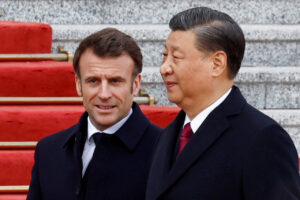
Raphaël Glucksmann, a member of the European parliament and the lead socialist candidate in France in the upcoming EU elections, has urged Emmanuel Macron to be “firm” against China and “not to remain silent in the face of the crimes” against the Uyghurs.
In an interview with France Inter radio on Monday morning he said it was wrong to roll out the red carpet in the way Macron has for the Chinese president.
“You can receive him, you can talk to anyone, but not like this. Not by taking him to the vacation village of his childhood, to his grandfather’s house, not, as the Élysée puts it, by giving this visit a friendly setting because Xi Jinping is not our friend. In addition to deporting the Uyghur people, repressing the Tibetans and Hong Kongers, suppressing opponents and threatening the Taiwanese.”
Glucksmann also claimed that China is killing French green tech putting solar panel companies out of business with its cut-price alternatives.
“We used to have solar panel champions in France and Europe. Today, how many companies produce solar panels in France? There’s only one left.
He added: “What I want for us is to no longer be the gall guys,” he said noting that when Canada sees distortions in trade with the Chinese it imposed tariffs of over 200%. “In Europe they charge 15%. That’s not a deterrent.”



