
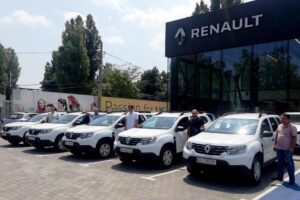
Prometey Group within the framework of the leasing program of OTP Bank (Kyiv) purchased Renault Duster cars for its employees, the company said on Facebook.
“Service vehicles contribute to the effective performance of job duties, which is especially relevant for agronomists in the fields, as well as an integral part of the compensation package and a way to motivate the employee,” Prometey noted.
The total volume of the leasing limit, allocated by OTP Bank for the purchases, is $3 million.
The cars were given to the agronomists of the production enterprises of the company LLC “Ukraina”, LLC “Visla” and LLC “Agro Capital Center”.
Prometey Group provides services in storing, processing and logistics of crops. Before the Russian aggression, the holding owned 34 elevators in the Nikolayev, Kirovograd, Kiev, Khmelnitsky, Zaporizhzhya, Sumy, Odessa, Kherson and Dnepropetrovsk regions.
By the end of 2021, the group planned to receive $45 mln EBITDA, while in 2020 this figure reached $32.6 mln and in 2019 – $30.5 mln.
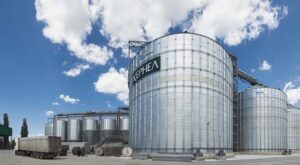
Kernel Agro Group is completing the construction of Starokonstantinov Oil Extraction Plant (SEP) in Khmelnitsky Oblast, CEO of the agro-holding Evgeniy Osipov said at the Grain Ukraine-2023 international grain conference.
“As early as next year, we will finish the construction of the Starokonstantinovsky Oil Extraction Plant, which will be able to process 1 million tons of sunflower annually,” he said in a statement on the company’s Facebook page on Wednesday.
According to Osipov, Kernel has invested more than $800 million in the Ukrainian market over the past few years.
“Each of our initiatives is implemented with the goal of strengthening the country’s agricultural potential. We must be ready to accept the products of Ukrainian farmers in time. We must provide all necessary services to our agrarians so that they can sell their products, get the necessary resources and invest them into production,” he stressed.
Osipov clarified that “Kernel” intends to increase the volume of processing and production of products with added value. To do this it is important to build effective logistics for the company’s partners to export their products.
“Our task is to increase the efficiency of the business system,” explained the CEO of Kernel.
As reported, in February 2023, “Kernel” acquired the river terminal “Danube Prom Agro” in the Ukrainian port of Reni on the Danube.
Kernel Agro Holding before the war was the world’s number one producer of sunflower oil (about 7% of world production) and its exports (about 12%). The company is one of the largest producers and sellers of bottled oil in Ukraine. Kernel is also involved in crop growing and sales of agricultural products.
The largest co-owner of Kernel, through Namsen Ltd. – Ukrainian businessman Andrei Verevskyi, with a 41.3% stake, has recently proposed Kernel’s delisting from the Warsaw Stock Exchange and a buyout of its shares from other shareholders.
For the first half of fiscal 2023 (FY, July-December 2022), Kernel cut its net profit by 12.6% YoY to $370.3

“Ukrzaliznytsia” (UZ) is launching a test flight of the “Kyiv-Warsaw” train with standard “wide” passenger cars in order to obtain the Polish side’s final permission to increase the number of trips and, respectively, seats on this route by two or three times, the press service of UZ said.
According to its data the purpose of the test is to confirm the compatibility of standard passenger cars of UZ with the modernized infrastructure of Polish Railways. The current stage of the project is the final one.
On Wednesday, May 31, 14 standard passenger cars of size 1-BM leave Kiev, which in Jagodina will be converted to euro bogies for “narrow” europeways (1435 mm).
“During my first trip to Poland as chairman of the board of Ukrzaliznytsia in the delegation headed by Deputy Prime Minister for Reconstruction of Ukraine – Minister of Development of Communities, Territories and Infrastructure Alexander Kubrakov, we agreed to finalize this project. Earlier, all the tests were carried out, and we realized: our standard cars can freely pass the test run, after which we will get the “green light” from the Polish side. This will allow in two or three times to increase the supply of seats for direct communication between the Ukrainian and Polish capitals, “- quoted in a press release, the head of the board of UZ Eugene Lyashchenko.
Reportedly, UZ has already engaged all RIC-class cars in its fleet (Regolamento Internazionale Carrozze – Italian). In addition, the company asked European partners to transfer new “narrow” cars, but it will take more than two years to order and build such cars. “This did not stop Ukrainian railroad workers, as the demand of our passengers prompts them to find non-standard solutions. Almost a year ago UZ initiated and conducted work with Polish railroad workers on this project realization”, – words of the UZ board member Alexander Pertsovsky are cited in the report.
There were several rounds of negotiations and agreements between the two sides on the issue of compatibility, received technical approval of the Polish regulator UTK (Urząd Transportu Kolejowego). At the request of the Polish side, measurements of the dimensions of each car were carried out jointly.
As noted, the number of seats on the direct flight of the train “Kyiv-Warsaw” is limited at the moment, as the Polish railroaders let in only a train equipped with “narrow” RIC-cars with three-seat compartments.
According to the press service, the direct flight Kiev-Warsaw-Kiev continues to enjoy a rush demand. “Every day only in the mobile application UZ registers more than 3 thousand requests from passengers who are looking for tickets in this service, which is 10 times more than the availability of seats,” – states the company.
As reported there are 42 RIC cars in the fleet of UZ, two of which have been purchased from Krukiv Wagon Works.
In order to increase the number of trips to Poland from Ukraine after the full-scale invasion of Russia, UZ has launched new routes. In particular, “wide” routes have been retained on the route from Kiev to Chełm. Two daily flights conveniently connect with Polish flights to Warsaw. There are also night flights between Kiev and Peremyshl (two sleeper flights in addition to the two Intercity+ flights). Direct flights are launched from Kharkiv to Chelm, from Zaporizhzhya, Dnipro, Odessa, Vinnitsa, Khmelnitsky, Ternopil and Lviv to Peremyshl.

The China Manned Spaceflight Program Administration (CMSA) on Monday announced plans to send astronauts (Chinese taikonauts) to the surface of the moon before 2030.
“According to the plan for a project to explore the moon by taikonauts, Chinese taikonauts will land on the moon for the first time before 2030, with two taikonauts driving a lunar rover to conduct scientific research,” the administration said in a statement on its website.
China has previously announced plans to land taikonauts on the moon and build a lunar research base there in the 2030s. The South Pole was suggested as a preliminary landing site because of the abundance of sunlight in the area and the presence of ice reserves from which water could be extracted.
China’s main rival in the “moon race” is the United States. In April, Bill Nelson, head of the U.S. National Aeronautics and Space Administration (NASA) said that the U.S. space agency expects to send astronauts to the moon in late 2025 or 2026 under the Artemis national lunar program.

The State Property Fund (SPF) will be able to resume big privatization, to lease state property for up to five years and will receive sub-sanctioned property upon the decision of the SAI and independently decide on its further fate.
According to the FGI in a press release, the relevant provisions are stipulated by law number 8250, which the Rada supported by 231 votes with the required minimum of 226 votes on May 30.
The fund specified that it will independently make management decisions on the sub-sanctioned property: privatization, sale, lease or management, and all the funds received will be directed to the Fund for liquidation of consequences of the armed aggression of the Russian Federation.
In addition, the law bans unsanctioned individuals and citizens of aggressor countries from holding positions as heads of state-owned companies and members of supervisory boards and cancels the procedure for approving local authorities for directors of state-owned companies managed by the SPF, the release said.
Regarding the lease, the Fund recalled that before the full-scale invasion, it could lease state property for up to 49 years, although the vast majority of contracts were for five years: in 2021, the share of five-year contracts was 88.8%.
At the same time, at the beginning of the war there were fears that due to low competition caused by the general uncertainty, the price of the lease may be underestimated, and from April 1, 2022 the Rada limited the validity of new contracts to the duration of martial law + 12 months after its cancellation, explained the IGF. He specified that during this time has concluded 1,153 such contracts.
“But in recent months, Ukrainian business has gradually adapted to the challenges of martial law … Term limits do not encourage entrepreneurs to participate in lease auctions, so now 38% of them do not pass due to lack of demand,” explained the Fund.
After the law enters into force, the agency expects to increase the income from renting state property by 20-25%, or 100 million hryvnias per year, as well as to improve the condition of the leased property.
According to a press release, the law also aims to improve the management structure of the IGF: the head of the Fund will have the right to appoint and dismiss deputies, 12 regional offices – separate legal entities will become structural units, and the organizational structure will be built on a functional principle. “As a consequence, a clearer and more understandable responsibility for the work of the State Property Fund and the installation of the KRI for subdivisions and market salaries for employees,” the statement said.

Foreign Minister Edgar Rinkevich nominated by New Unity has been elected president of Latvia in the third round of voting in the Saeima.
Fifty-two deputies voted for Rinkevich, the minimum required being 51 votes.
Uldis Pilens, the United List candidate, received 25 votes in the third round.



