

The U.S. dollar is getting cheaper against the euro, is stable against the pound and getting stronger against the yen.
Traders are focusing on the November U.S. Commerce Department report on Americans’ income and spending, which includes the dynamics of the Consumer Price Index (PCE and Core PCE) closely monitored by the Federal Reserve (Fed).
The Core PCE core inflation index, which excludes changes in food and energy prices, rose 0.2 percent in November from the previous month, the same as in October, experts polled by Dow Jones and The Wall Street Journal predicted. In annual terms, the index increase is expected to slow to 4.6% from 5% a month earlier.
On the eve of the U.S. Department of Commerce significantly improved its estimate of U.S. GDP growth in the third quarter – up to 3.2% in annualized terms from the previously announced 2.9%. This supported the dollar as traders took it as a signal that the Fed will raise the rate higher than expected to curb economic activity and inflationary pressures, Trading Economics said.
The euro/dollar pair was trading at $1.0610 as of 7:50 a.m. Friday versus $1.0598 at the close of the previous session.
The pound to dollar rate was at $1.2043 against $1.2045 the day before.
The value of the U.S. currency in a pair with the yen rose to 132.69 yen against 132.35 yen in previous trading.
Statistics from Japan, released on Friday, showed an acceleration in overall inflation in the country in November to 3.8% on an annualized basis – the highest since January 1991.
Consumer prices excluding fresh food (a key indicator tracked by the Bank of Japan) rose 3.7% year on year last month after climbing 3.6% in September. The rate of growth was the fastest since December 1981. In doing so, the figure exceeded the country’s central bank’s 2% target for the eighth month in a row.
The ICE-calculated index showing the dollar’s performance against six currencies (euro, Swiss franc, yen, Canadian dollar, pound sterling and Swedish krona) lost 0.06% in trading, while the broader WSJ Dollar Index lost 0.02%.
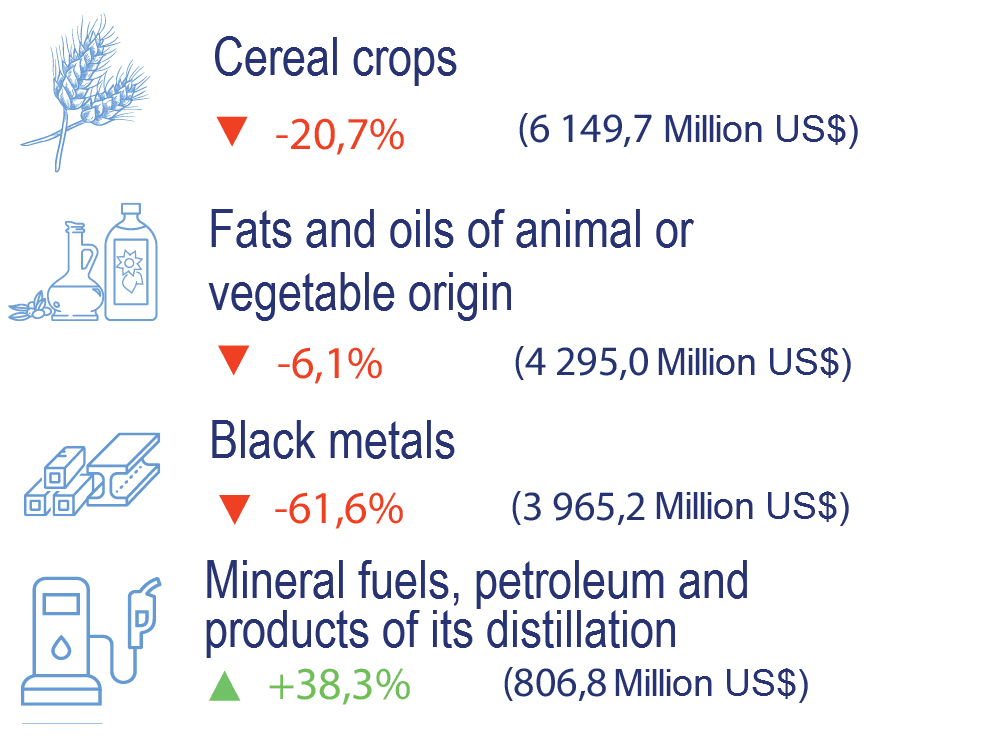
Export of goods in Jan-Sep 2022 to most important positions and in relation to same period of 2021
SSC of Ukraine

Oil prices rose on Friday and finished in the plus for the second week in a row amid a decline in US inventories and improved demand prospects due to the easing of anti-coveting restrictions in China.
The price of February futures on ICE Futures Exchange in London was $81.57 per barrel by 7:15 am on Friday. Those contracts fell by $1.22 (1.5%) to $80.98 a barrel at the close of trading on Thursday.
The price of WTI futures for February at electronic trades of NYMEX grew by that time by $0.71 (0.92%) to $78.2 per barrel. By closing of previous trades the cost of these contracts has gone down by $0.8 (1%) to $77.49 per barrel.
Trading activity in the oil market declined sharply before the holidays, adding to its volatility, Bloomberg noted.
“Traders seem to be ready for the vacations,” said Ed Moya, chief oil market analyst at Oanda. – The most important factor for the market remains the situation in China, and the optimism that the lifting of restrictions will continue and the demand for oil will increase, remains.”
Market participants are also following the news from the U.S., where natural gas production is falling due to difficult weather conditions in key production regions which were hit by a snowstorm. According to Bloomberg, gas production in the states on Thursday fell to less than 96 billion cubic feet, compared with 100 billion feet on Wednesday.

Ukrzaliznytsia has reported that four international flights were delayed by more than two and a half hours due to the accumulation of trains on the Polish border.
In particular, with the delay arrived: 715/716 Peremyshl – Kyiv (+7:13), 31/32 Peremyshl – Zaporizhzhia (+3:58), 705/706 Kyiv – Peremyshl (+2:37) and 89/90 Peremyshl – Kyiv (+2:30).
In addition, due to lack of voltage in the overhead system as a result of shelling on the Marganets – Nikopol section, UZ has changed the route of three trains: №62 Odessa – Kharkiv, №120 Lviv – Zaporizhzhya, and №276 Kiev – Zaporizhzhya-1. They will pass from station Krivoy Rog Main through Verkhovtsevo, Dnepr Main, Sinelnikovo-2, Sinelnikovo-1, Zaporizhzhia-1, Sinelnikovo-1 without going to stations Apostolovo, Nikopol, Chortomlyk, Marganets, Dneprobut-2.
Train No. 62 Odessa – Kharkiv will further pass through Pavlograd-1 and Lozovaya, bypassing Novomoskovsk Dneprovsky.

Ports of “Big Odessa” on Thursday sent 221 thousand tons of agricultural products in the framework of the “Grain Initiative”, said the Ministry of Infrastructure of Ukraine.
“Today a caravan of five ships left the ports of “Big Odessa”, which will deliver 221 thousand tons of agricultural products to Africa, Asia and Europe, including the bulk carrier Sea Bridle with 25 thousand tons of agricultural products for Libya,” the Ministry noted.
According to him, since the beginning of the grain corridor 12 ships with 305 thousand tons of Ukrainian grain to this African country.
The Ministry noted that there are 29 vessels in the ports, involved in the “grain initiative”. More than 1 million tons of Ukrainian agricultural products are loaded on them.
“Grain corridor” is also moving two vessels for the loading of 89 thousand tons of agricultural products.
At the same time in the Bosporus 92 vessels are waiting for their turn to be inspected by the SCS. Over the past day, seven ships received approval for further movement after the inspection.
According to the information of the Ministry of Infrastructure, at least 12 inspections per day are required for continuous movement through the grain corridor.
A total of 574 vessels have left the ports of Greater Odessa since August 1, which exported 14.6 million tons of Ukrainian food to Asia, Europe and Africa.

Ukraine in January-November this year reduced ferroalloys exports in physical terms by 48 percent year-on-year to 318,760,000 tonnes.
According to the statistics released by the State Customs Service (SCS), in monetary terms ferroalloys exports fell by 42.7% to $532.263m.
In addition, during this period, Ukraine imported 20,288 thousand tons of these products, down 64.2% compared to January-November 2021. In monetary terms, imports decreased by 56.3% – to $70.760 million.
As reported, Ukraine in 2021 increased the export of ferroalloys in volume terms by 6.9% compared to 2020 – up to 668.539 tons, in monetary terms, their exports rose by 58.2% – to $ 1 billion 43.880 million, with major exports to Turkey (19.87% exports in monetary terms), Italy (13.51%) and China (11.28%).
In addition, in 2021, Ukraine imported 59.569 thousand tons of these products, which is 75.6% more than in 2020. In monetary terms, imports rose by 84.5% – to $177.616 million. Imports were carried out mainly from Brazil (16.93%), Norway (15.72%) and Kazakhstan (15.1%).
Stakhaniv and Zaporizhia ferroalloys plants (NWF and ZZF) were organized by PrivatBank (Kiev) until the nationalization of the financial institution. Nikopol Ferroalloy Plant is controlled by EastOne Group, created in the fall of 2007 as a result of restructuring of Interpipe Group, as well as Privat Group.



