

The biopharmaceutical company Biopharma Plasma (Kyiv) has opened a plasma center in Kolomyia (Ivano-Frankivsk Oblast), marking the company’s 23rd plasma center. The company announced this on LinkedIn.
“This new center is another step toward expanding access to plasma donation and strengthening our contribution to the production of life-saving medicines,” the company stated.
As previously reported, in June, Biopharma Plasma opened a plasma center in Zhytomyr, which became the company’s 22nd plasma center. Before the war, Biopharma Plasma planned to open approximately four to five new centers each year, investing about $2.5 million in each.
By the end of 2027, Biopharma plans to launch a plant in Oradea, Romania, with an initial investment of 85 million euros. In September of this year, the company plans to launch the first phase of its plant in Uzhhorod for the production of pharmaceutical products and immunobiological preparations, which will provide a full cycle of blood plasma processing. The company has already invested 67 million euros in the construction; the total cost of the first phase is 75 million euros. According to the plan, the volume of blood plasma-based drug production in Uzhhorod will be twice that of production in Bila Tserkva, amounting to up to 1.5 million liters of blood plasma per year, while the project in Romania will be twice as large.
Biopharma Plasma, Donation, Kolomyia, PHARMACEUTICALS, PLASMA

Germany remains a country with one of the lowest homeownership rates in Europe, according to the Pestel-Institut. In 2025, only 43.5% of the country’s private households lived in their own apartment or house. This is the lowest figure in approximately two decades.
As reported by rebuild.news, owning a home in Germany is now more of an exception than the standard model of living: the majority of households continue to rent real estate.
Germany’s official statistics confirm this characteristic of the market. According to the Federal Statistical Office Destatis and Eurostat, in 2025, 52.8% of Germany’s population lived in rented housing. This is the highest share of tenants among all European Union countries. For comparison, in France it stood at 38.6%, in Spain at 26.4%, in Poland at 12.8%, and in Slovakia at only 6.2%.
The figures from the Pestel-Institut and Destatis differ somewhat due to methodology. Pestel estimates the share of households living in owner-occupied housing, while Eurostat data cited by Destatis are calculated at the population level. The German statistical office itself also publishes a homeownership rate of 41.9% for another sample of households.
The Pestel-Institut study shows that the problem is particularly noticeable among young Germans. Almost three quarters of residents aged 25-45 live in rented housing. Researchers cite rising construction costs, mortgage interest rates and insufficient affordability of home purchases for middle-income families as the main reasons.
Since 2000, the cost of constructing apartment buildings in Germany, according to the study, has risen by approximately 160%, while consumer prices have increased significantly more slowly. Even families with two average incomes in many regions face difficulties purchasing their own homes.
At the same time, the situation is complicated by an insufficient supply of new apartments. In 2025, around 206.6 thousand housing units were completed in Germany – 18% fewer than a year earlier, and the lowest figure since 2012.
The high share of tenants has long been a characteristic of the German real estate market model. A developed long-term rental market, strong tenant protection and a historically relatively low proportion of homeowners distinguish Germany from most Central and Eastern European countries, where the overwhelming majority of the population owns its housing.
At the same time, rents under new contracts are also rising rapidly. According to the European Commission, new rental rates in Germany increased by approximately 50.8% in 2013-2024, and by 76.3% in the seven largest cities.
GERMANY, HOMEOGERMANY, HOMEOWNERSHIPWNERSHIP, HOUSING, REAL ESTATE, RENTAL

According to Serbian Economist, 815,916 tourists visited the Budva Riviera in Montenegro from January through August 2026, a 17% increase compared to the same period last year, with Ukrainians remaining one of the most prominent groups of foreign visitors to the resort.
This was reported by Milan Tičić, director of the Budva Tourism Organization, in an interview with the Montenegrin publication Vijesti, published on September 18. According to him, tourists from 205 countries visited Budva over the course of eight months.
Serbia and Russia remain the resort’s largest traditional markets. The number of tourists from Serbia has increased by approximately 19% since the beginning of the year, while the flow of Russian tourists has grown by as much as 34%.
Some Western European markets are growing even faster in 2026. The number of visitors from Poland increased by 83%, from Italy by 59%, from the Netherlands by 51%, from Spain by 46%, from the United Kingdom by 25%, and from Germany and France by approximately 15%. Thus, the geography of foreign tourism in Budva is gradually diversifying, although Serbian and Russian tourists still hold the leading positions.
Ukrainians are also among the key tourist groups. According to data from the Budva Tourism Organization, during the peak season on August 7, 2026, Ukrainian citizens were among the top ten largest groups of guests in group accommodations, alongside tourists from Serbia, Russia, Israel, the United Kingdom, Germany, Bosnia and Herzegovina, and Poland.
In the private sector, Ukrainians’ presence is even stronger. In early August, they were the fourth-largest group after tourists from Serbia, Russia, and Bosnia and Herzegovina. In hotels and group accommodations, Ukrainians also consistently ranked among Budva’s top ten source markets.
By the end of August, the pattern remained similar. Among the most numerous guests at hotels and other collective accommodations, the Tourism Organization listed tourists from Serbia, Russia, Israel, the United Kingdom, Bosnia and Herzegovina, Ukraine, Germany, Poland, Turkey, and China.
The importance of the Ukrainian market is also confirmed by Montenegro’s national statistics. According to MONSTAT, in 2025, Ukrainians accounted for 4.3% of all overnight stays by foreign tourists in the country, tying with tourists from Turkey in this regard. The largest shares of overnight stays were accounted for by visitors from Serbia (23.4%), Russia (16.4%), Bosnia and Herzegovina (8.1%), and Germany (4.6%).
In the segment of private apartments and other private accommodations, the share of Ukrainians was even higher—4.7% of all overnight stays by foreign visitors. Serbian tourists accounted for 25.6%, Russian tourists—22.1%, citizens of Bosnia and Herzegovina—9.4%, and Turkish tourists—4.9%. At the same time, 94.8% of all overnight stays in Montenegro’s private sector occurred specifically at seaside resorts.
In 2025, a total of 2.729 million tourists visited Montenegro, accounting for 15.367 million overnight stays. Foreign visitors accounted for 95.8% of all overnight stays, and coastal resorts accounted for 92.6%, underscoring the critical importance of Budva and other coastal cities to the country’s tourism economy.
The growth in tourist traffic is already having an impact on Budva’s revenues. From January through August 2026, revenue from the tourist tax collected by the city’s tourism organization reached a record 2.477 million euros, which is 6% more than the previous year. In July, revenue increased by 16%, and in August, by 13%.
Budva remains one of Montenegro’s main tourist centers and is particularly popular among citizens of Serbia, Russia, Ukraine, and countries in Central and Western Europe. At the same time, the rapid growth in tourist arrivals from Poland, Italy, the Netherlands, and the United Kingdom indicates a gradual reduction in the resort’s dependence on a few traditional markets.

A fully operational set of nut processing equipment is offered for sale—from initial cracking and cleaning to calibration, sorting, and drying of the kernels. The facility is equipped with everything necessary to organize a complete production cycle and may be of interest to both existing processors looking to expand their capacity and entrepreneurs considering launching a turnkey nut processing business.
The cost of the complete equipment set is $27,000.
The core of the production line is a system with a capacity of 60–80 kg per hour, costing $15,000. It includes an impact machine for cracking nuts, a small aspiration unit that removes up to 15% of impurities, a vertical conveyor, a cracking machine with millstones, a large aspiration system for primary cleaning that removes up to 80% of debris and shells, as well as two conveyor sorting tables.
The owner has extended the large conveyor table to facilitate manual sorting of the product. On the small table, nut fragments are separated from the remaining shells.
To increase productivity, the line has been supplemented with a vibrating hopper for uniform feed of raw materials, costing $1,000.
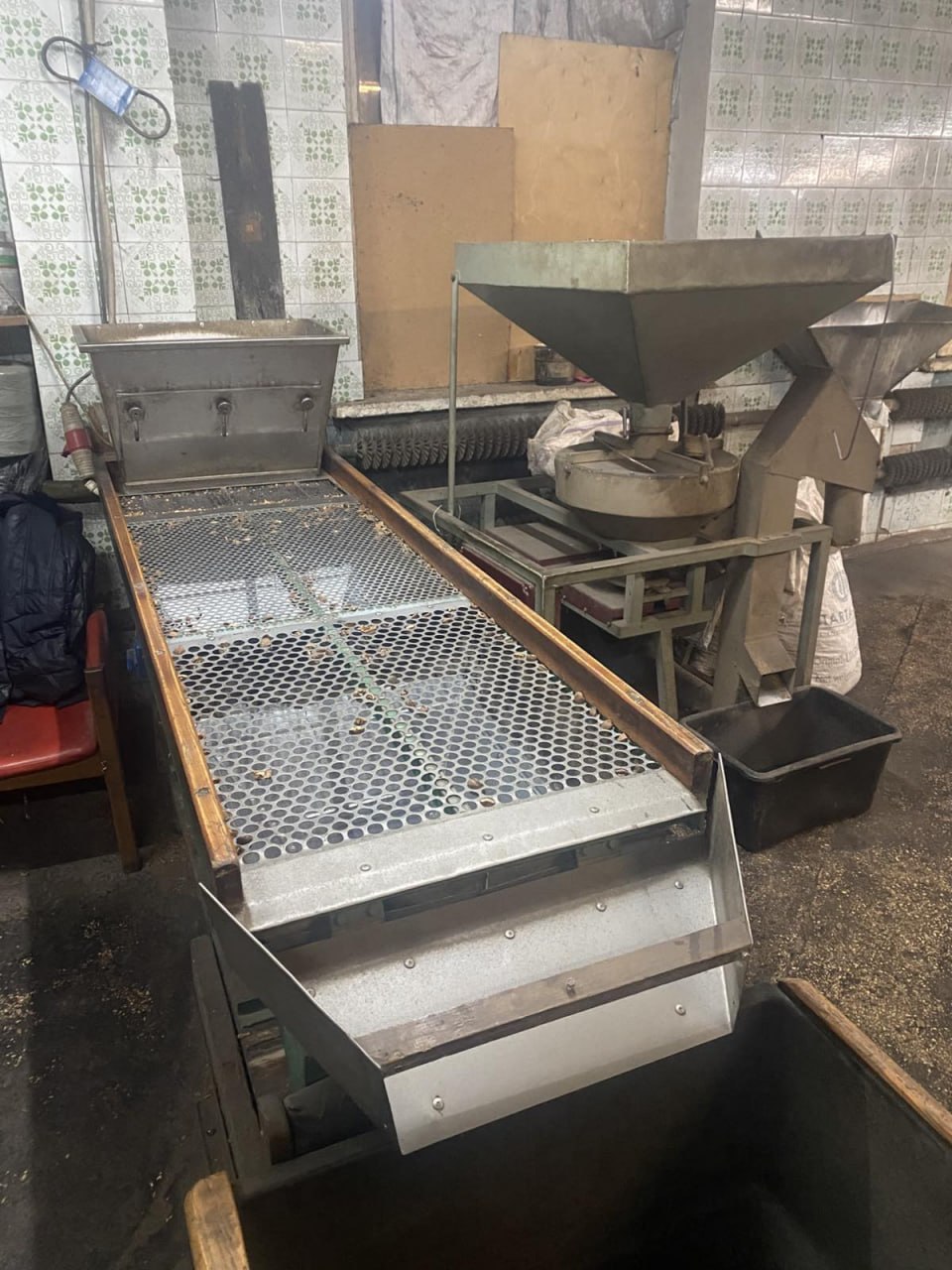
Another unit, costing $1,500, includes a vibrating hopper to separate shells from uncracked nuts and an additional large-capacity dust extraction system. Afterward, the uncracked nuts can be fed to a separate machine for re-cracking, costing $1,000.
For product sorting, the set includes a calibrator with 5 mm, 13 mm, and 19 mm openings—$1,000.
The set also includes a kernel drying unit with a capacity of up to 200 kg per load. The set includes the drying unit itself and a heat gun. The cost of the equipment is $500.
A separate advantage of the complex is a refrigeration unit costing $4,000, which has seen virtually no use and allows for the proper storage of finished kernels and the maintenance of product quality.
For waste processing, there is a machine worth $500 that grinds eggshells into a fine powder. This not only reduces the volume of production waste but also allows the eggshells to be treated as a separate product for further use or sale.
Along with the main equipment, the buyer receives a substantial set of production inventory with a total estimated value of approximately $1,500. This includes two scales, a hydraulic pallet jack, about 150 plastic crates, 40–50 pallets,two containers or devices for transferring products, bags and consumables, ties, lubricants, fasteners, cables, a spare engine for the drying cannon, a capacitor for the calibrator, tools, and other small items necessary for operation.
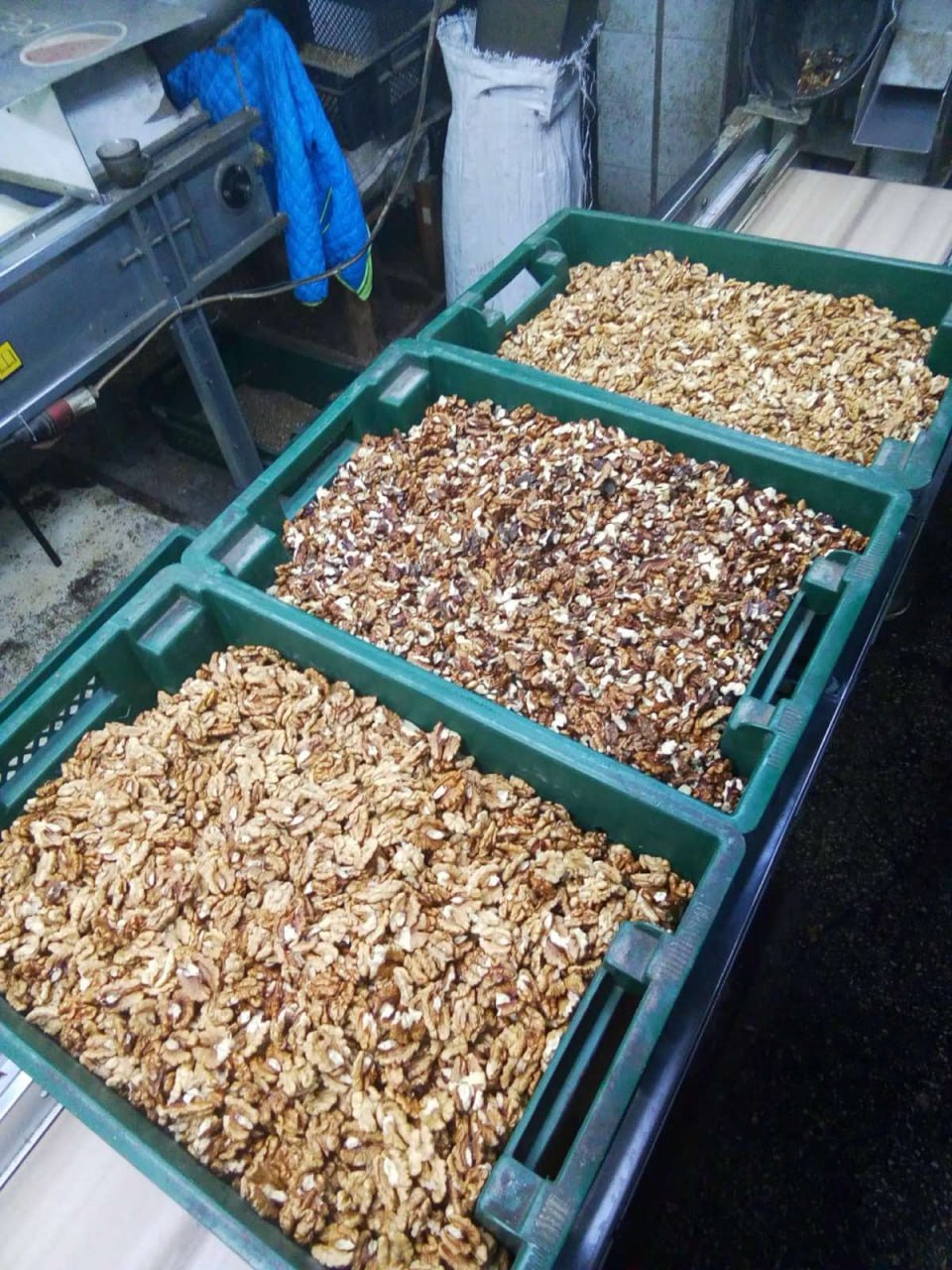
Additionally, the complex may include a nut dryer for nuts in the shell, valued at $1,000. It is currently located at the supplier’s orchard. This equipment also offers an additional commercial advantage: the supplier uses the dryer and, in return, sells the owner of the complex a harvest of premium-grade nuts. Thus, along with the equipment, it is potentially possible to retain the already established relationships with the raw material supplier.
If necessary, the price can be reduced to $25,500 by excluding the in-shell nut dryer and the shell crusher from the deal. The remaining equipment forms a single production line and is essential for full-scale, streamlined processing.
In fact, the buyer receives not a set of individual machines, but a ready-to-use production line: raw material feed → cracking → aspiration cleaning → re-cracking → sorting → grading → drying → storage of finished kernels.
The complex is suitable for processing your own harvest, purchasing nuts from farms and orchardists, producing kernels for wholesale and retail sales, as well as for the further development of shell processing operations.
The price of the complete complex is $27,000.
Optimized configuration: $25,500.
Main production line capacity: 60–80 kg/hour.
Kernel dryer loading capacity: up to 200 kg.
+380639425723
Dmytro
BUSINESS, EQUIPMENT, MANUFACTURING, NUTS, PROCESSING, PRODUCTION
Life Cycle Assessment (LCA) of buildings is gradually evolving in Europe from a voluntary tool to a mandatory regulatory requirement, changing the approach to design, material selection, and calculating the true cost of a building over its entire service life.
This is discussed in an analytical report by the Ukrainian engineering and construction company Rauta, published on September 20, 2026.
According to data cited by the company from the United Nations Environment Programme’s Global Status Report for Buildings and Construction 2025–2026, the construction and operation of buildings account for nearly 50% of global material extraction and about 37% of global carbon dioxide emissions. This is drawing increased attention from investors and designers not only to the initial construction costs but also to a building’s environmental impact over decades of operation.
LCA assesses the environmental impact of a building or a specific material from the extraction of raw materials through production, transportation, construction, operation, repair, demolition, and final recycling or disposal.
The methodology involves analyzing global warming potential, energy and water consumption, emissions to air, water, and soil, as well as waste generation. In Ukraine, this approach is based, in particular, on the international standards ISO 14040 and ISO 14044 and the European standard EN 15978.
According to Rauta, applying LCA as early as the design stage allows architects and engineers to compare alternative solutions not only in terms of price or thermal insulation performance, but also in terms of their total carbon footprint.
This makes it possible to change materials or structural solutions even before construction begins, when making adjustments to the project is significantly less expensive. LCA can also improve a building’s rating during certification under international systems such as LEED, BREEAM, and DGNB.
Environmental Product Declarations (EPDs), which contain verified data on a specific material’s environmental impact, are a key component of such analysis. Integrating this information into a BIM model allows for the automatic recalculation of the environmental performance metrics for the entire project following design changes.
According to Rauta, LCA calculations utilize both universal software solutions such as SimaPro, Sphera LCA, and openLCA, as well as specialized construction systems like Athena Impact Estimator and Preoptima, along with Revit add-ins such as One Click LCA, Tally, and Beacon.
The application of this methodology also changes the criteria for selecting building materials. Preference is given to solutions with lower embodied carbon, a long service life, the ability to be repaired or replaced without interrupting the building’s operation, as well as the potential for reuse or recycling.
Rauta notes that, based on these criteria, steel load-bearing and enclosure structures can offer a number of advantages due to their lower weight, reduced costs for foundations and transportation, and the ability to recycle steel and reuse metal structures, profiled sheeting, sandwich panels, and facade elements.
Changes in European regulations are becoming a particularly important factor for the Ukrainian construction market.
The EU Directive on the Energy Performance of Buildings (EPBD) (EU) 2024/1275 provides for the gradual introduction of accounting for the total carbon footprint of new buildings throughout their entire life cycle. Starting in 2028, the Global Warming Potential (GWP) must be included in the energy performance certificates for large new buildings with an area exceeding 1,000 square meters, and starting in 2030—for all new buildings.
In Ukraine, there is currently no mandatory requirement to conduct LCA calculations, so the methodology is primarily used in projects involving international clients or funding.
At the same time, Order No. 168 of the Ministry of Community and Territorial Development, dated February 6, 2025, which establishes requirements for nearly zero-energy buildings, lays the groundwork for a gradual transition from assessing energy efficiency alone to a broader life-cycle assessment.
At Rauta, they believe that European integration and post-war reconstruction could serve as additional incentives for the widespread adoption of LCA in Ukraine, as international financial organizations and donors are increasingly focusing on projects that meet European standards for energy efficiency and sustainable construction.
Companies that begin using LCA even before mandatory regulatory requirements are introduced can gain advantages in the form of lower operating costs, better preparedness to attract international financing, and faster adaptation to future European regulations.
A separate tool is Life Cycle Costing (LCC), which assesses not the environmental impact but the total cost of owning a building over its life cycle. Combining LCA and LCC allows investors to simultaneously evaluate the environmental consequences and long-term financial costs of various design solutions.
Thus, the approach to building assessment is gradually shifting from minimizing initial construction costs to analyzing the total cost and environmental impact over decades of operation.
Original source: Rauta article “How Building Life Cycle Assessment Is Changing the Approach to Design and Material Selection,” published on September 20, 2026. Rauta – Building Life Cycle Assessment

In January–August 2026, Ukraine produced 4.1 million metric tons of raw milk, which is 13% less than in the same period of 2025, according to the Association of Milk Producers (AMP), citing preliminary data from the State Statistics Service.
In January–August, agricultural enterprises accounted for 54% of raw milk production, while private farms accounted for 46%.
In August, private households produced 268,000 metric tons of raw milk, which is 5.2% less than in July and 28% less than in August 2025. From January through August, their production fell by 27% to 1.89 million metric tons.
In August, industrial enterprises produced 275,700 metric tons of raw milk, which is 1.9% less than in July but 2.8% more than in August 2025. In January–August, milk production on commercial dairy farms increased by 5%, to 2.21 million metric tons.
The industrial sector is increasing raw milk production compared to the same period last year, particularly due to growth in the western regions.
“The Rivne region is showing the highest growth rates in raw milk production. Improved efficiency in dairy cattle farming has contributed to increased milk yields in the Chernihiv region. Among the leaders in terms of milk yield growth are the western regions of Lviv, Ternopil, and Ivano-Frankivsk, as well as Chernihiv and Zhytomyr. Meanwhile, the Poltava region remains the leader in raw milk production,” the report states.
In January–August, approximately 55% of the raw milk produced by agricultural enterprises came from five regions: Poltava—318,700 metric tons, Cherkasy—267,800 metric tons, Khmelnytskyi—210,900 metric tons, Chernihiv—208,200 metric tons, and Vinnytsia—199,300 metric tons.
The AVM forecasts an increase in prices for dairy products due to rising transportation costs for delivering them to retail chains as a result of Russian shelling and the lengthening of logistics routes. This could lead to a decline in consumer demand and a decrease in the production of fresh dairy products.



