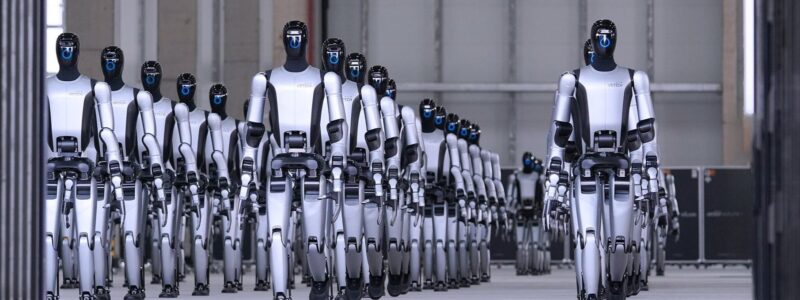
According to Experts.news, global production of humanoid robots has moved from isolated prototypes to the first mass-produced batches; however, the industry remains highly concentrated: Chinese companies accounted for about 85% of shipments in 2025.
According to estimates by the Chinese research center CCID, in 2025, Chinese manufacturers shipped approximately 14,400 humanoid robots, accounting for 84.7% of the global market. Thus, the global total was approximately 17,000 units. Other studies estimate global shipments at approximately 18,000 units.
According to IDC, the number of humanoid robots shipped worldwide in 2025 increased more than sixfold—by approximately 508%. However, statistics from various research organizations differ significantly, as some count only bipedal robots, while others also include wheeled humanoid platforms and general-purpose robots with artificial intelligence.
China remains the only country where humanoid robots are already being produced by the thousands by several manufacturers simultaneously. There are over 140 companies in the country working on humanoid robots, and the number of models available exceeds 330. AGIBOT, Unitree, and UBTECH have become the largest manufacturers.
TrendForce expects Chinese production of humanoid robots to grow by another 94% in 2026. Unitree and AGIBOT are expected to maintain their leading positions thanks to their well-developed supply chains, access to low-cost actuators, batteries, and sensors, and their capacity for mass assembly.
China’s advantage lies not only in artificial intelligence but also in its ability to rapidly reduce the cost of hardware. Some of Unitree’s entry-level models are already priced below $6,000, while most American and European systems are geared toward more expensive industrial pilot projects.
The U.S. lags significantly behind China in terms of the actual number of robots produced, but it has the largest announced manufacturing projects outside of China.
Figure has launched BotQ, a facility whose first production line is designed to produce up to 12,000 humanoid robots per year. In April 2026, the company announced its transition from prototypes to the production phase and that it had reached an assembly rate of one robot per hour.
Agility Robotics operates the RoboFab plant in Oregon with a potential capacity of over 10,000 Digit robots per year. Actual output is currently significantly lower than the stated maximum capacity.
The U.S.-Norwegian company 1X has begun full-scale production of its NEO home robot at a factory in California. Tesla is setting up its first production lines for Optimus but has not yet disclosed confirmed data regarding mass production.
South Korea’s Hyundai Motor Group plans to build a facility in the U.S. with a capacity of up to 30,000 robots per year by 2028. The facility is expected to produce, among other things, the Atlas humanoid robots developed by Boston Dynamics. The first Atlas robots are scheduled to arrive at Hyundai’s U.S. facilities in 2028.
One of the most advanced European projects is Germany’s NEURA Robotics, which has developed the 4NE1 humanoid robot.
The company calls it the first European humanoid robot ready for industrial production. NEURA is collaborating with Bosch and Schaeffler, planning to scale up production of robots for industry, logistics, and service tasks.
In 2026, NEURA announced that it had raised up to $1.4 billion to expand mass production and develop a network of centers where robots will be trained to perform real-world tasks.
In Serbia, AGIBOT and Minth Group are preparing to launch a facility in Šabac. The initial production volume is stated at 1,000–2,000 humanoid robots per year. The facility is expected to open in August 2026, although the timeline has already been revised several times. Therefore, Serbia should for now be classified among countries with announced but not yet confirmed mass production.
If the project is implemented, Serbia could become one of the first countries in Europe where Chinese humanoid robots will be mass-produced and adapted for regional markets.
Japan has many years of experience in developing humanoid robots, but so far has focused primarily on research, components, medicine, and elder care. Kawasaki continues to develop the Kaleido platform but has not announced mass production on a scale comparable to that of Chinese companies. TrendForce believes that Japan’s competitive advantage could lie in actuators, sensors, control systems, and solutions for elderly care.
In South Korea, Samsung has acquired control of Rainbow Robotics and intends to integrate its robotics developments with its own artificial intelligence and software technologies. Hyundai is simultaneously developing Atlas through its subsidiary Boston Dynamics, though the group plans to build a large factory in the U.S.
There is no comprehensive international registry of humanoid robot production. Companies disclose the potential capacity of their factories much more frequently than actual production volumes, and the term “humanoid robot” is applied to various types of devices.
The only reliably confirmed fact is China’s leadership, with a share of approximately 85% of global shipments in 2025. The remaining roughly 15% is accounted for primarily by the U.S. and small batches, prototypes, and pilot series from Europe, Japan, and South Korea.
In 2026–2028, the distribution may change following the launch of plants by Figure, Agility Robotics, Tesla, Hyundai, NEURA, and the Serbian AGIBOT project. However, for now, China retains a significant advantage in terms of actual production volume, component costs, and supply chain readiness.