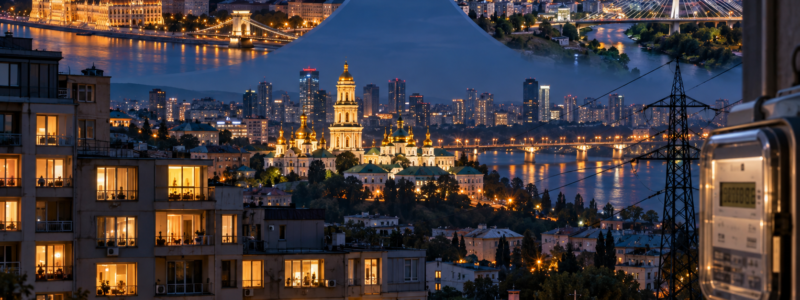
Kyiv ranked first among 33 European capitals for the lowest electricity costs for households in September 2026, reports the Experts Club information and analytical center. The cost of one kilowatt-hour, including taxes, in the Ukrainian capital was 8.4 euro cents, according to data from the international Household Energy Price Index (HEPI) study, published by Euronews Business on October 14.
Budapest ranked second at 10.3 euro cents per kWh, while Podgorica came third, where electricity cost 11.3 euro cents. The five cheapest capitals also included Belgrade (11.6 euro cents) and Valletta (12.3 euro cents).
The average cost of electricity in the capitals of European Union countries was 27.2 euro cents per kWh. Thus, electricity in Kyiv was approximately 69.1% cheaper than the EU average, in Budapest 62.1% cheaper, in Podgorica 58.5% cheaper, and in Belgrade 57.4% cheaper.
The most expensive electricity for households was recorded in Brussels, where the price reached 41.3 euro cents per kWh. It was followed by Berlin (39.6), Dublin (38.7), Bern (38.6) and London (38.3).
Among other European capitals, high tariffs were recorded in Rome (36.6 euro cents), Vienna (34.4) and Prague (34.3). In Madrid, electricity cost 28.3 euro cents per kWh, and in Paris, 28.1 euro cents.
The difference between the most expensive and the cheapest capitals was almost fivefold: 41.3 euro cents in Brussels compared with 8.4 euro cents in Kyiv.
According to HEPI, from the beginning of February to the beginning of September 2026, the average cost of electricity for households in EU capitals increased by 4.2%. Meanwhile, natural gas prices rose by 12% over the same period.
The differences between European capitals are explained by the structure of their energy mix, dependence on imported energy resources, tariff policies, taxes and government mechanisms for supporting households.
At the same time, researchers emphasize that comparing nominal tariffs does not fully reflect the affordability of electricity for the population. When purchasing power is taken into account, the ranking changes significantly, as household incomes and overall price levels differ considerably across European countries.
The Household Energy Price Index study has been conducted monthly since 2009 with the participation of the Austrian energy regulator Energie-Control, the Hungarian regulator MEKH and the international consulting company VaasaETT. It covers 33 European capitals and takes into account supplier tariffs, network charges, taxes and government subsidies.