
In January–June 2026, NASK “Oranta” collected insurance premiums totaling 1.9 billion UAH, which is 7.3% more than in the same period a year earlier (1.77 billion UAH).
According to the insurer’s website, the company issued over 1.36 million insurance policies in January–June. Compared to the first half of 2025, this number increased by 8.1%.
The majority of the portfolio consisted of compulsory motor third-party liability insurance (CMTPL) policies—UAH 1.57 billion (+6.6%). The company issued over 609,000 CMTPL policies.
Premiums from accident insurance increased by 61.7% to 18.8 million UAH, and from health insurance by 51.5% to 76 million UAH. Premiums from comprehensive auto insurance (CASCO) rose by 26.5% to 52.6 million UAH. The number of health insurance policies increased by 48.2% to 254,000, and comprehensive auto insurance (CASCO) policies by 59% to 5,400. In liability insurance, the number of policies issued more than doubled to 91,800.
The company also reports that during the first six months of 2026, it made insurance payments totaling 763.4 million UAH, which is 55.1% more than during the same period in 2025.
The largest share of payouts was for compulsory motor third-party liability insurance (CMTPL)—638.4 million UAH, which is 74.7% higher than the figure for the corresponding period last year. Payments under “Green Card” policies totaled 64.2 million UAH, while comprehensive auto insurance (CASCO) payments amounted to 27.1 million UAH. Health insurance payouts rose by 87.9% to nearly 26 million UAH.
At the end of the first six months, Oranta’s assets totaled 3.86 billion UAH, a 36.3% increase compared to the same period a year earlier. Equity rose by 57.5% to 1.26 billion UAH, while insurance reserves increased by 27.3% to 2.39 billion UAH.
The company’s net income for the first half of the year was 306.1 million UAH, compared to 73.7 million UAH for the same period in 2025. A total of 230 million UAH in taxes was paid to budgets at all levels—48% more than in the first half of last year.
“The results for the first half of the year confirm that Oranta is gradually transitioning to a more diversified business model. Auto insurance remains the foundation of our portfolio, but health insurance, comprehensive auto insurance (CASCO), and other areas we have identified as priorities are making an increasingly significant contribution. It is essential for us that business growth be accompanied by the strengthening of financial stability and the company’s ability to fulfill an ever-increasing volume of obligations to our clients,” said Jacek Meizner, Chairman of the Board of NASK ORANTA.
NASK “Oranta” is the legal successor to “Ukrderzhstrakh,” founded on November 25, 1921, and has been conducting insurance operations in Ukraine for over 100 years.
The company has been a full member of the Motor Transport Insurance Bureau of Ukraine (MTIBU) since 1994 and a member of the Nuclear Insurance Pool since 2003.
The insurer’s main shareholder is the Ukrainian business group DCH.
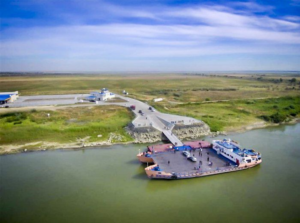
The geography of diesel fuel imports into Ukraine changed significantly in July 2026: despite record supplies from Romania, imports from Greece, Türkiye and Israel declined sharply, while the main burden is increasingly shifting to the western border.
According to the A-95 Consulting Group, Ukraine imported a total of 562,000 tonnes of diesel fuel in July, 5% more than in the same period last year.
On the southern route, Romania was the only major source to increase supplies significantly.
Imports of Romanian diesel fuel rose by 25%, from 143,400 tonnes in July 2025 to 179,300 tonnes in July this year. This was the highest figure since the beginning of 2025.
A completely different trend was observed among other suppliers along the southern and Mediterranean routes.
Imports from Greece decreased by 45%, from 60,700 tonnes to 33,100 tonnes. According to the A-95 infographic, supplies from Türkiye fell from approximately 31,000 tonnes to several thousand tonnes, while imports from Israel declined to isolated shipments.
At the same time, supplies through Poland and Lithuania increased sharply.
Poland increased its diesel fuel exports to Ukraine by 26%, to 202,800 tonnes, while Lithuania increased them by as much as 65%, to 84,300 tonnes.
According to A-95 Director Serhii Kuiun, one of the main reasons for the redistribution of supply flows was the record shallowing of the Danube, which created additional logistical difficulties, as well as continuing security risks.
As a result, Poland became the largest diesel fuel supply channel for Ukraine, while Poland, Romania and Lithuania jointly accounted for 83% of all imports in July.
The changes demonstrate how quickly the Ukrainian market is being forced to restructure its supply routes depending on the state of river logistics, security in the Black Sea region and the availability of European petroleum products.
At the same time, even the increase in total imports did not allow Ukraine to completely avoid a fuel shortage in July. A-95 attributes this to a combination of increased demand, a price-driven buying rush and higher diesel consumption by the transport sector.
Analysts expect supply to increase and the market to stabilise in August.
Source: A-95 Consulting Group, Experts Club
Poland, Romania and Lithuania accounted for 83% of all diesel fuel imports into Ukraine in July 2026, indicating the high concentration of the country’s fuel logistics across three European routes.
In total, Ukraine imported 562,000 tonnes of diesel fuel during the month, 5% more than in July last year, according to a study by the A-95 Consulting Group.
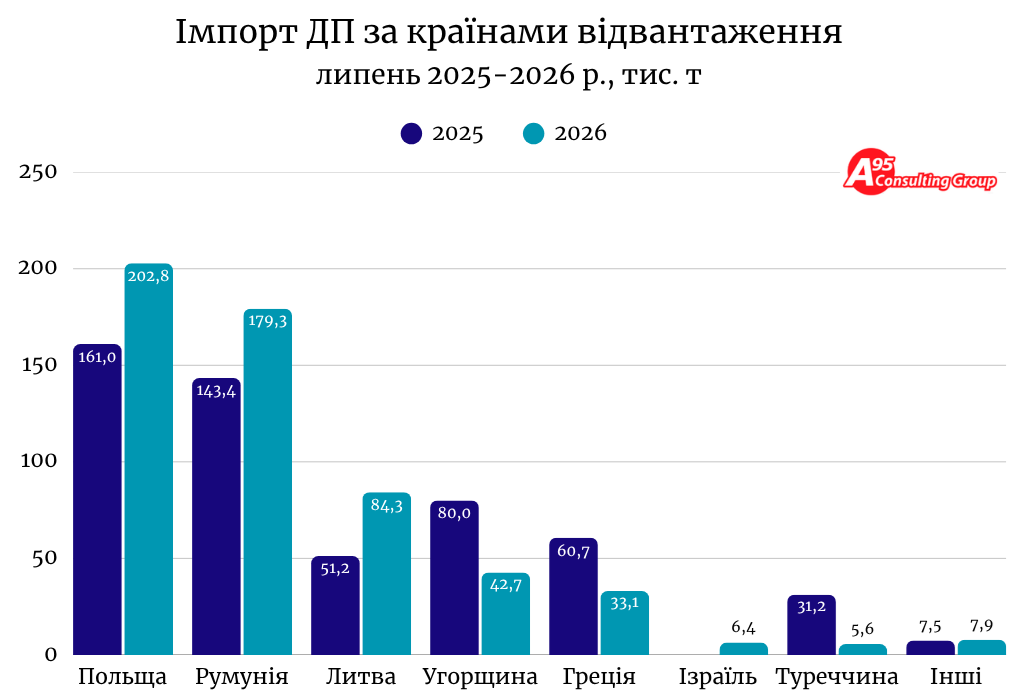
Poland was the largest supplier, providing 202,800 tonnes, or about 36% of total imports. Over the year, Polish supplies increased by 26%, from 161,000 tonnes.
Romania ranked second with 179,300 tonnes. Supplies increased by 25% and reached their highest level since the beginning of 2025.
Lithuania ranked third, demonstrating the highest growth rate among the three main suppliers. Imports from the country increased by 65%, from 51,200 tonnes to 84,300 tonnes.
Together, these three countries supplied about 466,000 tonnes of diesel fuel out of total imports of 562,000 tonnes.
This supply structure resulted from a significant restructuring of Ukraine’s fuel logistics.
According to A-95 Director Serhii Kuiun, the increased pressure on the Polish route is primarily associated with the record shallowing of the Danube and security risks.
At the same time, the importance of several alternative routes declined sharply. Supplies from Hungary decreased from approximately 80,000 tonnes in July last year to 42,700 tonnes this year, while supplies from Greece fell from 60,700 tonnes to 33,100 tonnes. Imports from Türkiye also declined to several thousand tonnes.
The high concentration of supplies allows the Ukrainian market to use the developed infrastructure of EU countries, but simultaneously increases its dependence on the stability of several major logistics corridors.
At the corporate level, ORLEN S.A. remains the largest supplier. Through its refineries in Poland and Lithuania, the company shipped 137,000 tonnes of diesel fuel to Ukraine, accounting for about a quarter of total imports.
Source: A-95 Consulting Group, Experts Club

In July 2026, the state-owned company Ukrnafta increased its diesel fuel imports by 2.4 times compared to July of last year—to nearly 60,000 metric tons—ranking second among the country’s largest importers.
These figures were reported by the “A-95 Consulting Group.” A total of 134 companies imported diesel fuel in July.
The OKKO Group retained first place, importing more than 73,000 metric tons of diesel fuel. Its imports rose by 32% compared to July 2025.
Ukrnafta accounted for about 59,800 metric tons, or approximately 10.6% of the country’s total diesel fuel imports in July.
UPG took third place with 53,200 metric tons. Next came Energo Trade JSC with 50,700 metric tons and WOG with 42,900 metric tons.
Thus, the five largest importers together imported about 280,000 metric tons of diesel fuel—nearly half of the total volume of supplies to Ukraine in July.
Among the major market players, the Western Fuel and Energy Company (ZPEK) demonstrated the highest growth rate, increasing its imports by a factor of 5.3—to approximately 32,000 metric tons.
The sharp increase in Ukrnafta’s purchases comes amid its growing role in the Ukrainian petroleum products market following the expansion of its own network of gas stations and trading operations.
Overall, Ukraine imported 562,000 metric tons of diesel fuel in July—5% more than a year earlier.
However, despite the rise in imports, A-95 reported a fuel shortage in the market. Analysts cite several reasons for this, including increased demand following a rise in global prices, higher purchases by industrial and private consumers, and increased consumption due to the shift in agricultural exports toward road and rail transport.
In August, analysts expect the situation to gradually normalize thanks to a decline in global prices and an increase in fuel supply.
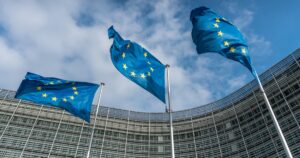
According to Experts.news, the European Commission is preparing proposals to reform the EU enlargement process, which are set to form the basis for a strategic discussion among EU leaders in October 2026. One of the key areas of discussion is the introduction of additional safeguards that would allow for the restriction of certain rights of new member states in the event they violate their obligations to the EU.
The European Commission has confirmed that it is preparing the reform. As early as July 6, an EC representative told Euronews that Brussels was working on its own proposals ahead of the October summit, as member states themselves are increasingly engaged in discussions regarding the new rules.
The European Council has officially confirmed that at its meeting on October 15–16, 2026, EU leaders will hold a strategic discussion on the Union’s enlargement and internal reforms. However, there is as yet no official confirmation that the European Commission will present the final package on October 15 specifically.
One of the most discussed options is a temporary restriction on certain voting rights of new member states.
Back in June, Germany, France, the Netherlands, Belgium, and Luxembourg proposed discussing the possibility of a transition period during which new EU members would be unable to block decisions in the most sensitive areas, where unanimity among all countries is currently required.
This primarily concerns foreign policy, the EU budget, and the Union’s further expansion.
In addition, the five countries propose including special safeguard mechanisms in future accession treaties. These would allow measures to be taken against a new member state in the event of a serious deviation from the principles of democracy, the rule of law, or media freedom.
These proposals are largely linked to Hungary’s experience under Viktor Orbán, when Budapest repeatedly used the unanimity requirement to block important EU decisions.
However, for now, the discussion centers on reform options rather than newly agreed-upon rules.
This discussion is of the greatest significance for Montenegro, which is currently the most advanced candidate for accession.
According to the European Commission, the country has opened all 33 negotiation chapters, 16 of which have already been provisionally closed. Podgorica intends to conclude negotiations and become the 28th member of the European Union in 2028.
European Commission President Ursula von der Leyen stated in June that Montenegro’s accession by 2028 is “achievable.” The EU has already begun drafting the future accession treaty.
Therefore, Montenegro’s accession treaty could potentially become the first document of a new generation, providing additional guarantees for the EU following the country’s admission.
However, the European Commission is concerned about a scenario in which new conditions would be developed exclusively for Montenegro. That is why Brussels wants to establish a universal approach that can also be applied to future candidate countries.
The reform will be of direct importance to both Ukraine and Moldova.
Negotiations with both countries accelerated significantly in the summer of 2026. In June, the EU opened the first negotiation cluster with Ukraine and Moldova, focusing on fundamental issues—the rule of law, democratic institutions, and public administration. In July, negotiations also made progress on foreign policy issues.
That said, Ukraine and Moldova are much further from concluding negotiations than Montenegro.
For Kyiv, the future model is particularly important: if the EU does indeed introduce transitional restrictions on the right of veto, Ukraine could potentially gain full membership but would initially have limited ability to block decisions in certain areas.
At the same time, such a system could facilitate political consensus on Ukraine’s membership within the current EU, as some member states fear that expanding from 27 to more than 30 members would significantly complicate decision-making.
The assertion that France, Germany, and the Netherlands are generally opposed to rapid EU enlargement requires clarification. These countries support further enlargement but belong to a group of states that demand prior strengthening of institutional safeguards and stricter oversight of future members’ compliance with the rule of law. Together with Belgium and Luxembourg, they have proposed developing a new template for accession treaties.
France, in particular, takes a cautious stance regarding Ukraine’s accelerated accession. Officials in Paris are concerned about the budgetary implications, the impact of Ukraine’s large agricultural sector on the single market, and the potential for the decision-making process to become more complicated in an expanded EU.
Germany, on the other hand, actively supports enlargement but at the same time insists on reforming the European Union itself and is considering options for the gradual integration of new member states.
Essentially, the debate boils down to an attempt to resolve the tension between two objectives.
On the one hand, the geopolitical situation is prompting the EU to accelerate the accession of Montenegro, Albania, Ukraine, and Moldova. Brussels views enlargement as a tool for strengthening European security and limiting the influence of Russia and China in the Western Balkans and Eastern Europe.
On the other hand, existing member states are reluctant to admit new members who, once admitted, could use their veto power to exert pressure on other EU countries.
Therefore, the future model may be based on the following principle: full membership is granted more quickly, but some of the new member state’s political tools remain limited during a transition period, and compliance with obligations continues to be monitored even after accession.
The final parameters of such a system have not yet been agreed upon. The main political discussion is set to take place at the European Council on October 15–16, 2026, after which it will become clearer which of the proposed mechanisms may be included in the future accession treaties for Montenegro, Ukraine, Moldova, and other candidates.
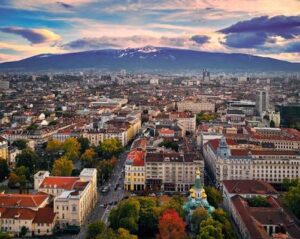
The British newspaper Metro has named Sofia the most underrated capital in Europe, highlighting the city’s combination of relatively affordable prices, historical heritage, modern cultural life, and proximity to natural attractions.
According to the British publication, the Bulgarian capital remains significantly less popular among mass tourists than traditional destinations in Western and Southern Europe, despite its potential for short city breaks.
Metro cites the British market as one example. In 2025, approximately 343,000 travelers from the United Kingdom visited Bulgaria, whereas Spain welcomes around 18 million British tourists annually. Thus, even with growing interest, the gap between Bulgaria and one of Europe’s largest tourist destinations remains vast.
At the same time, tourism in Sofia itself is growing. According to the city’s tourism authorities, the capital welcomed more than 1 million tourists from January through September 2025, and the number of arrivals increased by approximately 10% year-over-year. Foreigners accounted for about 63% of visitors.
Metro highlights Sofia’s historic center as one of its main attractions, where monuments from different eras are concentrated within a small area.
St. Alexander Nevsky Cathedral remains one of the city’s main attractions. The British publication also draws attention to the archaeological complex of ancient Serdica, a significant portion of which can be seen right in the center of modern Sofia.
The city’s proximity to Vitosha Mountain is cited as a distinct advantage. As a result, a trip to Sofia allows visitors to combine exploring the capital with hiking trails and outdoor recreation without having to travel long distances to another region of the country.
British journalists also highlight the capital’s burgeoning cultural scene. Among the events mentioned is the A to JazZ music festival, and among the cultural venues are the Sofia City Art Gallery and other museums in the city.
Another factor contributing to the city’s appeal is the relatively low cost of food, public transportation, and entertainment compared to other European capitals. Metro considers Sofia’s affordability to be one of its advantages amid rising travel costs to the most-visited cities in Western Europe.
Overall, Bulgaria welcomed approximately 13.6 million foreign visitors in 2025, a 2.7% increase from the previous year, according to data from the country’s National Statistical Institute. More than 9.5 million tourists were registered at lodging facilities, a 5.8% increase over the year.
Thus, the British Metro’s focus on Sofia aligns with a broader trend of growing interest in Bulgaria as a destination in its own right for city tourism, rather than merely as a country of summer resorts and winter getaways.



