
The government of Ukraine proposes to increase the excise tax rate for alcoholic beverages classified as “intermediate products” from 8.42 to 12.23 UAH per 1 liter, i.e. to the level of the rate for sparkling and carbonated wines.
As reported by the Ministry of Finance, the corresponding bill with amendments to the Tax Code, the Cabinet of Ministers approved at a meeting on Friday.
“Revision of excise duties is due to the need to bring national legislation closer to the legislation of the European Union, which is relevant in view of Ukraine’s status as a candidate country for EU membership,” the Finance Ministry said.
The document provides for bringing in compliance with the norms of the EU Council Directive No. 92/83/EEC classification of alcoholic beverages in the part concerning the definition of the term “intermediate products” – wines and other fermented beverages referred to codes 2204, 2205, 2206 according to the Ukrainian classification of goods for foreign economic activity. In particular, we are talking about vermouth, cider and perry.
The Ministry of Finance predicts an increase in revenues from such an increase at the level of 4.5 million UAH per month.

The international company Unilever has started construction of a new factory in Bila Tserkva, Kyiv region. Today a commemorative capsule was laid at the site of the future enterprise in the industrial park “Bila Tserkva”, the Head of Kyiv Regional State Administration Ruslan Kravchenko said on his Facebook page on Friday.
It is also reported that the amount of investment in the factory is € 20 million. Almost 100 new jobs will be created at the enterprise. The factory will produce personal care products, shampoos and shower gels, the goods will be mainly oriented for the Ukrainian market. Potentially, the enterprise will produce products for other markets in Europe.
The report notes that the total area of the site for the development is 4.2 hectares. The production capacity of the enterprise is more than 5000 tons per year. The construction of the factory is planned to be completed at the end of 2024. Erection will take place taking into account the highest environmental standards. There will be comfortable working conditions, office space is designed to meet the needs of immobile groups. A ground mobile shelter has already been arranged for safe work, and in time an underground shelter will also be built.
“The construction site of the new factory in the industrial park was not chosen by chance – there are all necessary communications and road infrastructure. The development of industrial parks supports the restoration of industry in Kyivshchyna during Russia’s war against Ukraine. The opening of new production facilities contributes to the income and well-being of local communities, increases tax revenues and stimulates the development of small and medium-sized enterprises in the region”, – said Ruslan Kravchenko.
Ruslan Kravchenko thanked the CEO of Unilever Ukraine Vasyl Bovdilov and the founder of UFuture, which includes the industrial park “Bila Tserkva”, Vasyl Khmelnitsky for the example, which “should be followed by other investors and joint efforts to develop the economic potential of Kyiv region”.
Earlier it was reported that Unilever Plc will allocate EUR20 mln for the construction of a factory in the Kiev region to produce personal care products, shampoos and shower gels under the brands Dove, Axe, TRESemmé and Clear,

Ukraine’s state budget has received a $230 million loan from the Japanese government under the World Bank’s Emergency Project for Inclusive Support for the Recovery of Agriculture in Ukraine (ARISE), the Finance Ministry said on Friday evening.
“In the conditions of war, agriculture suffers significant losses, which, in turn, jeopardizes food security not only in Ukraine but also around the world. Raising funds under ARISE is an important contribution to providing access to financing for the agricultural business of Ukraine,” Finance Minister Sergii Marchenko said in a release.
It is specified that the funds were raised from the Trust Fund for the Promotion of the Necessary Expansion of Credit for Ukraine (ADVANCE Ukraine).
The Ministry of Finance recalled that the ARISE project aims to support farmers’ access to finance through concessional lending (compensation for costs under the 5-7-9 program) and improve small farms’ access to finance through grants.
The amount of project funding is currently $550 million, of which $500 million will be used to finance the state program “Affordable Loans 5-7-9%” in 2023-2024 with a focus on agricultural enterprises, and almost $50 million is provided for grants for small farmers.
As reported, on March 20, Ukraine received the first tranche of EUR4.5 billion from the EU under the Ukraine Facility program and $1.5 billion from Canada, while before that, all external revenues amounted to only $1.2 billion since the beginning of the year. In addition, on Friday night, the IMF Board of Directors approved the disbursement of the fourth tranche of the EFF Extended Fund Facility program to Ukraine, which should arrive in two to three days.
According to the National Bank, Ukraine may receive external financing worth $10 billion or even more from mid-March to the end of April, against the $37.3 billion required in the state budget for the entire year.
In January-February this year, Ukrainian companies increased exports of ferrous scrap by 62.6% year-on-year to 40,354 thousand tons from 24,822 thousand tons.
According to statistics released by the State Customs Service (SCS) on Wednesday, exports of scrap metal increased 2.15 times in monetary terms to $12.903 million from $7.104 million.
Scrap metal exports in January-February were carried out to Poland (95.50%), Germany (4.39%) and Lithuania (0.09%).
In February, 23,194 thousand tons of scrap metal were exported (17,160 thousand tons in January) for $7.825 million ($5.078 million in January).
In the first two months of the year, the country imported 191 thousand tons of scrap metal for $68 thousand. Imports were carried out from Slovakia (77.94% in monetary terms), Poland (16.18%) and Moldova (5.88%), while in January-February 2023, 45 thousand tons were imported for $16 thousand.
As reported, in 2023, the scrap collecting enterprise of Ukraine increased the export of scrap metal from the country by 3.4 times compared to the previous year – up to 182,485 thousand tons from 53,557 thousand tons. In monetary terms, exports increased 2.74 times to $52.723 million from $19.271 million.
Earlier, Ukrmetallurgprom President Oleksandr Kalenkov stated in an op-ed on the Interfax-Ukraine website that scrap metal is exported through the European Union, which has a preferential export duty of EUR3 per ton, and from there the raw materials are redirected to real customers. He noted that exporting raw materials directly to customers would cost EUR180 in export duties, and the Ukrainian budget has already lost UAH 350 million.
The head of Ukrmetallurgprom called for a temporary ban on the export of ferrous scrap to provide steelmakers with strategically important raw materials in the ongoing war. He also clarified that a ton of scrap metal processed into steel brings in 10 times more to the budget than the EU export duty, which is about $300 per ton.
In 2022, Ukraine reduced exports of ferrous scrap by 11.5 times compared to the previous year, to 53,557 thousand tons, and in monetary terms, it decreased by 12.4 times, to $19.271 million.
Estimated number of population in regions of Ukraine based on number of active mobile sim cards (mln)
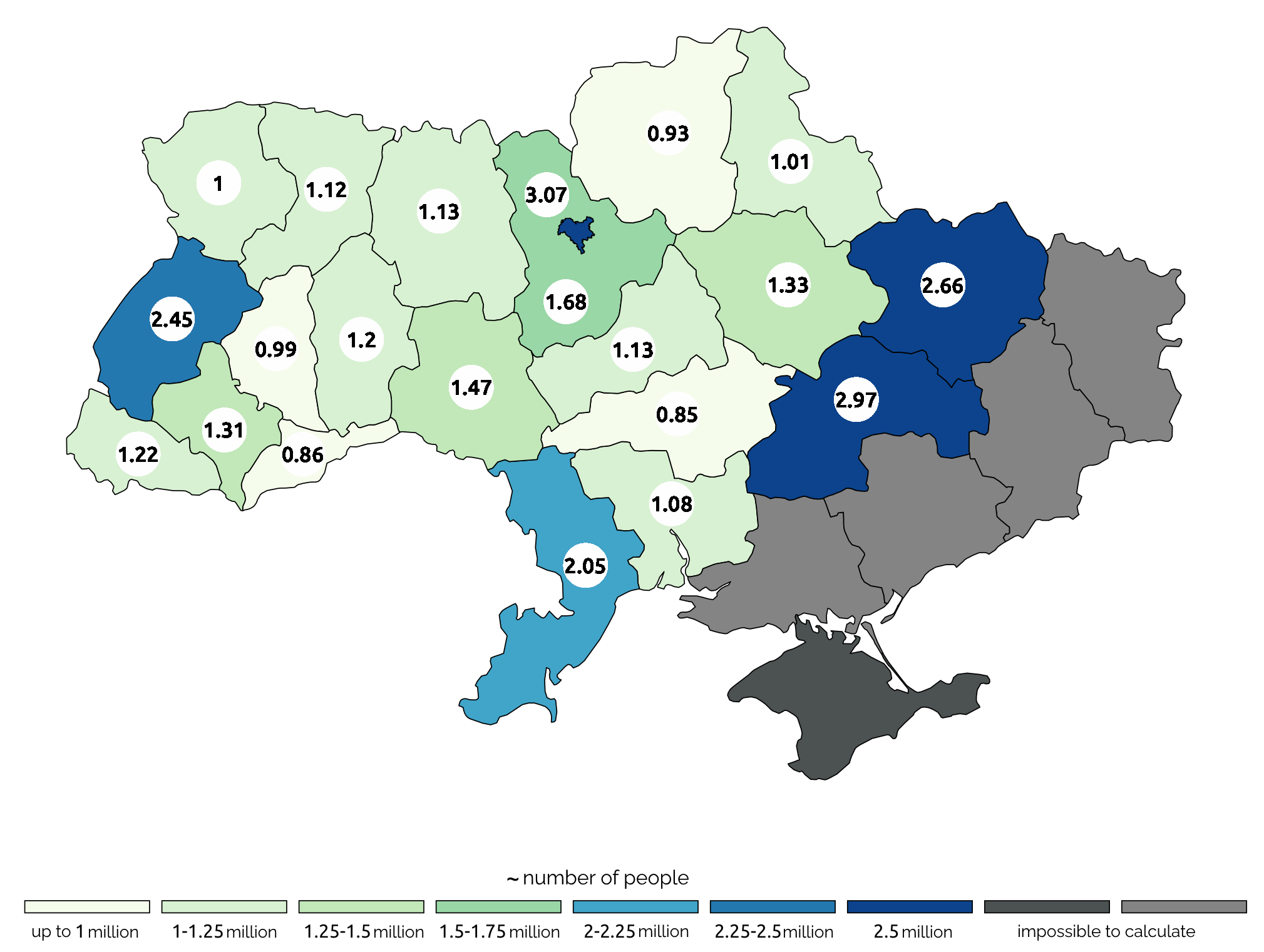
Source: Open4Business.com.ua and experts.news
In January-February of this year, Ukrainian mining companies increased exports of iron ore in physical terms by 2.64 times compared to the same period last year, to 5 million 664.230 thousand tons.
According to the statistics released by the State Customs Service on Wednesday, foreign exchange earnings from iron ore exports increased 2.34 times to $552.818 million over the period under review.
Iron ore was exported mainly to China (40.32% of supplies in monetary terms), Slovakia (17.22%) and Poland (11.50%).
In the first two months of 2024, Ukraine imported iron ore worth $29 thousand in a total volume of 102 tons, while in January-February 2023, it imported iron ore worth $17 thousand in a volume of 28 thousand tons. Imports in January-February 2024 were carried out from Norway (44.83%), Slovakia (27.59%) and Italy (27.59%).
As reported, in 2023, Ukraine decreased exports of iron ore in physical terms by 26% compared to 2022 – to 17 million 753.165 thousand tons, foreign exchange earnings from iron ore exports amounted to $1 billion 766.906 million (down 39.3%). Iron ore was exported mainly to Slovakia (28.39% of supplies in monetary terms), the Czech Republic (19.74%) and Poland (19.56%).
Last year, Ukraine imported iron ore worth $135 thousand in the total amount of 250 tons. During this period, imports were made from Norway (34.81%), Italy (28.89%) and the Netherlands (28.89%). While in 2022, iron ore was imported for $65 thousand in a total volume of 101 tons.
In 2022, Ukraine decreased exports of iron ore in physical terms by 45.9% compared to 2021 – to 23 million 984.623 thousand tons, while foreign exchange earnings decreased by 57.8% to $2 billion 912.974 million. Iron ore was exported mainly to Slovakia (19.23% of supplies in monetary terms), the Czech Republic (17.32%) and Poland (16.49%).
In 2022, Ukraine imported iron ore worth $65 thousand in a total volume of 101 tons, while in 2021 – $184 thousand in a volume of 1,202 thousand tons. Imports were carried out from Norway (36.92%), the Netherlands (27.69%) and the UK (16.92%).



