
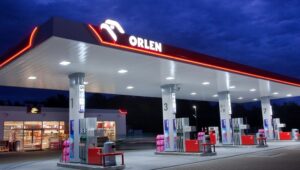
Polish oil concern Orlen, which owns Orlen Lietuva, which operates the Mazeikiai refinery, sold PLN2.292 billion ($513.1 million at current exchange rates) worth of products to customers headquartered in Ukraine in the first half of 2023, up 61.9% from the first half of 2022.
According to the company’s consolidated report on the Warsaw Stock Exchange, meanwhile, revenue in Ukraine fell by 8.2% to PLN1.046 billion ($234.2 million) in the second quarter of this year to the second quarter of last year.
The document specifies that directly Polish Orlen increased sales for Ukraine in the first half of the year to PLN1.253 billion ($280.5 million), although in the second quarter they decreased by 39.2% to PLN541 million ($121.1 million)
Overall, the Polish oil major’s sales jumped 79.1% to PLN184.891 billion ($41.4 billion) in the first half of this year, including a 29.1% jump to PLN74.612 billion ($16.7 billion) in the second quarter of this year.
The report indicates that since the beginning of February 2023, after the expiration of the contract with Rosneft, Russian oil supplies have covered only about 10% of the company’s demand for the commodity.
“These were only pipeline deliveries that were not subject to international sanctions,” Orlen pointed out.
It added that at the end of February 2023, the Russian side suspended deliveries through the Druzhba pipeline to Poland, which consequently led to the termination of the last contract with Tatneft for pipeline deliveries of crude oil to Poland from the Russian direction, so currently ORLEN refineries in Poland do not receive crude oil from Russia.
It is emphasized that the company has recently taken intensive actions to diversify supplies to the above mentioned refineries, which are carried out by sea transport from the North Sea, West Africa, the Mediterranean basin, as well as the Persian Gulf and the Gulf of Mexico. Among others, Saudi Aramco is an important partner in the import portfolio for this feedstock, with whom Orlen has a strategic contract for crude oil supply in 2022. In addition, a long-term contract with BP for the supply of Norwegian crude oil was also concluded in 2023. Thus, according to the group, the suspension of oil supplies from Russia will not affect the supply of the company’s Polish customers, including gasoline and diesel fuel.

Ukraine ranks 28th in the world in wine production according to data for 2022, reported in the center of socio-economic research “CASE Ukraine”.
“We produced as of 2022 660 thousand hectoliters, or 0.26% of the world wine market,” – stated the experts.
According to the report, the first place belongs to Italy with 49.843 million hectoliters, which is 19.3% of total world production, the second – France (45.59 million hectoliters, 17.65%), the third – Spain (35.7 million hectoliters, 13.83%).
The analysts attributed the reasons for Ukraine’s low wine production to the destruction of vineyards in the Soviet Union during the fight against alcoholism, the Russian Federation’s transformation of the wine-growing regions of Kherson and Mykolaiv regions into a frontline zone since the occupation of Crimea in 2014, as well as the absence of a land market until 2020 and the existence of restrictions on land acquisition by legal entities and foreign investors.
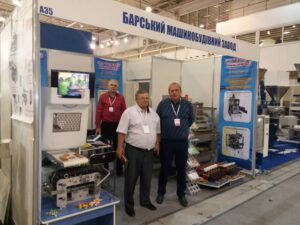
PrJSC Barskyi Machine-Building Plant (Barmash, Bar, Vinnytsia region), a major Ukrainian manufacturer of equipment for the food industry, gas and electric boilers, plans to use its net profit of UAH 1.6 million in 2022 for business activities.
This is stipulated by the draft decision of the company’s general shareholders’ meeting scheduled for September 28, the agenda of which has been published in the information disclosure system of the National Securities and Stock Market Commission (NSSMC).
In particular, the shareholders intend to amend the company’s charter and replace the management board with a new management board. In this regard, it is planned to terminate the powers of the Chairman of the Board Ilya Luka, his First Deputy Gennadiy Luka and members of the Board Vasyl Gontar and Oleksandr Lototskiy.
At the same time, it is proposed to elect Ilya Luka (CEO) and Gennadiy Luka (director) to the board, who, according to the Unified State Register of Legal Entities and Individual Entrepreneurs, are the ultimate beneficiaries of Barmash.
The Bar Machine-Building Plant produces, among other things, equipment for the alcoholic beverage, wine, oil and fat, canning, confectionery, and bakery industries, and since 2000, gas, electric, and solid fuel heating boilers under the ThermoBar brand.
According to opendatabot, in 2022, the company reduced its net income by 19.4% compared to 2021, while net profit increased to UAH 1.6 million from UAH 0.92 million.
According to the company, its assets amounted to UAH 94.29 million in 2022 (down 12.7%), including total receivables, which decreased by 36% to UAH 9.8 million. Current liabilities decreased by 7.2% to UAH 34.3 million, while long-term liabilities decreased by 14.4% to UAH 4.8 million.
Retained earnings amounted to UAH 2.52 million compared to UAH 0.92 million a year earlier.

The assets of pawnshops in the second quarter of 2023 increased by 6.2%, or by UAH 264 million – to UAH 4.54 billion, the National Bank of Ukraine said in a review of the non-banking financial sector.
According to its data, in general for the first half of the year they increased by 10.7%, or UAH 439 million, completely overlapping the reduction of UAH 188 million last year.
At the same time, it is indicated that the number of pawnshops continues to decline: after leaving the market last year 78 companies, in the first quarter of this year followed by 12, and in the second quarter – another 7 pawnshops. As a result, the number of market participants at the middle of this year was 164 – almost half the number at the end of 2019 (324).
The National Bank specified that among all sectors of the financial market, pawnshops were the fastest-growing both in the second quarter of this year and over the half-year, surpassing even banks, whose assets grew by 5.6% and 8.8%, respectively.
According to the NBU, the loan portfolio of pawnshops added UAH 245 million and UAH 298 million in the first and second quarters, respectively, reaching UAH 3.672 billion at the end of the period.
This allowed to increase interest income in the first quarter to UAH 656 million, in the second – to UAH 780 million, which is respectively by 2.9% and 96.8% more than in the same period last year.
At the same time, although revenues for salaries rose from UAH 100 million in the fourth quarter of last year to UAH 121 million in the second quarter of this year, they are still much lower than the approximately UAH 200 million before the war.
Rent expenses have also increased: from UAH 93 mln in the fourth quarter of last year to UAH 111 mln in the second quarter of this year, although before the war they amounted to about UAH 170 mln.
According to the results of the first quarter of this year, the net profit of pawnshops amounted to 14.21 million UAH, at the end of the second quarter it increased to 52.26 million UAH, while the same periods last year pawnshops ended with a net loss of 56.86 million UAH and 123.89 million UAH, respectively.
The volume of cash assets of pawnshops after a decrease in the first quarter from UAH 388 mln to UAH 340 mln in the second quarter increased only by UAH 3 mln, while the volume of fixed assets decreased during the half-year from UAH 463 mln to UAH 381 mln, probably due to the reduction in the number of companies in the market.
The growth of loans was largely due to an increase in accounts payable: from UAH 2.512 billion at the beginning of the year to UAH 2.659 billion at the end of the first quarter and UAH 2.902 billion at the middle of the year, while shareholders’ equity grew by only UAH 83 million to UAH 1.44 billion during this time.
The National Bank added that after the coverage ratio fell to 108% in the first quarter, it recovered to 111% in the second quarter. As for the structure of collateral, the share of precious metal products rose from 72% to 73% over the six months, while the share of household appliances fell from 28% to 26%.

Ovostar Union, one of the leading producers of eggs and egg products in Ukraine, earned $20.63 million in net profit in the first half of 2023, while the same period in 2022 ended with a net loss of $19.78 million.
According to the group’s report on the Warsaw Stock Exchange, its revenue for the six months increased by 56.8% to $88.69 million, mainly due to higher prices for its products.
Gross profit in the first half of this year amounted to $26.99 million against a gross loss of $10.39 million last year, operating profit – $20.12 million against a loss of $17.57 million, and EBITDA – $21.7 million against a negative $15.5 million in the first half of last year.
It is indicated that such an increase in profitability was also achieved by reducing the cost of sales by more than half – from $47.8 million to $23 million – due to good feed prices and the devaluation of the hryvnia.
The group also reported that its total debt for the year decreased from $12.5 million to $2.5 million, while free cash flow increased from $3.7 million to $50.3 million, including $0.5 million to $24.7 million in Ukraine (including the equivalent of $7.6 million in hryvnia), $3.1 million to $21.2 million in Lithuania, and $0.02 million to $4.2 million in the UAE. As a result, the net debt increased from $8.8 million to negative $47.9 million. In particular, Ovostar has fully repaid its loans to Ukrsibbank and OTP Bank for $8.5 million.
According to the report, the share of egg sales in revenue decreased to 70% from 74% in the first half of last year, while the share of egg products increased from 26% to 30%. At the same time, the share of egg exports in total revenue increased from 23% to 36%, and the share of egg products exports increased from 13% to 18%.
“Against the backdrop of the ongoing Russian military invasion of Ukraine and the overall unfavorable situation in the national economy, the management decided to suspend the investment program,” the document also says.
As specified, in the reporting period, only minor investments were made in production facilities and infrastructure, amounting to $5.8 million compared to $4.3 million in the first half of 2022.
In the first half of this year, Ovostar withdrew from the International Food Trade company (British Virgin Islands).
In mid-June 2011, the group’s holding company, Ovostar Union N.V., conducted an IPO of 25% of its shares on the WSE and raised $33.2 million. The majority stake in the company is owned by Prime One Capital Limited, which is controlled by its CEO Boris Belikov and Chairman of the Board of Directors Vitaliy Veresenko.
“In 2022, Ovostar earned $6.09 million in net profit, which is 3.7 times more than in 2021. At the same time, revenue increased by 1.7% to $135.63 million.
In the first quarter of 2023, the group earned $8.98 million in net profit, while the same period in 2022 ended with a net loss of $16.44 million. Its revenue for the period increased by 70.7% to $47.30 million.

Romania will double the capacity of its main Black Sea port of Constanta and the Danube sea lanes within two months to help Ukraine deliver grain beyond Russia’s reach, Romanian Prime Minister Marcel Ciolacu told the Financial Times.
The Romanian prime minister emphasized that the plan would be implemented regardless of Russian attacks on Ukrainian ports on the other side of the Danube, on the border with Romania.
“In 2023, Ukraine will have about 40 million tons of grain for export. To (facilitate) this, we have increased capacity both in Constanta harbor and on the routes leading to Constanta harbor to make this happen. We mobilized as much as we could,” he said.
Ciolacu recalled that Romania’s promise to expand the shipping corridor by deepening the Danube and expanding port infrastructure came after Russia withdrew from the Black Sea Grain Initiative, which allowed Ukrainian grain to reach world markets via the Black Sea. Moscow also threatened commercial ships and prevented them from leaving Ukrainian ports, which led to exports being diverted through the Danube.
“We have learned well the lessons related to Russia. We have zero dependence on Russian energy and resources. Our support for Ukraine is unconditional,” the Romanian Prime Minister emphasized.
According to him, increasing the capacity of the Black Sea port of Constanta and other routes will allow Ukrainian grain exports to reach 4 million tons per month.
Ciolacu said that investments are currently being made in the Sulina Canal. In addition, there are other “solutions”, such as allowing ships to transit at night from October and increasing cargo transportation to at least 14 ships per day. Doubling the size of barges also “means that Ukraine will not have to use grain warehouses as often,” he said.
The prime minister informed that Romania will open more road border crossings and improve its railroad infrastructure at stations bordering Ukraine to speed up cargo handling.
“Romania has remained silent on military aid to Kiev,” the FT writes and adds that increased military and infrastructure spending related to the war in Ukraine is having an impact on the country’s budget. Romania’s central bank predicts the budget deficit will jump to 7.5% of gross domestic product this year, well above the target of 4.4% and 6.2% in 2022.
Ciolacu intends to meet with EU officials in Brussels this week to discuss measures to close the financing gap. He said there was “no possibility” that the EU would cut Romania’s funding to impose more austerity on Bucharest.
“We had to reorganize the budget to help Ukrainian supplies,” the prime minister said, adding that he would try to get EU approval to take war-related items outside the deficit calculations.
“These were unanticipated expenditures … so we will need an exemption from the tax code,” Ciolacu summarized.



