

SoftServe, an IT company with Ukrainian roots, announced the active return of its own specialists from abroad and from western regions.
An average of 10-20 people return home from overseas and western regions every day, the company said in a statement released on Wednesday.
“Since the beginning of Russia’s invasion of Ukraine, the SoftServe IT company has relocated more than 4,000 employees to the western regions and abroad. However, since May, the company has observed a trend towards the return of IT specialists to their usual locations – now 1082 people have returned home”, – is noted in the message of the company.
According to SoftServe, since May, the dynamics of people returning from abroad has been constant: according to the company’s internal statistics, 10-15 people return to Ukraine every day.
“In May, the most people were outside Ukraine – 1,900 employees. Since then, this figure has steadily decreased, and now 314 employees have arrived in Ukraine. According to surveys, about 170 more are planning to return home as soon as possible. However, we, as a company we go as far as possible towards the decision of employees regarding where to work from.For those who want to stay abroad, we offer the possibility of employment in local branches of the company for a year or even longer in the hub countries: Poland, Romania, Bulgaria and Latin America”, – comments Ekaterina Gubareva, VP HR SoftServe.
Most of all, SoftServe IT specialists return to Kyiv: as of the beginning of June, more than 400 people arrived there.
“Our offices in Kyiv have not closed their doors to employees and their families since the beginning of the war and have served as a shelter and place of work. When it became relatively safe, we switched to normal operation. Now two of our offices have co-working spaces, where an average of 10 % of employees, but there is an upward trend. In the summer, we plan to launch a certification center and equip a parking lot with chargers for electric cars,” Elena Lebedeva, director of the Kyiv development center, is quoted in the message.
Slower, but also brass knuckles, the number of people who return to the Dnieper (+38 people since April) and Kharkiv (+10 people since May).
However, 10 workers have left Odessa since May.
In addition, there is a trend towards returning to their usual places of residence of workers who were forced to leave for the western regions of Ukraine.
In total, more than 1,100 SoftServe employees have moved since the beginning of the war in Lviv, Ivano-Frankivsk and Uzhgorod – now almost a quarter of them have already left, and this process is dynamic.
Almost half of the people who relocated to the city since the beginning of the war left Ternopil.
Less active workers are leaving Vinnitsa, Khmelnitsky and Rivne.
According to internal surveys, as of today, 99% of SoftServe employees say they are safe. For comparison, in March this figure was 84%.
SoftServe is included in the list of the largest IT service companies in Ukraine. To date, it has about 13.5 thousand employees and 40 offices around the world. The main offices of the company are located in Lviv and Austin (Texas, USA). The company’s development centers are located in Lviv, Kyiv, Dnipro, Kharkov, Rivne, Ivano-Frankivsk, Chernivtsi, Uzhgorod, Ternopil, Odessa, Vinnitsa and Khmelnitsky, as well as in Poland, Bulgaria, Romania and Latin America.

Import volumes from Russia to Germany have continued to grow since the beginning of 2022, while trade between Germany and Ukraine has fallen, Ukrainian Ambassador to Germany Andriy Melnyk said.
“This is madness. Despite the Russian aggressive war, in January-April 2022, Germany increased imports from Russia by 60% (!) and transferred almost 6 billion euros more to Moscow. Trade between Ukraine and Germany fell by 11%,” Melnyk wrote on Twitter.

During the sowing campaign-2022, Ukraine sowed 13.4 million hectares of land with the main agricultural crops, which is 93% of the 14.4 million hectares planned for the current season, including 0.22 sown during the week (June 3-9) million hectares, the Ministry of Agrarian Policy and Food announced on Friday.
According to the data published on its website, as of June 9, the area under sunflower crops is 4.69 million hectares (95% of the 4.93 million hectares planned for 2022), corn – 4.63 million hectares (95% of 4.85 million ha), spring barley – 951.2 thousand ha (93% of 1.02 million ha), spring wheat – 191.1 thousand ha (sowing completed), oats – 159.2 thousand ha (97% of 163 .6 thousand ha), peas – 130.6 thousand ha (89% of 145.7 thousand ha).
In addition, the sown area under potatoes is 1.11 million hectares (93% of 1.19 million hectares), soybeans – 1.21 million hectares (97% of 1.25 million hectares), sugar beet – 182.1 thousand hectares. ha (88% of 206.9 thousand ha), spring rapeseed – 33.4 thousand ha (sowing completed), millet – 48.5 thousand ha (78% of 62.3 thousand ha), buckwheat – 74 .9 thousand ha (92% of 81.6 thousand ha).
The Ministry of Agrarian Policy clarified that the area sown this season has already amounted to 81.7% of the indicators of last year, in which 16.92 million hectares were sown.
The ministry stressed that harvesting of winter crops will begin in some regions from next week. They were sown in 2021 on a total area of 7.7 million hectares, including 6.5 million hectares under winter wheat, 1 million hectares under barley, and 0.16 million hectares under rye.
As reported, due to the military aggression of the Russian Federation in Ukraine this season, a reduction in the acreage of high-margin crops (sunflower and corn) is expected while increasing the acreage of crops that are easier to produce, but important in terms of food security – peas, barley and oats.
Prime Minister of Ukraine Denys Shmyhal announced on April 20 that Ukraine will sow approximately 14.2 million hectares of agricultural land this season, which is 80% of last year’s figure of 16.9 million hectares.
Earlier, the Ministry of Agrarian Policy estimated the sown area under spring crops in 2022 at 13.44 million hectares compared to 16.92 million hectares in 2021.
Rostislav Shurma, Deputy Head of the President’s Office, called the goal of Ukraine in 2022 to harvest at least 70% of last year’s volumes.

President of the European Commission Ursula von der Leyen said she had arrived in Kyiv and intended to meet with President of Ukraine Volodymyr Zelensky.
“Good to be back in Kyiv. With President Volodymyr Zelensky I will take stock of the joint work needed for reconstruction and of the progress made by Ukraine on its European path,” she said on Twitter.
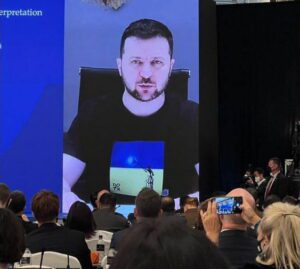
President of Ukraine Volodymyr Zelensky said that the world must always support proactive measures to prevent violence.
He said this on Saturday at the 19th Asia Shangri-La Dialogue Security Summit, answering a question about what can be done to counter China’s campaign of economic and military coercion against Taiwan.
“I think that today’s example of Ukraine is an example for the whole world. The world must always support any action related to pre-emptive measures so that there is no war,” he said.
According to Zelensky, “there is no positive from the war in the world. No one gets a positive, except for some political leaders who daily increase their ambitions because of their political appetite.”
“The world should decide everything diplomatically. Support states that need it. Do not leave this or that state alone with another state, which may be stronger financially, territorially, in terms of weapons. If problems can be solved by diplomacy, they must be solved,” he said.
“But do not turn on after the war starts, when there are tens and hundreds of thousands of victims. The war does not benefit anyone except the ambitions of some people,” Zelensky stressed.
According to Olivia Enos, senior political analyst at the Center for Asian Studies, the Chinese delegation left the hall during Zelensky’s speech.
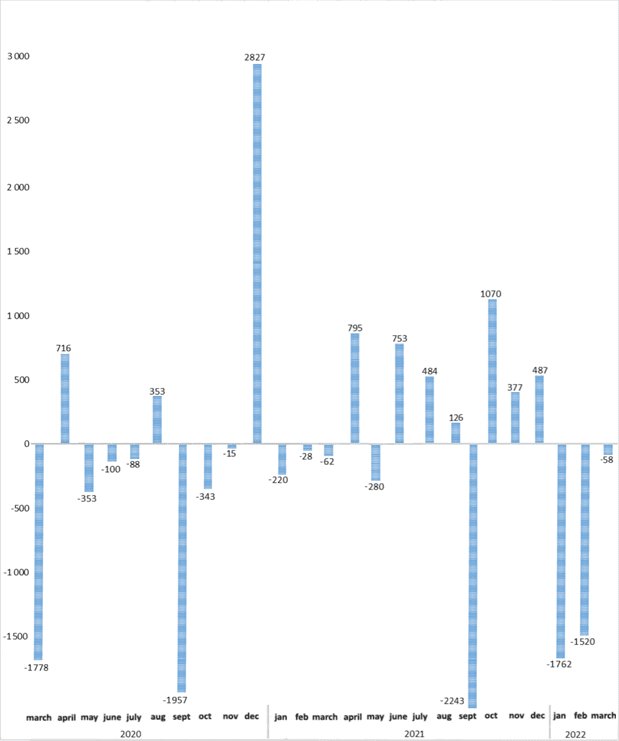
Dynamics of balance of payments of Ukraine (USD mln)
NBU



