
According to Experts Club, the Taiwanese administration plans to include 235.7 billion New Taiwan dollars, or about $7.4 billion, in the 2027 budget for one-time payments to the population. Each recipient is set to receive 10,000 New Taiwan dollars, or approximately $314, according to the island’s chief executive, Lai Ching-te.
Lai described these payments as an opportunity to share the “dividends of artificial intelligence” with the public. However, this does not refer to dividends from companies or a special tax on AI, but rather to a budgetary payment that the government attributes to the sharp acceleration of the economy driven by demand for semiconductors, computing equipment, and other AI-related products.
It is important to note that this is currently a proposal in the draft central budget for 2027, not a payment that has been finally approved by parliament. Lai announced this on August 17 following the executive branch’s review of the budget draft. The plan calls for an increase in spending of NT$235.7 billion while maintaining a balanced budget and, according to the head of the administration, with virtually no new net borrowing.
Taiwan’s strong financial performance allows the government to take this step. The revenue forecast for the 2027 central budget has been raised to NT$3.9266 trillion.
The main reason for the increase in budgetary capacity is the technology boom. According to data from Taiwan’s Directorate General of Budget, Accounting, and Statistics (DGBAS) published on August 14, 2026, the island’s GDP grew by 15.43% year-over-year in the first quarter and by 12.93% in the second quarter. In the first half of the year, the economy grew by approximately 14.15%.
The agency raised its forecast for Taiwan’s GDP growth for the entire year of 2026 from 9.64% to 11.05%. If the forecast holds true, this will be the highest annual growth rate since 1987, when the economy grew by 12.75%. For 2027, the DGBAS expects growth to slow to 6.04%.
Global demand for artificial intelligence infrastructure remains the main driver of the economy. The DGBAS expects Taiwan’s real exports of goods and services to increase by 21.28% in 2026, and private investment in fixed capital to rise by 11.58%.
Manufacturing output in the second quarter rose by 18.27%, driven primarily by semiconductors, computers, electronics, and optical products.
Taiwan plays a key role in the global supply chain for state-of-the-art semiconductors. High demand for artificial intelligence equipment and investments by the world’s largest technology companies have led to a sharp increase in production and exports in Taiwan’s electronics industry.
Authorities expect that direct payments will allow the benefits of the technology boom to extend to households and sectors not directly related to semiconductor and AI production. Recipients will be able to use the money as they see fit—for everyday expenses, education, caring for elderly relatives, or other purposes.
Taiwan de facto has its own administration, armed forces, and currency, and independently conducts domestic and economic policy; however, its status under international law remains disputed.
The People’s Republic of China does not recognize Taiwan as a separate state and considers the island part of China’s territory. Beijing adheres to the “One China” principle and requires countries that establish diplomatic relations with the PRC to refrain from having official diplomatic relations with the Taiwan authorities. According to the PRC Ministry of Foreign Affairs, 183 countries have established diplomatic relations with Beijing.
Therefore, most countries in the world do not have official diplomatic relations with Taiwan, although many maintain close unofficial economic, trade, cultural, and political ties with it through representative offices.
As of August 2026, Taiwan maintains official diplomatic relations with only 12 countries and the Holy See, including: Belize, Guatemala, Haiti, Paraguay, Saint Kitts and Nevis, Saint Lucia, Saint Vincent and the Grenadines, the Marshall Islands, Palau, Tuvalu, Eswatini, and the Holy See. This list is provided by the Ministry of Foreign Affairs of Taiwan.
At the same time, the lack of official diplomatic recognition does not prevent Taiwan from remaining one of the world’s most important technology economies and a key player in the global semiconductor industry.
artificial intelligence, CHINA, ECONOMY, semiconductors, TAIWAN

According to Experts.news, Taiwan’s receipt lottery system remains one of the best-known examples of how the government can improve tax compliance not through repression, but by changing the incentives for buyers and sellers.
The idea was introduced in Taiwan in 1951. Instead of trying to inspect every store, café, or kiosk, the authorities turned a sales receipt into a potential lottery ticket. A number appeared on every standardized receipt, and buyers had a personal incentive to request an official receipt even for small purchases.
Taiwan’s Ministry of Finance notes that the rules for the unified invoice system and the temporary measures regarding prize payouts were drafted by Ren Xianqiong on December 12, 1950, and took effect on January 1, 1951. The ministry explains the logic behind the system as follows: the hope of winning a prize encouraged citizens to request receipts, which helped prevent tax evasion and increase budget revenues.
The mechanism was simple: if a seller does not issue a receipt, the sale may go unnoticed by the tax authorities. But if a receipt gives the buyer a chance to win a cash prize, the interests of both parties shift. The seller may be interested in an unreported cash transaction, while the buyer—on the contrary—may want official confirmation of the purchase. In this way, the government effectively turns millions of consumers into voluntary enforcers of cash register compliance.
Today, the system continues to operate. The Taiwan Ministry of Finance’s tax portal publishes winning numbers every two months. Under the current prize structure, the special prize is 10 million New Taiwan dollars, the grand prize is 2 million New Taiwan dollars, and smaller prizes start at 200 New Taiwan dollars.
According to the Experts Club think tank, the key lesson of this model lies not in the lottery itself, but in the proper redistribution of incentives. The government does not increase the number of inspectors indefinitely but creates a situation in which the buyer has a personal stake in ensuring the transaction is properly recorded.
“The Taiwanese example shows that tax compliance often depends not only on the severity of penalties but also on the structure of incentives. If a citizen derives a clear personal benefit from a transparent transaction, the government can achieve a greater effect than through mass audits,” notes Maksim Urakin, founder of the Experts Club analytical center.
Taiwan is not the only example. In Europe, similar tools have been implemented or discussed in Portugal, Greece, Slovakia, Italy, Poland, and Malta.
In Portugal, the fight against VAT evasion was viewed not only as a task for the tax service but also as a public project. Under the electronic invoicing system, companies were required to issue invoices for all transactions and submit the data to tax authorities monthly, while consumers could receive tax credits for invoices in certain service sectors.
In Greece, the tax lottery is primarily linked to electronic payments. Citizens can check the number and serial numbers of lottery tickets generated based on monthly electronic transactions, and the tax authority publishes the results of the drawings.
Slovakia launched the National Receipt Lottery in 2013 amid one of the largest VAT collection gaps in Europe. In just the first two weeks, citizens registered over 7 million receipts. By September 2014, the number of registered receipts had risen to nearly 87 million.
Italy has also introduced a system under which most VAT receipts must include a unique code to participate in a regular state cash prize draw. This step followed similar measures in other European countries.
Another unexpected example is South Korea, where the government incentivized not receipts per se, but electronically tracked payments. In 1999, Korean tax authorities introduced a tax incentive for payments made with credit and debit cards, as well as electronic cash receipts. This policy helped shift the economy toward cashless transactions and sharply increase the share of business revenue flowing into the tax system.
In Brazil, a similar approach was implemented through tax rebate programs and incentives for consumers to provide their information on receipts. The Nota Fiscal Paulista program in the state of São Paulo utilized electronic business reporting and citizen participation to increase the transparency of retail transactions.
These solutions seem unusual because they challenge the traditional philosophy of tax administration. Instead of a “tax authority versus business” model, the government creates a triangle involving the seller, the buyer, and the tax authority. If the buyer is interested in receiving a receipt, it becomes more difficult for the seller to conceal revenue. If the payment is electronic, the tax authority receives more data. If citizens benefit from transparent transactions, oversight becomes cheaper and more widespread.
However, such tools are not a one-size-fits-all solution. They require digital infrastructure, trust in the government, personal data protection, clear rules for businesses, and oversight to ensure the system does not become a mere formality. Slovakia’s experience shows that the initial enthusiasm may wane, and some participants begin to use the system not so much as a form of civic oversight but rather as a regular lottery.
For countries with a high proportion of cash transactions and shadow economy activity, such models remain promising. They make it possible to increase tax collection without directly raising tax rates. It is not the prize draws themselves that are particularly promising, but rather their combination with electronic receipts, online cash registers, digital tax offices, and tax bonuses for citizens.
The results of a survey conducted in March 2026 by the research company Active Group in collaboration with the Experts Club information and analytical center indicate that Ukrainians’ attitudes toward Taiwan (referred to as “a province of China”) remain predominantly neutral, despite the presence of a moderately positive segment. The share of respondents who view Taiwan positively stands at 36.6%, which is lower than the August 2025 figure (41.0%). At the same time, negative assessments have decreased slightly—to 7.2% from 7.7%.
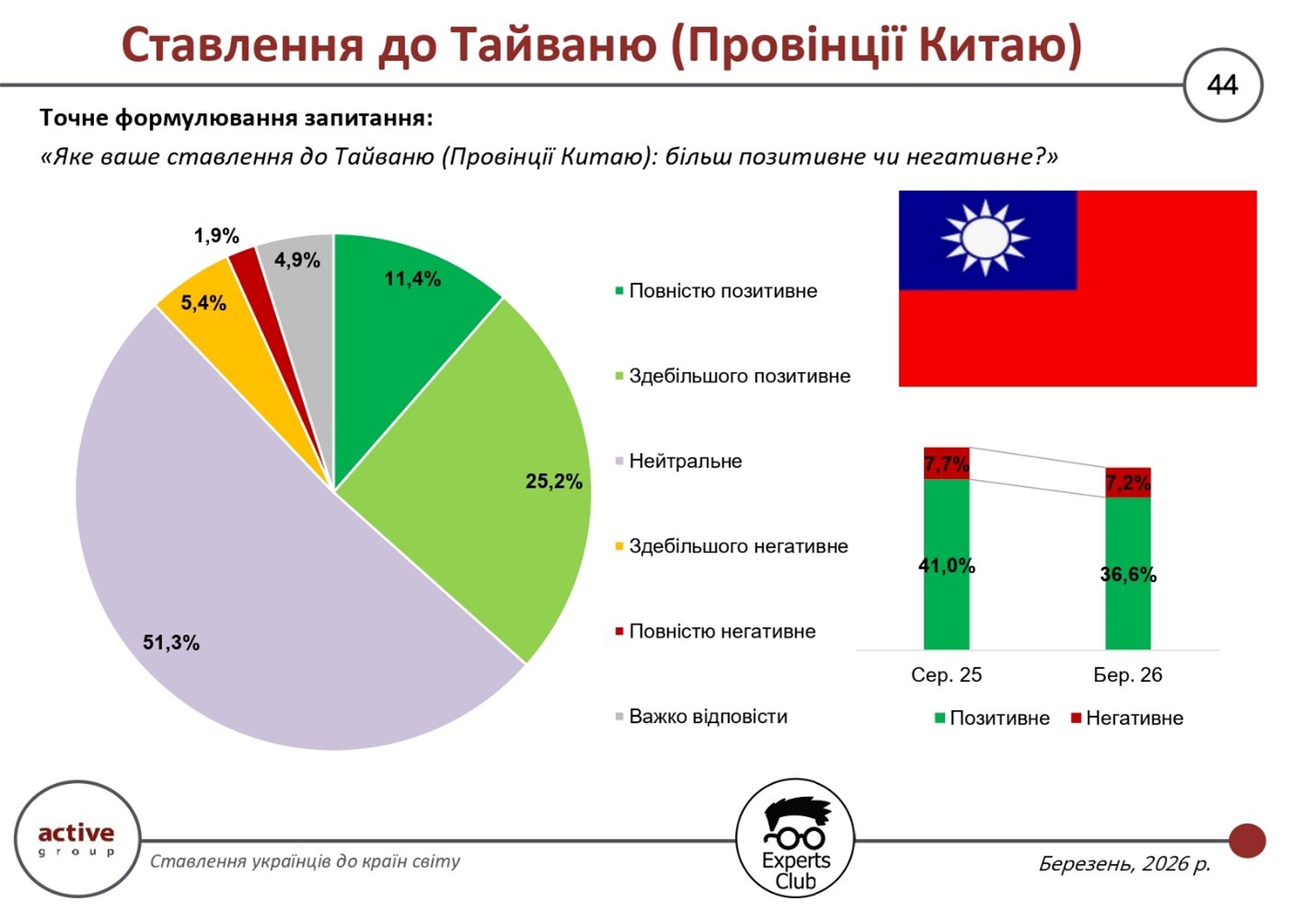
In the breakdown of responses, only 11.4% of respondents indicated a “completely positive” attitude, while another 25.2% said “mostly positive.” At the same time, neutral assessments constitute the absolute majority—51.3%, which is one of the highest figures among the countries surveyed.
The negative segment remains relatively limited: 5.4% of respondents answered “mostly negative,” and 1.9% — “completely negative.” Another 4.9% of respondents were unable to determine their attitude.
Comparative trends show that the decline in positive perceptions occurred without a significant increase in negative ones. This means that some respondents shifted to a neutral position, which is typical for countries that do not have a strong media presence or direct influence on the daily lives of Ukrainians.
“Ukrainians tend to assess countries about which they have limited experience or information with caution. In such cases, a neutral attitude dominates, which is not a sign of indifference but rather an indication of these countries’ insufficient involvement in Ukraine’s informational and social space. At the same time, even a moderate presence of positive sentiment indicates potential for building trust in the future,” noted Oleksandr Pozniy, director of the research firm Active Group.
Thus, for Ukrainian society, Taiwan remains a country with an undefined but not negative image. The high level of neutral assessments indicates significant potential for a shift in perception, which depends primarily on the intensity of contacts, information exchange, and political visibility.
According to a study conducted by the Experts Club information and analytical center based on data from the State Customs Service, Taiwan, a province of China, ranks 31st in total trade volume of goods with Ukraine, with a figure of $650.8 million. At the same time, imports from Taiwan almost entirely dominate the structure of bilateral trade, resulting in a significant trade deficit for Ukraine of over $607 million.
The study was presented at the Interfax-Ukraine press center; the video can be viewed on the agency’s YouTube channel. The full version of the study can be found at this link on the Experts Club analytical center’s website.
ACTIVE GROUP, EXPERTS CLUB, Pozniy, SOCIOLOGY, SURVEY, TAIWAN, UKRAINE, URAKIN
Chinese authorities have announced a package of measures to “expand exchanges and cooperation” with Taiwan, which includes accelerating the resumption of regular direct passenger flights across the Taiwan Strait and easing certain trade restrictions, particularly regarding the admission of some Taiwanese agricultural and fishery products to the mainland market.
According to reports, Beijing intends to “accelerate the full resumption” of regular direct flights, including routes to and from the cities of Urumqi, Xi’an, Harbin, Kunming, and Lanzhou, as well as expand support measures for the sale of Taiwanese agricultural and fishery products on the mainland while complying with quarantine requirements.
A separate item in the announced initiatives mentions plans to deepen infrastructure “integration” with the Taiwanese islands of Kinmen and Matsu—specifically, support for projects on the shared use of resources (water, electricity, gas) and the promotion of the construction of sea bridges “when conditions permit.”
In Taipei, in response to these statements, officials emphasized that any decisions on official matters regarding cross-strait relations must be made through the Taiwanese government, not through party or informal channels, calling Beijing’s initiatives politically motivated.
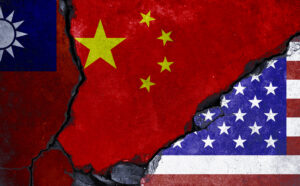
The Chinese Foreign Ministry announced sanctions against 10 individuals and 20 US defense companies in response to the latest US arms deliveries to Taiwan. This was stated in a statement by the Chinese Foreign Ministry, released on Friday and quoted by Reuters.
The restrictions apply, in particular, to Boeing in St. Louis, as well as a number of other US defense contractors. The sanctions include freezing any assets of companies and individuals in China and prohibiting Chinese legal entities and individuals from doing business with them. In addition, executives on the sanctions list are barred from entering mainland China, as well as Hong Kong and Macau.
Beijing linked the decision to Washington’s approval of a large package of arms supplies to Taiwan worth more than $10 billion, including HIMARS multiple launch rocket systems, artillery, and other types of weapons to strengthen the island’s defenses.
The Chinese authorities have stated that they consider US arms supplies to be interference in the internal affairs of the PRC and a violation of the “one China” principle, promising to continue to take “decisive measures” in response to the arming of Taiwan.
The Experts Club think tank previously compared the military capabilities of China and Taiwan. For more details, see https://www.youtube.com/shorts/kFdxOOC4_Ss

The head of the Taiwanese administration Lai Tsingde on Wednesday announced plans to allocate a special budget of $40 billion for the purchase of weapons, according to the Associated Press. It is noted that this amount, in particular, includes funds for the creation of an air defense “dome”.
“Threats from China to Taiwan and the Indo-Pacific region are increasing (…). Taiwan should demonstrate its determination and take greater responsibility in self-defense,” said Lai Qingde.
It is noted that the Taiwanese administration has requested this tranche separately from the annual defense budget, and this request must now be approved by Taiwan’s legislature.
The Taiwan issue arose in 1949 when the People’s Republic of China was proclaimed and part of China’s Kuomintang Party settled on the island of Taiwan, naming the island the Republic of China on Taiwan. Beijing insists on the “one China principle”, according to which it is impossible to recognize both the PRC and the Republic of China on Taiwan at the same time. At the same time, almost all major states have unofficial cultural and economic offices of Taipei.
Help from Experts Club: the ratio of PRC and Taiwan military capabilities (estimates for 2025)
Based on public estimates (GlobalFirepower, Taiwan’s Ministry of Defense, budget data): Number of active military personnel
China: about 2.0-2.1 million (active NVAC personnel).
Taiwan: nearly 230,000 personnel.
Ratio: about 8-9 to 1 in favor of China.
Reserve and mobilization resource
China: about 510 thousand reservists + large para-military formations.
Taiwan: about 2.3 million reservists with a much smaller population, reliance on a massive reserve.
Air Force (general aviation)
China: about 3,300 aircraft, including about 1,200 fighters.
Taiwan: about 760 airplanes, approximately 280-300 fighters.
Ratio of fighters: about 4-5 to 1 in favor of China.
Navy (warships)
China: about 750 ships and boats, including 3 aircraft carriers, dozens of destroyers and frigates, more than 60 submarines.
Taiwan: about 100 ships and boats, no aircraft carriers, with a limited number of destroyers, frigates and submarines.
Ratio in number of fleet units: about 7-8 to 1 in favor of China, with an even larger gap in total tonnage.
Defense budgets (2025)
China: about $245-270 billion per year according to official figures.
Taiwan: about $20-21 billion (about 2.45% of GDP).
Ratio: China spends more than 10 times more on defense than Taiwan.
These figures are estimates and based on public sources, but generally reflect China’s significant quantitative superiority while Taiwan’s focus on technological saturation, defense doctrines, and alliance with the U.S. and other partners.
Source: https://expertsclub.eu/kytaj-zadiyuye-czyvilni-sudna-v-navchannyah-po-tajvanyu-zmi/



