

Summer is the best time for small trips, new impressions and discovering places that often remain outside tourists’ attention. In order to see a medieval castle, walk among lavender fields, admire views of the Dnipro from above or visit a canyon with rocks billions of years old, it is not at all necessary to travel far from the capital.
Journalists of the culture department of the Interfax-Ukraine news agency have prepared a selection of interesting locations in Kyiv region and near it that are perfect for a weekend trip. Our route includes historical landmarks, natural wonders, picturesque parks and places where you can take a break from the noise of the city, take beautiful photos and simply enjoy summer.
In addition, a detailed list of cultural events in Kyiv can be found on the Instagram page ty_kyiv.
ty_kyiv is the official information partner of the Open4business website.
Buky Canyon
Distance from Kyiv: about 180 km, approximately 2.5–3 hours by car.
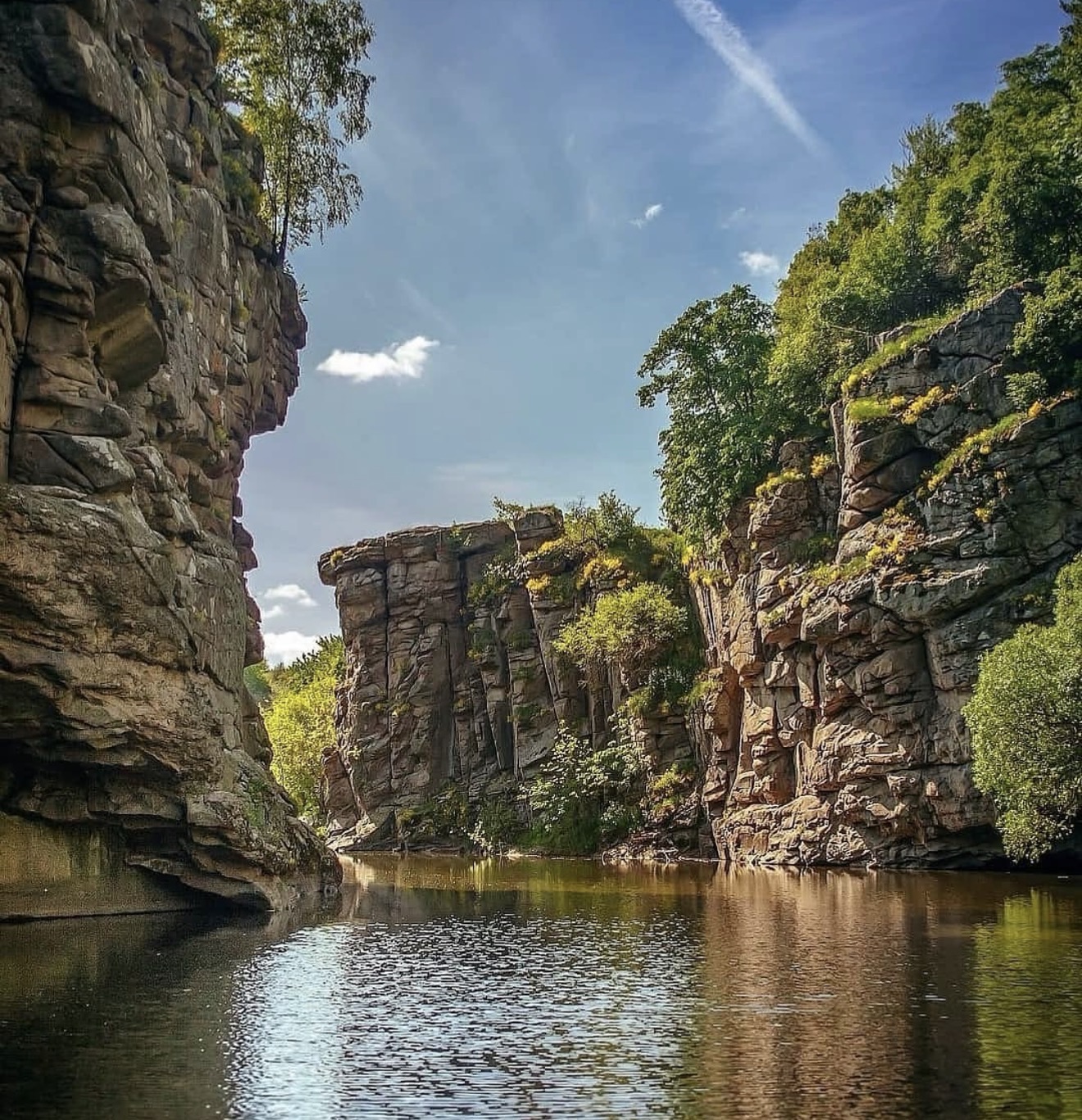
If it seems to you that for impressive natural landscapes you need to go to the Carpathians or abroad, Buky Canyon will easily change this opinion. It is one of the most beautiful natural locations in Central Ukraine, which is often called the Ukrainian Grand Canyon.
The canyon is located on the Hirskyi Tikych River in Cherkasy region. Its main feature is huge granite cliffs up to 30 meters high, which, according to geologists’ estimates, are about 2 billion years old. That is why the local landscapes look so unusual for Ukraine.
Another highlight of the location is the picturesque Vyr waterfall. Once an old water mill operated here, and today it is one of the most popular photo zones of the canyon.
Here you can:
Buky is especially beautiful in June, July and August, when the cliffs contrast with the bright greenery of the banks. In sunny weather, the water takes on rich shades, and the views resemble shots from tourist brochures about Norway or Canada.
The ideal trip format is to leave Kyiv in the morning, spend several hours near the canyon, walk around the village of Buky and return home in the evening with a full gallery of photos and the feeling that you have been much farther away than three hours from the capital.
Radomysl Castle
Distance from Kyiv: about 90 km, approximately 1.5 hours by car.
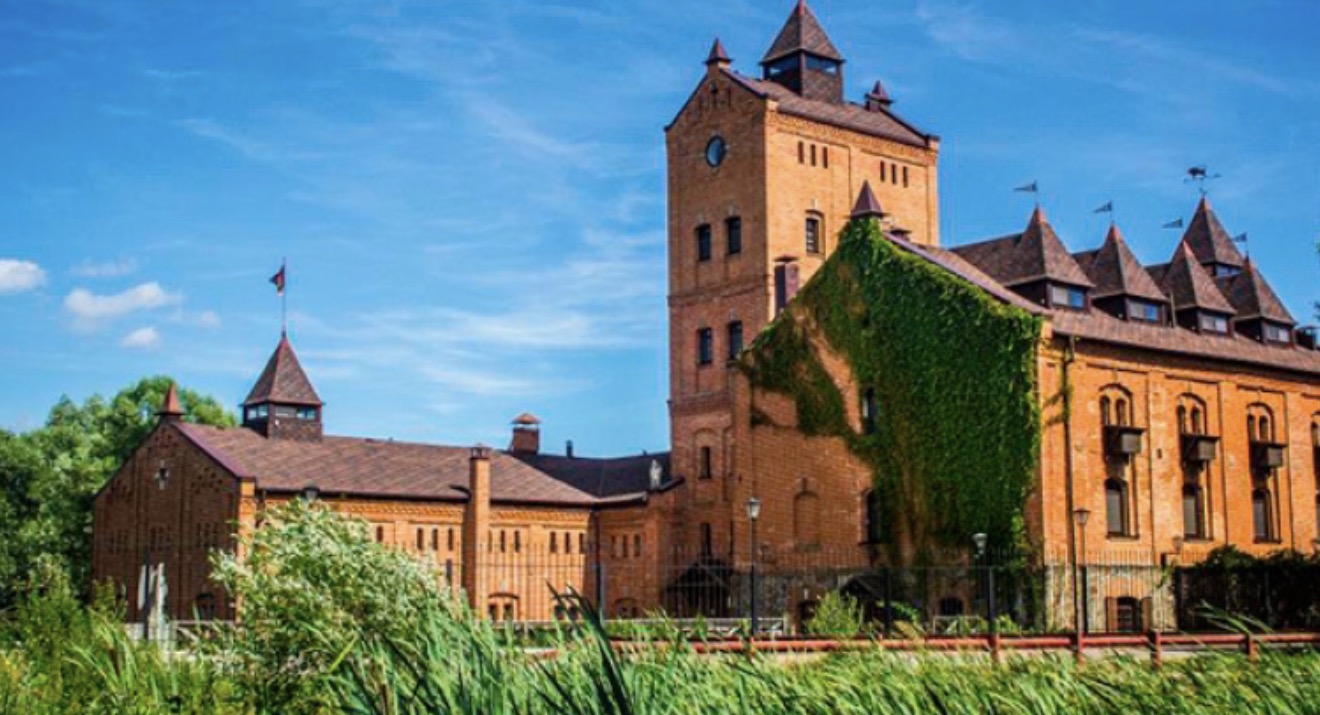
If you want to feel like the hero of a historical novel for at least one day, go to Radomyshl. Here, among granite rocks and waterfalls, stands a real castle, which more resembles a medieval fortress somewhere in France or Germany than a tourist location in Zhytomyr region.
Once, the paper mill of the Kyiv-Pechersk Lavra operated on this site, where paper was produced for printing the first Ukrainian books. Today, there is a castle-museum here with the largest collection of home icons in Ukraine. In the halls you can see hundreds of ancient images, each of which has its own history.
But the main thing in Radomysl is the atmosphere. Narrow stone staircases, high towers, a bell tower with a panoramic view, bridges over the water, granite boulders and a park with waterfalls create the feeling that you have entered another era.
Here you can:
It is especially beautiful in summer, when the territory is immersed in greenery, and the water around the castle reflects its towers, creating a truly fairy-tale landscape.
Mezhyhirya
Distance from Kyiv: about 25 km, 30–40 minutes by car.
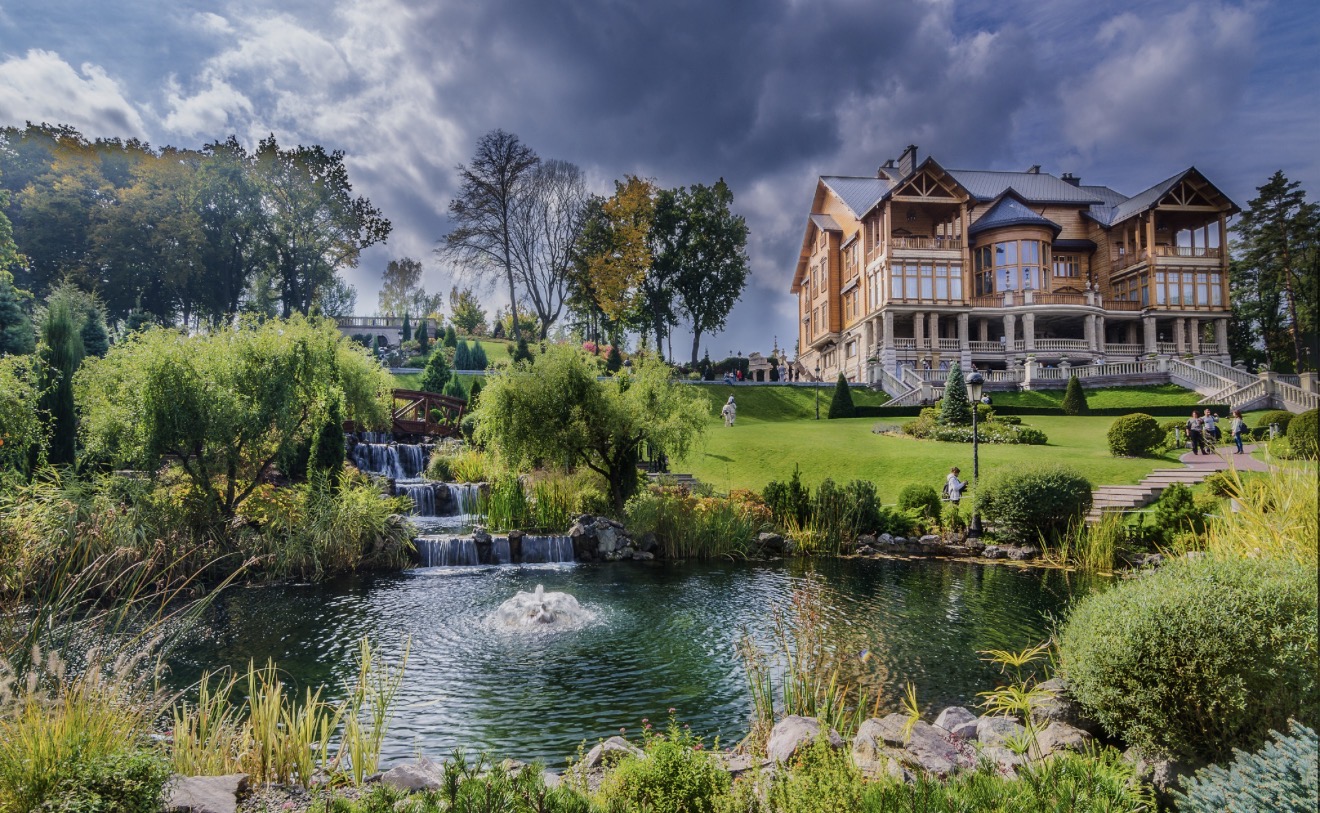
If you want to escape from the noisy city but not spend half a day on the road, Mezhyhirya is one of the best options. Once this territory was the closed residence of fugitive President Viktor Yanukovych, and today it has turned into a huge park open to everyone.
The area of the complex exceeds 140 hectares, so it is quite difficult to walk around everything in one day. There are well-kept alleys, dozens of flowerbeds, lakes, fountains, the embankment of the Kyiv Sea and observation platforms with beautiful panoramas.
One of the most popular locations is the famous wooden house “Honka,” which became a symbol of the excessive luxury of the former authorities. The zoo, where ostriches, pheasants, peacocks and deer live, as well as the collection of retro cars, deserve no less attention.
Here you can:
Mezhyhirya is especially impressive in summer, when the territory is literally immersed in flowers and greenery. Here it is easy to forget that the center of Kyiv is only a few dozen minutes away. That is why many visitors return here again and again: not for the history of political scandals, but for peace, nature and the opportunity to spend a day in the fresh air.
Korostyshiv Canyon
Distance from Kyiv: about 110 km, approximately 1.5 hours by car.
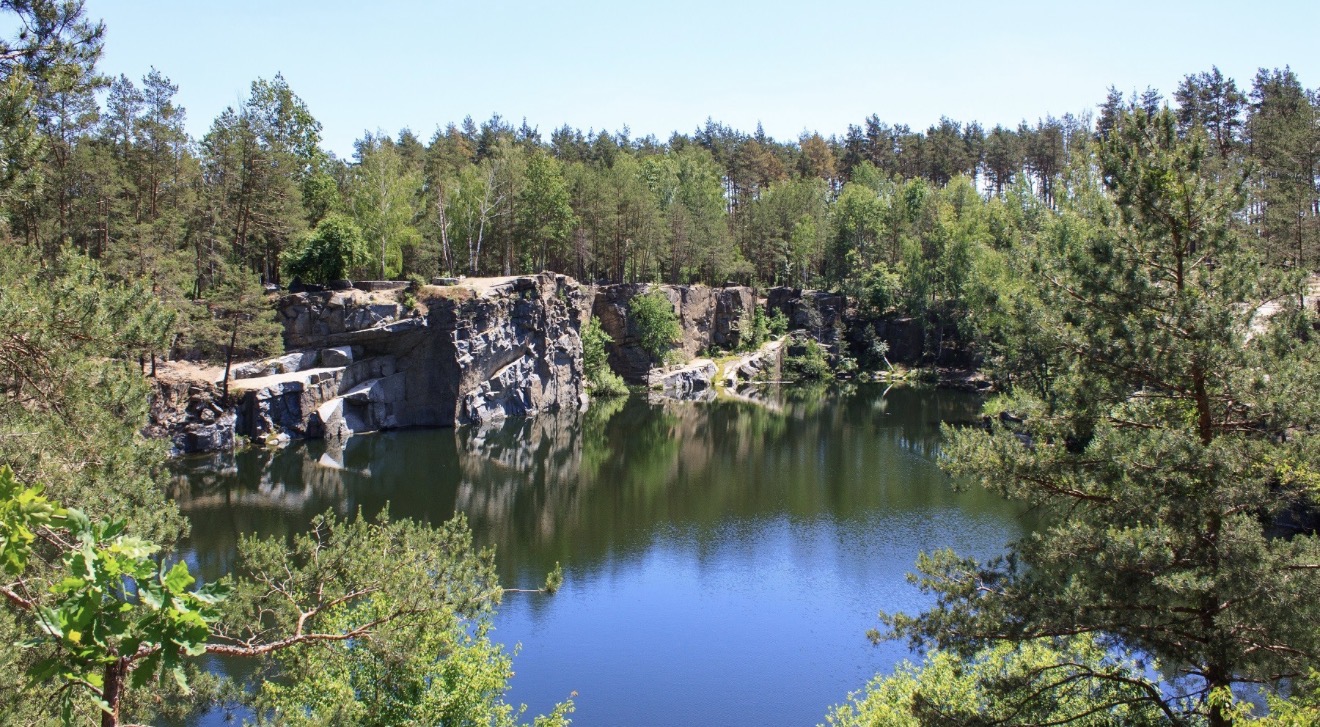
If you want to see a place that more resembles frames from a film or a postcard from a travel magazine than an ordinary location in Zhytomyr region, go to Korostyshiv Canyon.
Granite was once mined here. When the quarry stopped operating, it was gradually filled with water. This is how a lake with surprisingly clean water appeared, surrounded by high cliffs and a pine forest. It was the combination of turquoise water, granite shores and pine trees that made this place one of the most popular destinations for recreation near Kyiv.
In sunny weather, the water takes on an incredible emerald shade, which is why the canyon is often called the Ukrainian “Maldives.” That is why photographers, bloggers and everyone looking for beautiful recreation locations regularly come here.
Here you can:
A separate bonus is the atmosphere. Unlike many tourist places, there is no feeling of fuss here. The pine trees create natural coolness even on hot days, and the high cliffs add a special character to the landscape.
The best time for a trip is from June to September. Many people come here only for a few hours, but often stay almost for the whole day. After all, Korostyshiv Canyon is exactly the case when the road takes an hour and a half, while the impressions remain for a long time.
Kyivan Rus Park
Distance from Kyiv: about 45 km, approximately 50 minutes by car.
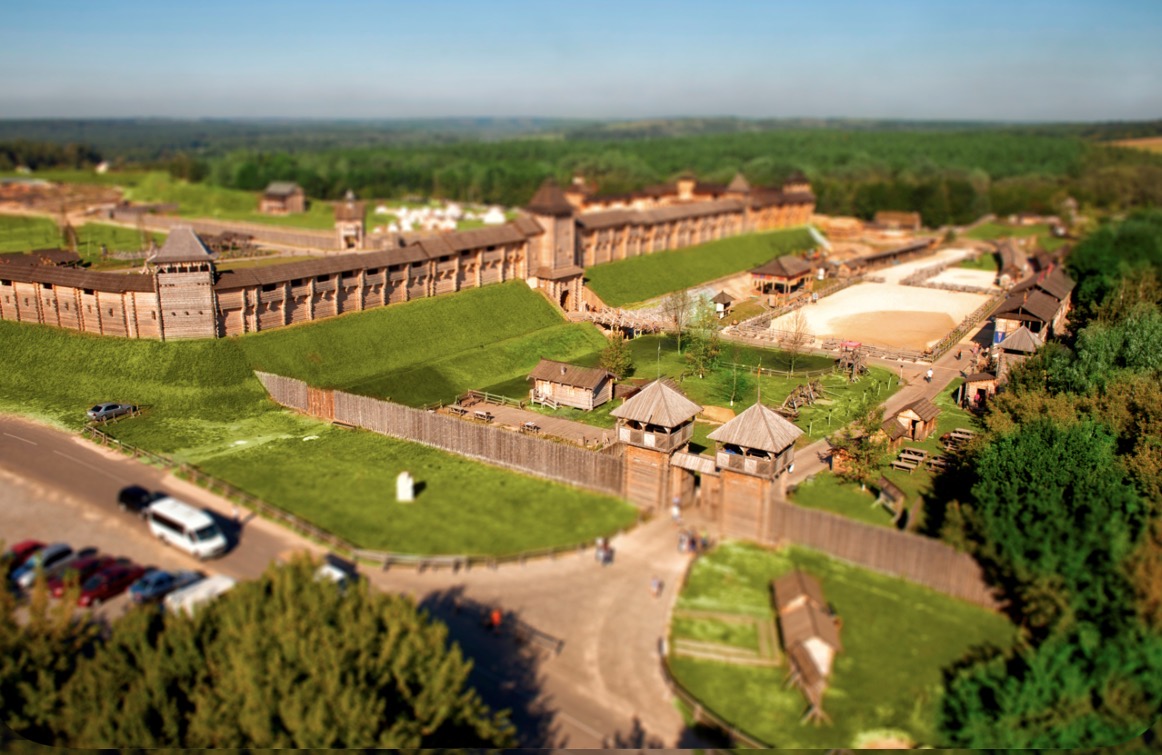
Do you want to travel back a thousand years for a few hours and see what Kyiv was like in the times of the princes? Then you should go to Kyivan Rus Park in the village of Kopachiv. It is not just an open-air museum, but a real journey through time.
Here, the citadel of ancient Kyiv of the 5th–13th centuries is recreated in full size. Massive wooden fortifications, princely chambers, watchtowers and ancient gates allow you to feel the atmosphere of the era when Kyiv was the capital of one of the largest states in Europe.
But the most interesting part begins when history comes alive. On different days, knight tournaments, theatrical performances, horse shows, festivals of medieval culture and reconstructions of historical battles take place here. Sometimes you can see real sword fights or hear how the ancient music of Kyivan Rus sounded.
Here you can:
The park is especially liked by families with children, because here history can not only be read in a textbook, but literally touched with your hands. And adults often admit that they are no less fascinated than children.
If Buky or Korostyshiv Canyon is about nature, then Kyivan Rus is an opportunity to feel like a prince, a warrior of the princely retinue or a guest of ancient Kyiv for one day. And all this less than an hour’s drive from the capital.
Kaniv Mountains
Distance from Kyiv: about 140 km, approximately 2–2.5 hours by car.
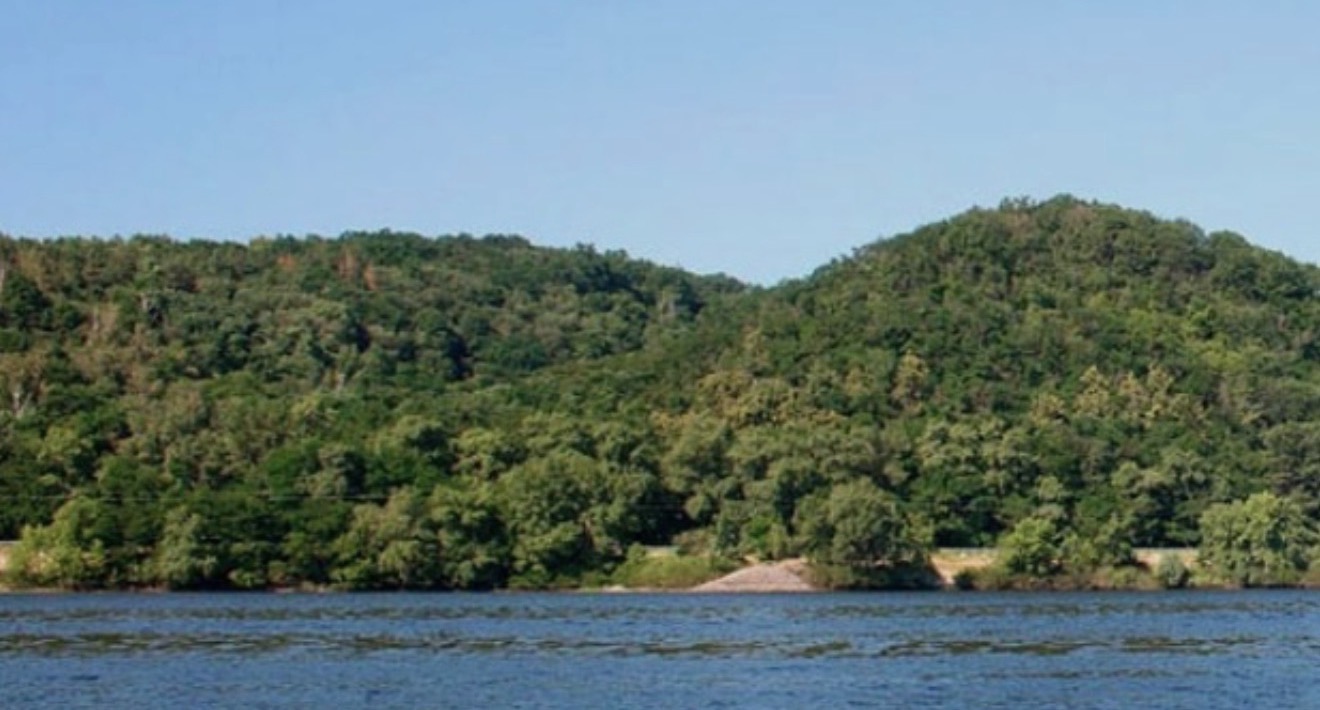
If you want to see the Dnipro the way artists, poets and travelers saw it hundreds of years ago, it is worth going to the Kaniv Mountains at least once. This place is completely unlike the usual image of flat Ukraine. Here high hills suddenly drop down to the water, and the views are so large-scale that they take your breath away.
Taras Hill, the burial place of Taras Shevchenko, is located right here. However, the Kaniv Mountains are not only about history. This is one of the most beautiful natural locations in central Ukraine, where you can see dozens of kilometers of Dnipro slopes, forests and water expanses.
In clear weather, the observation platforms offer panoramas for which photographers come here specially. The mountains become especially beautiful at sunrise or before sunset, when the Dnipro begins to literally glow with gold.
Here you can:
There is another reason why it is worth coming here. The Kaniv Mountains are a place where you can literally feel the scale of Ukraine. There are no loud attractions, food courts or crowds of tourists here. There is only the wind, the smell of grasses, the boundless Dnipro and a feeling of calm that is so lacking in a big city.
This is one of those locations people go to not for photographs, but for emotions. And only then do they return home with hundreds of shots on their phone.
Oleksandriia Arboretum
Distance from Kyiv: about 85 km, approximately 1 hour by car.
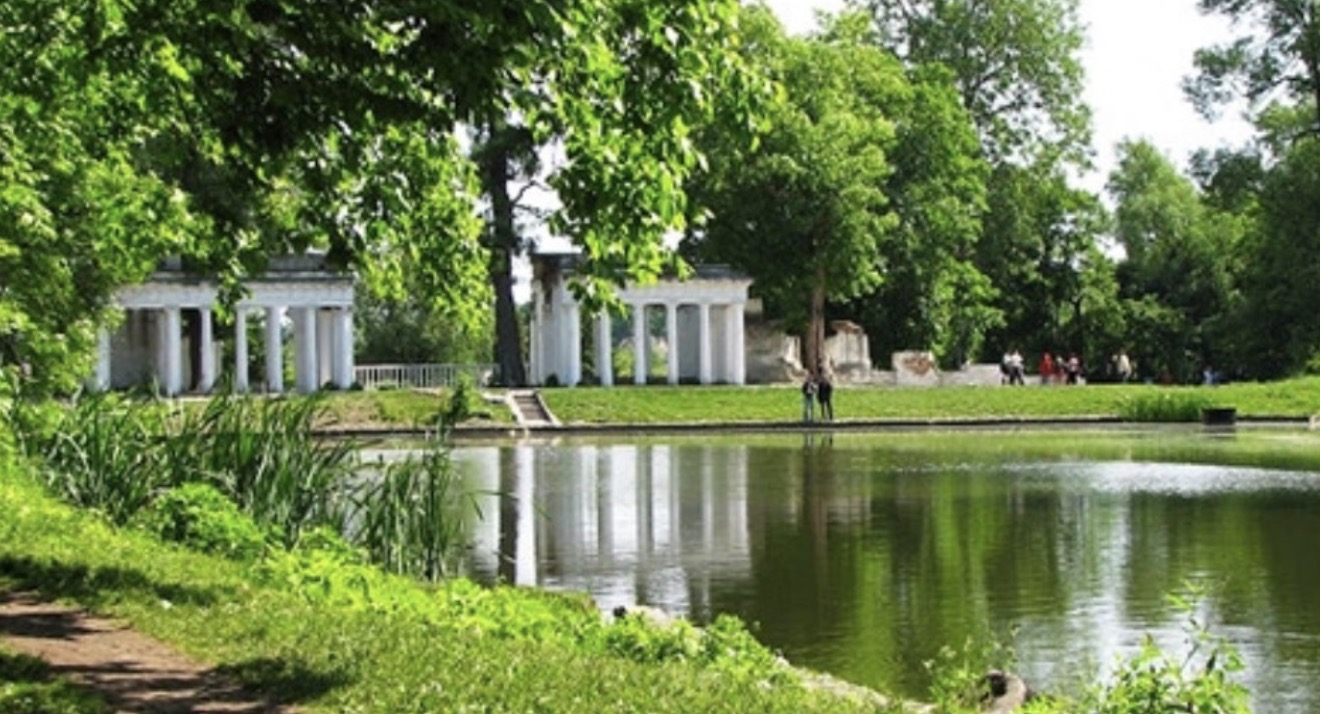
If you want to feel like the hero of a costume film about European aristocracy for at least one day, go to the Oleksandriia Arboretum in Bila Tserkva. It is not just a park, but a real green pearl of Ukraine, which has existed for more than 230 years.
At the end of the 18th century, the park was created by Countess Oleksandra Branitska, one of the richest women of that time. Architects and gardeners from different European countries were invited to arrange it. Today, Oleksandriia is the largest arboretum in Ukraine and occupies more than 400 hectares.
There are no attractions or loud entertainment here. People come here for beauty, silence and atmosphere. Ancient colonnades, romantic bridges, waterfalls, ponds, islands and hundreds of plant species create the feeling that you are walking through the grounds of an old European estate.
The park’s architectural monuments create its special atmosphere: the Luna colonnade, the Chinese Bridge, the Ruins, the Rotunda and numerous sculptures. Each location has its own history and legends.
Here you can:
Oleksandriia looks most beautiful at the beginning of summer, when the park literally explodes with greenery and blooming. But even on a hot July day, it is easy to find coolness here under the crowns of old trees.
Many visitors compare the park with famous gardens of Europe. And the most pleasant thing is that for this you do not need to fly to France or Austria — an hour’s drive from Kyiv is enough.
This is a place for those who want not just to tick a box on a list of tourist locations, but to truly rest, slow down and enjoy beauty that has not gone out of fashion for more than two centuries.
The Flooded Church in Husyntsi
Distance from Kyiv: about 80 km, approximately 1–1.5 hours by car.
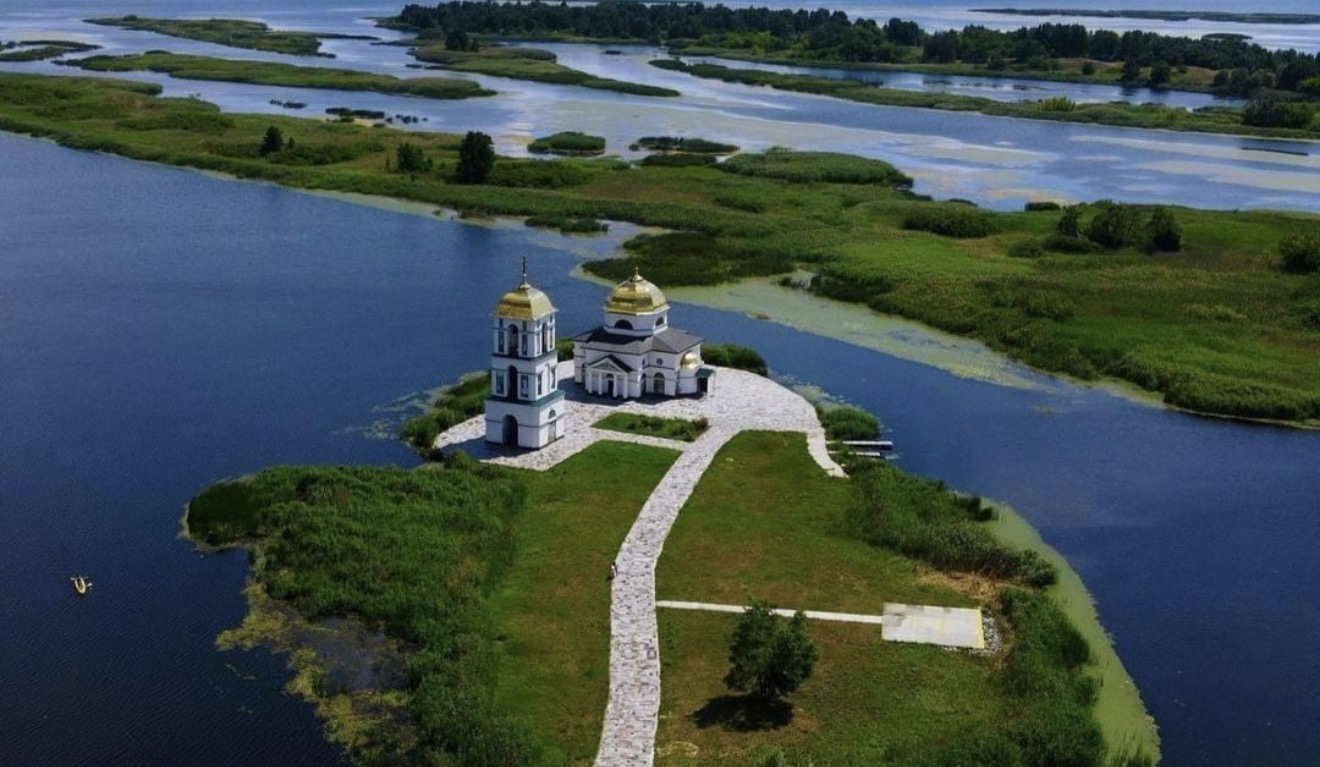
There are places that are difficult to explain with a photograph. They need to be seen with your own eyes. The flooded church in Husyntsi is exactly such a location.
In the middle of the huge Kaniv Reservoir stands a lonely old church, which seems to emerge directly from the water. From afar it looks like a set for a historical film or a frame from a mystical novel. In reality, however, it is a real landmark with a dramatic history.
Once there was the village of Husyntsi on this site. In the 1970s, during the creation of the Kaniv Reservoir, dozens of settlements ended up under water. People were resettled, houses were demolished, but the Church of the Holy Prophet Elijah miraculously remained. Today it stands on a small patch of land, surrounded by water on all sides.
It is this history that gives the place its special atmosphere. There are no noisy attractions or tourist entertainment here. There is only water, silence and a church that survived an entire flooded village.
Here you can:
It is especially beautiful here in the evening. When the sun begins to sink below the horizon, the water around the church takes on golden shades, and the church itself is reflected in the reservoir. At this moment it is easy to understand why many travelers call Husyntsi one of the most romantic and at the same time most mystical locations near Kyiv.
If you are looking for a place not only for beautiful photos, but also for reflection, calm and recharging, the flooded church in Husyntsi definitely deserves a place on your summer route.
Dobropark
Distance from Kyiv: about 30–40 km, approximately 40 minutes by car.
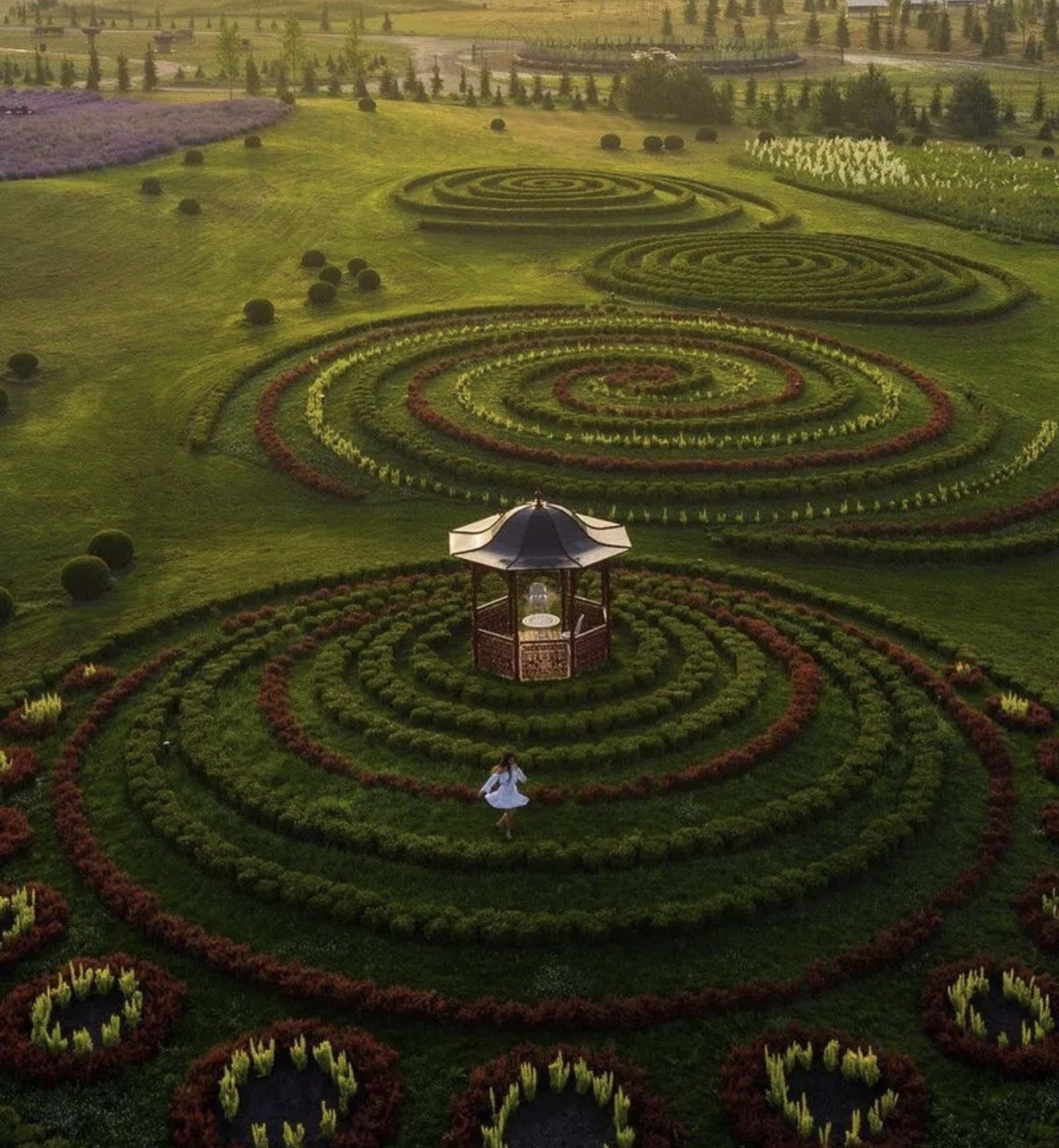
If you have at least once seen endless lavender fields, flower arches or photos among thousands of flowers on social networks and thought that this was somewhere in France, it is quite possible that in fact it was Dobropark.
In just a few years it has turned into one of the most popular summer locations near Kyiv. It is a huge landscape park that changes depending on the season. In spring people come here for tulips, in summer — for lavender, hydrangeas and roses, in autumn — for bright natural colors.
The main feature of Dobropark is its scale. Millions of flowers have been planted here, and each zone is designed to look like a separate photo location. That is why the park has long become one of the favorite places for family walks, romantic dates and photo shoots.
Here you can:
Dobropark becomes especially beautiful during the lavender blooming period. At this time the air is filled with the scent of flowers, and the purple fields stretch so far that they resemble the landscapes of Provence.
Many people come here for beautiful pictures, but stay longer. After all, Dobropark is not only about photos. It is a place where you can take a break from the city rhythm, slowly walk along the alleys, lie on the grass, drink coffee among flowers and feel a real summer mood for at least a few hours.
If you are looking for a location where you can spend a weekend with the whole family, arrange a romantic walk or simply recharge among nature, Dobropark is definitely worth adding to your summer route.

The mining and metallurgical group Metinvest has signed a new seven-year loan agreement worth 20 million euros with the Black Sea Trade and Development Bank (BSTDB), strengthening its long-standing partnership with the international financial institution.
According to a press release, the agreement was signed by Oleksiy Sobolev, Ukraine’s Minister of Economy, Environment, and Agriculture, during the Ukraine Recovery Conference (URC 2026) in Gdańsk, Poland.
As noted, the financing will help strengthen the group’s energy resilience in Ukraine, specifically by installing the first solar power plants with a total capacity of 37 MW, as well as supporting critical energy infrastructure. Additionally, this will help reduce Metinvest’s carbon footprint.
The new agreement continues Metinvest’s cooperation with the China-Belarus Trade and Investment Bank (CBTIB), which began with investment loans in 2020 and working capital financing in 2024.
Metinvest CEO Yuriy Ryzhenkov emphasized that the partnership with the Black Sea Trade and Development Bank (BSTDB) reaffirms confidence in Metinvest’s long-term strategy: “This financing will help us modernize our production facilities, invest in renewable energy, and strengthen Ukraine’s industrial potential.”
For his part, CBTR President Dr. Serhat Keksal noted that the long-standing partnership with Metinvest reflects CBTR’s commitment to supporting sustainable Ukrainian companies.
“This financing will help strengthen industrial production, enhance energy resilience, and support Ukraine’s economic recovery. We also highly value our partnership with the Japan Bank for International Cooperation (JBIC), which reaffirms our shared commitment to supporting Ukraine’s recovery and sustainable development,” concluded the CEBT Chairman.
Metinvest is a vertically integrated group consisting of mining and metallurgical enterprises. Its facilities are located in Ukraine—in the Donetsk, Luhansk, Zaporizhzhia, and Dnipropetrovsk regions—as well as in the European Union, the United Kingdom, and the United States. The holding’s main shareholders are the SCM Group (71.24%) and Smart Holding (23.76%). Metinvest Holding LLC is the management company of the Metinvest Group.

The main problem in Ukraine’s labor market is a labor shortage; at the same time, between 3.5 and 5 million people of working age are excluded from the labor market, said Daria Marchak, Deputy Minister of Economy, Environment, and Agriculture, during the Ukraine Recovery Conference (URC 2026) in Gdańsk (Poland) on Friday.
“Currently, three-quarters of businesses in Ukraine are facing a shortage of workers and are closing down precisely because of this labor shortage. But we have somewhere between 3.5 and 5 million people of working age who are excluded from the labor market for various reasons,” Marchak emphasized.
According to her, this group includes people with disabilities, including veterans, as well as internally displaced persons and women.
In this regard, the deputy minister considers the main task to be “doing everything possible to ensure that these people gain access to the labor market and overcome all obstacles.” To this end, she proposes a comprehensive overhaul of training systems and competency standards, as well as providing relevant retraining opportunities to anyone who wishes to participate.
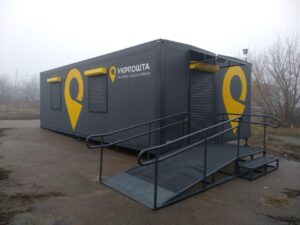
JSC “Ukrposhta” has completed the installation of 38 modular branches in 16 regions, including Kharkiv, Kherson, Zaporizhzhia, Sumy, Chernihiv, Mykolaiv, and Dnipropetrovsk regions, the company’s CEO, Ihor Smilianskyi, announced on Telegram.
According to a press release published by Ukrposhta, the project was implemented thanks to financial support from the European Bank for Reconstruction and Development (EBRD), which allocated EUR 600,000 in the form of an investment grant from the Special Crisis Response Fund.
“At these branches, local residents can receive pensions and social benefits, order medications through the ‘Ukrposhta.Apteka’ service, receive and send packages and letters, pay for utilities, and use financial services,” Smiliansky noted.
The CEO of the postal operator noted that out of the 40 modular branches installed, two were destroyed during the project’s implementation in the Sumy and Donetsk regions.
It is noted that, depending on the number of residents in the community, the company installed two types of modules. Specifically, there are 25 branches with an area of 22 square meters and another 13 with an area of 45 square meters.
These branches are equipped with ramps for people with limited mobility, autonomous heating systems, and the ability to connect to backup power sources to operate during blackouts.
Smilyansky also added that the number of modular branches will continue to grow in the future, funded entirely by Ukrposhta’s own resources.
In total, during the full-scale invasion, 49 of the company’s permanent branches were completely destroyed, and another 648 facilities were damaged.
Over the past month, “Ukrposhta” has also recorded damage to one branch almost every day.
“In recent weeks, we have once again seen how important it is to quickly resume operations. The enemy destroyed our logistics hub in Kharkiv, and after the attack on Kyiv, only a crater remained where the branch in Troyeshchyna used to be. Every day, other facilities come under fire,” the CEO of Ukrposhta is quoted as saying in the press release.

Georgia is preparing to tighten its immigration rules following a sharp increase in the number of applications for residence permits based on marriage to a Georgian citizen.
According to the Georgian Ministry of Internal Affairs, the number of applications for residence permits based on marriage tripled in the first quarter of 2026. Authorities believe this trend may indicate abuse of the system and the use of sham marriages to legalize one’s stay in the country.
The new amendments provide for the creation of a separate type of residence permit for spouses of Georgian citizens. Before issuing such a document, the state will verify the authenticity of the marriage through a special commission. This residence permit will remain valid until the applicant is eligible to receive a permanent residence permit.
In addition, Georgia plans to criminalize sham marriages entered into for the purpose of obtaining citizenship, a residence permit, or any other legal basis for staying in the country. Possible penalties include deportation of the foreign national, a re-entry ban for a period of two to ten years, a fine, house arrest for a period of one to two years, or imprisonment for up to two years.
The amendments also expand the powers of the Ministry of Internal Affairs’ Migration Department. It is planned to grant the department the right to conduct operational and investigative activities to detect illegal migration and abuses of migration procedures.
A separate set of changes concerns foreign students. The authorities intend to introduce additional requirements for admission to Georgian higher education institutions and vocational schools, including an international language certificate or passing a language exam. There are also plans to set maximum quotas for the admission of foreign students, and educational institutions will be required to enter information about them into a unified information system.
Georgia explains the reform as necessary to make the migration system more transparent, secure, and manageable. The authorities note that current rules do not always allow for effective monitoring of whether foreigners are actually studying, are in genuine marriages, or are using these grounds merely as a formality.
The issue of migration has become particularly sensitive for Georgia since 2022, when the country accepted a significant number of foreigners from Russia, Ukraine, Belarus, and other countries. At the same time, the composition of the foreign population in the country is diverse: some migrants are there due to relocation, some for educational purposes, and others are people of Georgian origin who have already obtained foreign citizenship and have returned.
According to data released by Georgian Prime Minister Irakli Kobakhidze in February 2026, the country issued 107,307 thousand residence permits to citizens of 164 countries. Russian citizens accounted for 32,129 thousand permits, or 29.9% of the total. The authorities clarified that a significant portion of this group consists of former Georgian citizens or people of Georgian descent.
The second-largest group of residence permit holders consists of Indian citizens: 23,930 thousand people, mostly students. Next are citizens of Azerbaijan and Ukraine—6,290 thousand people, or 5.9 percent—followed by Armenia (over 5 thousand), Belarus (3,738 thousand), Turkey (3,645 thousand), and Iran (3,331 thousand). Other notable groups include citizens of Sudan, China, Jordan, Pakistan, Egypt, and the United States.
Separately, there are Ukrainians living in Georgia without a regular residence permit. According to Kobakhidze, up to 25,000 Ukrainians are in the country with de facto refugee status, and the total number of Ukrainians in Georgia is estimated at approximately 30,000 people.
According to preliminary census data, the total number of foreigners residing in Georgia—including both legal and illegal migrants—is estimated at approximately 257,000 people. More than 70% of foreigners, according to government estimates, come from post-Soviet countries, the EU, the United States, and Israel.
Thus, the tightening of rules regarding marriage and student residence permits is part of a broader restructuring of Georgia’s migration policy. The country is seeking to remain open to businesspeople, students, and expatriates, while at the same time strengthening control over the grounds for foreigners’ residence and reducing the number of formal legalization schemes.

Enterprises engaged in operations with ferrous metal scrap called for lifting the de facto ban on scrap exports from Ukraine and introducing quotas for supplies of this raw material to EU countries in the amount of 200,000 tonnes per year.
This position was voiced by business representatives at the press conference “Ukraine’s Scrap Market: Between the Needs of the Economy and Regulatory Uncertainty” at the Interfax-Ukraine agency on Friday.
President of the Ukrainian Association of Secondary Metals (“UAVtormet”) Volodymyr Bublei noted that steel production over the first 5 months of the current year decreased by 6%, while scrap consumption fell by 7.6%, to 604,000 tonnes. Because of this, the country lost EUR60 million in foreign currency revenue, and tax revenues to the state budget decreased accordingly.
According to him, due to the ban on scrap exports, scrap prices on the domestic market fell. Thus, Ukrzaliznytsia sold scrap this year at a price of UAH 5,500, whereas in 2025 the average price was UAH 8,500 per tonne. When selling 50,000 tonnes of scrap, UZ lost UAH 3,000 on each tonne.
“Consumers are now selling scrap on the domestic market at $160-165 per tonne, while entrepreneurs in the EU pay $360 per tonne. Thus, we lose an average of $200,” Bublei stated.
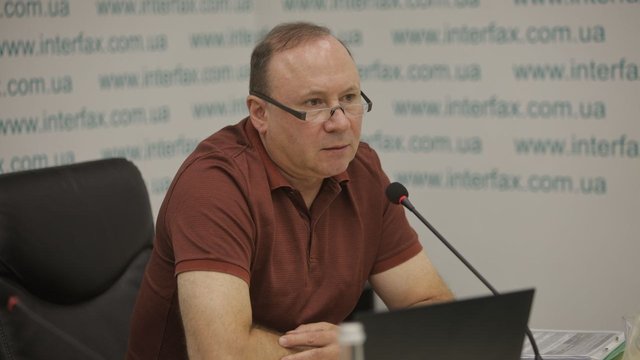
He proposed holding a meeting at the government level in order to sort out the situation on the market and draw up a balance of scrap consumption. In addition, he considers plans to increase VAT on scrap operations to be wrong.
General Director of Ukrmet-Invest LLC Serhii Vovk noted that his company dismissed 150 employees because of the de facto ban on scrap exports.
“Of 18 divisions, 6 remain, the rest have been put up for sale because of million-scale losses. Previously, we supplied 5-6,000 tonnes of scrap to the market, now it is 2,000 tonnes. The scrap procurement sector accordingly reduced payments to the budget. Overall, the state lost more than UAH 500 million in budget revenues,” Vovk said.
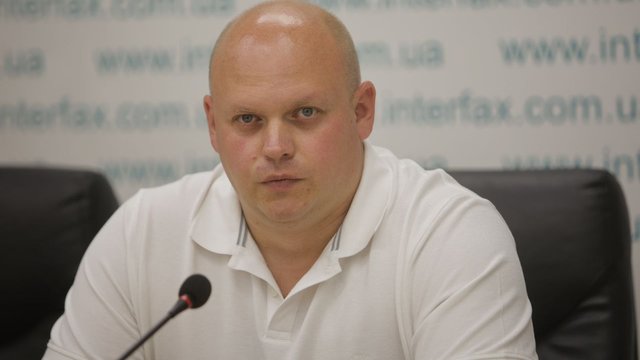
General Director of the UKRMET Group of Companies Vladyslav Kleshchynskyi noted that after the de facto closure of scrap exports, the industry “broke down.”
“We closed two terminals, a port and 10 sites. But the industry should not be closed when there is no possibility to sell products on the domestic market. A compromise solution is to introduce an export quota of up to 200,000 tonnes for scrap supplies to the EU,” Kleshchynskyi said.
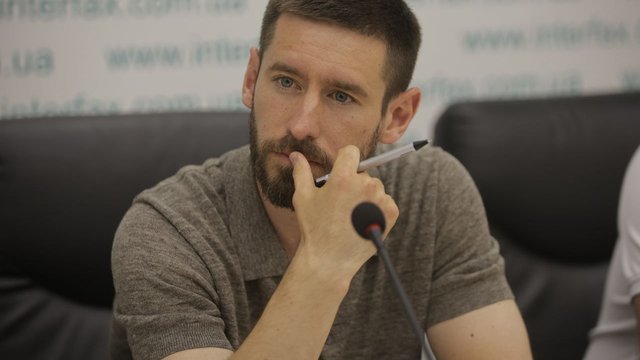
Development Director of Mirten LLC Mykola Klymovych appealed to the government: “We are not demanding benefits or assistance – give us the opportunity to work under market conditions.”
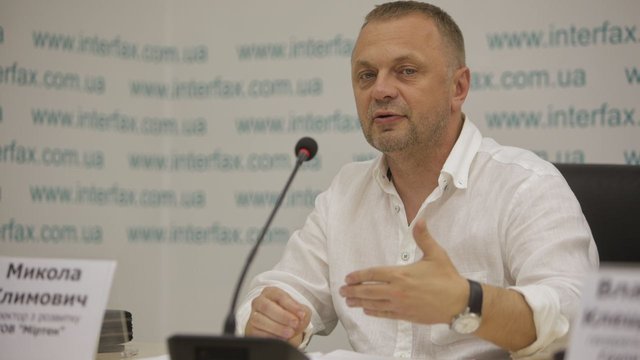
Earlier, head of UAVtormet Volodymyr Bublei stated that as a result of the introduction from January 1 of the current year of a zero quota for the export of ferrous metal scrap, the scrap procurement industry is losing its potential, reducing raw material procurement and being forced to cut employees.
As reported, Ukraine’s scrap procurement enterprises in 2025 increased the export of ferrous metal scrap by 45.3% compared with the previous year – to 448,685 tonnes from 293,190 tonnes. In monetary terms, scrap exports in 2025 grew by 44.5% – to $131.927 million from $91.311 million. Scrap exports during the specified period were formally carried out mainly to Poland (75.42% of supplies in monetary terms), Greece (10.19%) and Italy (6.65%).
In connection with the sharp growth in exports of strategic raw materials from Ukraine, the Ministry of Economy initiated the introduction of a licensing and quota regime for scrap exports with the establishment of a zero quota volume. The government introduced a zero export quota for 2026 for exports of ferrous metal scrap.
Ukraine’s scrap procurement enterprises in 2024 increased exports of ferrous metal scrap by 60.7% compared with 2023 – to 293,190 tonnes from 182,465 tonnes. In monetary terms, scrap exports over the year grew by 73.2% – to $91.311 million from $52.723 million.
SCRAP_METAL, SERHII_VOVK, VLADYSLAV_KLESHCHYNSKYI, VOLODYMYR_BUBLEI, МИКОЛА_КЛИМОВИЧ



