A neutral stance continues to dominate Ukrainians’ attitudes toward Egypt: in August 2026, 61.3% of respondents expressed this view. 28.1% of those surveyed view the country positively, while 6.9% view it negatively. Compared to March, the share of positive assessments has decreased, while the share of negative ones has increased, according to the Experts Club Information and Analytical Center.
According to the results of the August survey, 7.2% of Ukrainians have a completely positive attitude toward Egypt, while 20.9% have a mostly positive attitude. A neutral stance is held by 61.3% of respondents. 6.3% view the country mostly negatively, 0.6% view it entirely negatively, and another 3.7% were undecided.
The balance of positive and negative assessments based on these indicators is +21.2 percentage points. Thus, positive attitudes toward Egypt are roughly four times more prevalent than negative ones; however, the high proportion of neutral responses remains the defining characteristic of how the country is perceived.
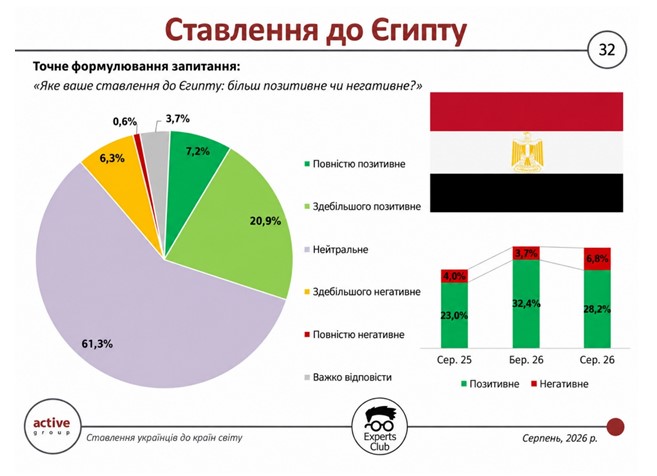
Compared to March 2026, attitudes have deteriorated slightly. In the previous survey wave, 10.5% of respondents rated Egypt entirely positively, and 21.9% rated it mostly positively—meaning the overall positive rating stood at 32.4%. 62.5% of respondents were neutral, and the share of negative ratings in the aggregated results was about 3.7%.
Thus, over the course of five months, the share of positive responses decreased by 4.3 percentage points—from 32.4% to 28.1%—while the share of negative responses increased by approximately 3.2 percentage points—to 6.9%. The share of neutral assessments changed only slightly—from 62.5% to 61.3%. The balance between positive and negative attitudes decreased from approximately plus 28.7 to plus 21.2 percentage points, respectively.
Maksym Urakin, founder of the Experts Club information and analytical center and a candidate of economic sciences, believes that the case of Egypt clearly illustrates the difference between a country’s economic importance to Ukraine and the extent of its presence in the public consciousness.
“Egypt is a very important export market for Ukraine, primarily for agricultural and food products. At the same time, for most Ukrainians, this country remains more of a tourist destination than an economic partner. That is precisely why we see such a high proportion of neutral assessments: economic ties are significant, but they are not always visible to the general public,” Urakin noted.
According to him, the positive trade balance with Egypt makes this market particularly important for Ukraine amid a general foreign trade deficit.
“When a country provides Ukraine with a significant trade surplus, it is no longer a secondary partner. Such markets must be viewed strategically—in terms of maintaining exports, expanding the range of goods supplied, and fostering long-term economic ties. In the case of Egypt, the potential for this is obvious, but public perception has simply not yet caught up with the country’s actual economic role,” Urakin added.
Thus, Egypt demonstrates a noticeable gap between its economic significance and public perception. Despite the fact that the country is one of Ukraine’s most profitable trading partners in terms of the trade balance, over 60% of Ukrainians continue to view it neutrally. This indicates limited awareness and low emotional engagement rather than a negative attitude.
The survey was conducted in August 2026 using self-administered online questionnaires in the SunFlowerSociology panel among 800 Ukrainian citizens aged 18 and older. The previous wave also included 800 respondents; the sample was representative by age, gender, and region, with a maximum theoretical margin of error of ±3.5 percentage points for indicators at the 50% confidence level.
ACTIVE GROUP, EGYPT, EXPERTS CLUB, FOREIGN TRADE, international relations, NORTH AFRICA, PUBLIC OPINION, SOCIOLOGY, UKRAINE, URAKIN