

Ukraine’s retail trade turnover in January–May 2026 increased by 9.2% compared to the same period in 2025, according to the State Statistics Service (SSS).
According to its data, in nominal terms, retail trade turnover for the first five months of this year amounted to 1.19 trillion UAH.
Retail trade turnover in May increased by 5.2% compared to April of this year, and by 10.9% year-over-year compared to May 2025.
Derzhstat notes that the turnover of retail trade enterprises (legal entities) in January–May 2026 increased by 9.3% compared to January–May 2025 and amounted to 0.83 trillion hryvnias.
At the same time, retail trade turnover for retail enterprises rose by 5.2% in May compared to April of this year.
According to the statistics agency, retail trade turnover in Ukraine grew by 7.5% in 2025.
The State Statistics Service notes that the data does not include territories temporarily occupied by the Russian Federation or parts of the country where hostilities are (or were) taking place.
ENTERPRISE, RETAIL TRADE, State Statistics Service, TURNOVER, UKRAINE

Carlo Formosa, the Italian Ambassador to Ukraine, met with representatives of Italian companies already operating in Ukraine, as well as with businesses implementing new projects in the country, according to a statement from the Italian Embassy in Ukraine.
“An opportunity to pool experience, contacts, and knowledge, establish new connections, and strengthen Italy’s presence in Ukraine,” the embassy’s Facebook post states.
The event served as a platform for exchanging experience, establishing new contacts, and strengthening cooperation among Italian companies operating in the Ukrainian market.
The embassy noted that the meeting took place following a series of webinars involving over 1,000 Italian companies and was aimed at further strengthening a cohesive and coordinated business community.
Particular attention was paid to the activities of the Italian Business Association (IBA), established several months ago at the embassy’s initiative to enhance the visibility and unifying potential of Italian business in Ukraine.
“The Embassy continues to facilitate dialogue between businesses and institutions, encouraging the exchange of expertise and the coordination of efforts within the ‘System Italy’ to support Italy’s economic presence in Ukraine,” the post states.

On June 25, the “Delta-Lotzman” branch of the state-owned enterprise “Ukrainian Sea Ports Authority” announced a tender for voluntary health insurance services. According to the Prozorro electronic public procurement system, the estimated cost is 8.360 million UAH. Documents for participation in the tender will be accepted until July 10.
The state-owned enterprise “Delta-Lotzman” was established by order of the Ministry of Transport of Ukraine in 1998 with the aim of improving conditions for ensuring the safety of navigation, protecting human life at sea and the environment, in Ukraine’s territorial waters in accordance with the requirements of international agreements and conventions, as well as to streamline the structure of maritime pilotage services in the northwest.
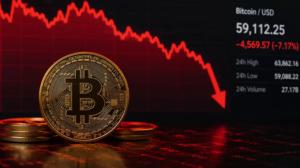
According to Fixygen, the cryptocurrency market is ending the week on a down note: Bitcoin has once again fallen below the psychological $60,000 level, Ether has approached $1,550, and most major altcoins are trading under pressure amid capital outflows from crypto ETFs, harsher expectations regarding Fed interest rates, and a strengthening dollar.
As of Thursday and Friday, Bitcoin was trading around $59,200, down approximately 3% over the past 24 hours.
The intraday low was around $58,200. Ether fell to $1,550, losing about 5.5% over the day, while Solana held steady around $68–69.
The week marked a continuation of June’s weak performance. Earlier this month, Bitcoin was trading above $70,000, but the market then faced a series of negative factors: record or near-record outflows from U.S. spot Bitcoin ETFs, growing investor interest in stocks of companies related to artificial intelligence, a strengthening U.S. dollar, and deteriorating sentiment surrounding major corporate Bitcoin holders.
This week, the pressure intensified after Bitcoin once again fell below $60,000. CoinDesk noted that the cryptocurrency’s decline is occurring even amid periodic gains in other risky assets, as capital continues to flow into the technology and AI segments of the stock market. According to CoinDesk, Deutsche Bank attributed Bitcoin’s drop below $60,000 to the Fed’s hawkish rhetoric, outflows from ETFs, and concerns surrounding companies with high Bitcoin exposure.
Ethereum has also failed to serve as a safe-haven asset within the crypto market. Trading at around $1,550, the second-largest cryptocurrency by market capitalization remains under pressure alongside the broader market. The decline in ether indicates that investors are currently reducing their exposure to crypto assets in general, not just bitcoin.
Solana appeared slightly more resilient intraday, but the overall sentiment for altcoins remains weak. When Bitcoin falls below key levels, investors typically reduce their positions in riskier tokens faster than in the market’s core assets.
The dynamics of spot Bitcoin ETFs in the U.S. remain a separate factor. In June, the market already experienced several waves of outflows from funds that had previously been one of the main sources of demand for Bitcoin. When ETFs stop supporting the market with inflows, Bitcoin becomes more sensitive to macroeconomic data, yields, the dollar, and overall risk appetite.
Globally, cryptocurrencies are now competing for capital not only with traditional assets but also with the AI sector. Reuters previously noted that investors are increasingly shifting funds toward AI-related stocks and anticipated major IPOs, while bitcoin is experiencing one of its weakest starts to the year in the past decade.
Through the end of the week, the key technical level for Bitcoin remains the $58,000–$60,000 range. Holding this range could give the market a chance to stabilize, but a sustained move below $58,000 would reinforce expectations of a further decline. In this case, the next area of focus could be $55,000, which some analysts view as a potential level for a local bottom to form.
The base case scenario for the coming days is heightened volatility and cautious attempts at stabilization following the sharp decline. For a sustained recovery, the market will need a combination of several factors: an end to outflows from ETFs, a weaker dollar, softer expectations regarding Fed interest rates, and a return of risk appetite for crypto assets.
For now, the crypto market remains in defensive trade mode: investors prefer to reduce their exposure, cut their losses, or wait for new signals from ETF flows and the U.S. macroeconomy.

Ukrainians in the Republic of Moldova will be able to obtain Ukrainian citizenship through a simplified procedure: The Cabinet of Ministers has included this country on the list of states whose citizens are eligible for this mechanism, Ukrainian Prime Minister Yulia Svyrydenko announced.
“I discussed this decision with Moldovan Prime Minister Alexandru Munteanu. This is a natural step for our countries. We are united by a shared border, a shared path toward the European Union, and mutual support in the face of Russian aggression. There is a large Ukrainian community living in Moldova, and we want people to have easier access to Ukrainian citizenship,” she wrote on Telegram.
The prime minister noted that the next step will be to make this procedure as convenient as possible.
“Currently, to obtain citizenship, one must pass exams on the Ukrainian language, the Constitution, and the history of Ukraine, but this can only be done in Ukraine. We are working on the possibility of taking these exams remotely. We also need to streamline the final stage of processing documents through diplomatic missions abroad so that people can obtain a Ukrainian passport without unnecessary obstacles,” Svyrydenko emphasized.
In addition, the parties separately discussed the development of joint transportation infrastructure, in particular the construction of a new bridge between Ukraine and Moldova.

Starting July 9, a retrospective of films by Italian director Paolo Sorrentino, titled “Sorrentino’s Summer,” will begin at select movie theaters across Ukraine.
As part of the program, three films by one of the most famous contemporary Italian directors will be shown on the big screen once again: “The Great Beauty,” “Youth,” and “The Grace.”
“The Great Beauty” is one of Sorrentino’s most famous works. It was this film that earned the director an Oscar and a Golden Globe for Best International Feature Film.

The program also includes “Youth”—the director’s second English-language film, starring Michael Caine, Harvey Keitel, Rachel Weisz, Paul Dano, and Jane Fonda.
The third film in the retrospective will be *Grace*—the opening film of the Venice International Film Festival, which had its world premiere in the main competition.
Screenings will take place July 9–12 at select theaters across Ukraine. The program was initiated by the Italian Cultural Institute in Ukraine, the Italian Embassy in Ukraine, and the film company “Arthouse Traffic.”
Paolo Sorrentino is an Italian director and screenwriter, one of the most recognizable figures in contemporary European cinema. His works are distinguished by their visual sophistication and focus on themes of memory, aging, beauty, loneliness, power, and the search for the meaning of life. Among the director’s most famous films are “The Great Beauty,” “Youth,” “The Hand of God,” “The Wonder,” “The Consequences of Love,” and “Il Divo.”
Arthouse Traffic, FILM, ITALY, retrospective, Паоло Соррентіно



