

According to data from the National Council of Ukraine on Television and Radio Broadcasting and the Register of Media Entities, there are currently nearly 7,000 active media licenses in Ukraine. 53% of all media outlets in Ukraine are print media. There are also record-holders: one media owner holds 119 media outlets, and the largest company holds 71 media licenses. A third of media outlets are registered in the Kyiv region.
There are currently 6,995 valid media licenses in Ukraine, not counting suspended ones. Most of them belong to Ukrainian companies and individuals, and only 42 belong to foreign TV channels and radio stations.
In total, there are 3,160 media owners listed in the Registry, 10 of whom are foreign.
We are monitoring changes on the page Registry of Media Entities.
The record holder among legal entities for the number of active media licenses is Ihor Trill: 119 licenses. He is the founder of the Diana Plus publishing house, which has been operating for over 20 years and produces print newspapers and magazines. Second place goes to Taras Khotymchuk with 85 licenses—the founder of the regional weekly Tviy Vybir, as well as the t1.ua portal. Also in the top five are Oksana Tanasychuk (53 licenses), who is also associated with the Diana Plus publishing house, Andriy Lobachov (49)—owner of the publishing house Kuzya, which specializes in children’s educational publications—and Pavlo Khotymchuk (46), who owns the weekly “You and Me, and the Whole Family” and others.
Among companies, the figures are somewhat more modest. Thus, the largest holder of media licenses is Art-Kompleks Publishing House with 71 licenses. The company has specialized in crossword puzzles and children’s publications for over 25 years. Next is Taras Shevchenko National University of Kyiv with 61 licenses, which publishes university bulletins and specialized publications for students. Following is Editorial Systems with 53 licenses. The company specializes in publishing regional newspapers on various topics. In fourth place is Ivan Franko National University of Lviv with 50 licenses, which also publishes university bulletins and specialized publications. Rounding out the top five is Public Broadcasting with 45 licenses.
The company brings together national television channels (including “Pershyi,” “Suspilne Kultura,” and “Suspilne Sport”), radio stations (“Ukrainian Radio,” “Radio Promin,” and “Radio Kultura”), and digital platforms.
At the same time, media licenses are also held by companies whose primary business is far removed from journalism. For example, among media owners, one can find Energoatom, Epicenter K, ArcelorMittal Kryvyi Rih, and a number of other large enterprises.
The list of major players also includes those well-known to Ukrainians as media services. In particular, MEGOGO holds 11 licenses, and the bookmaker VBET Ukraine holds 10.
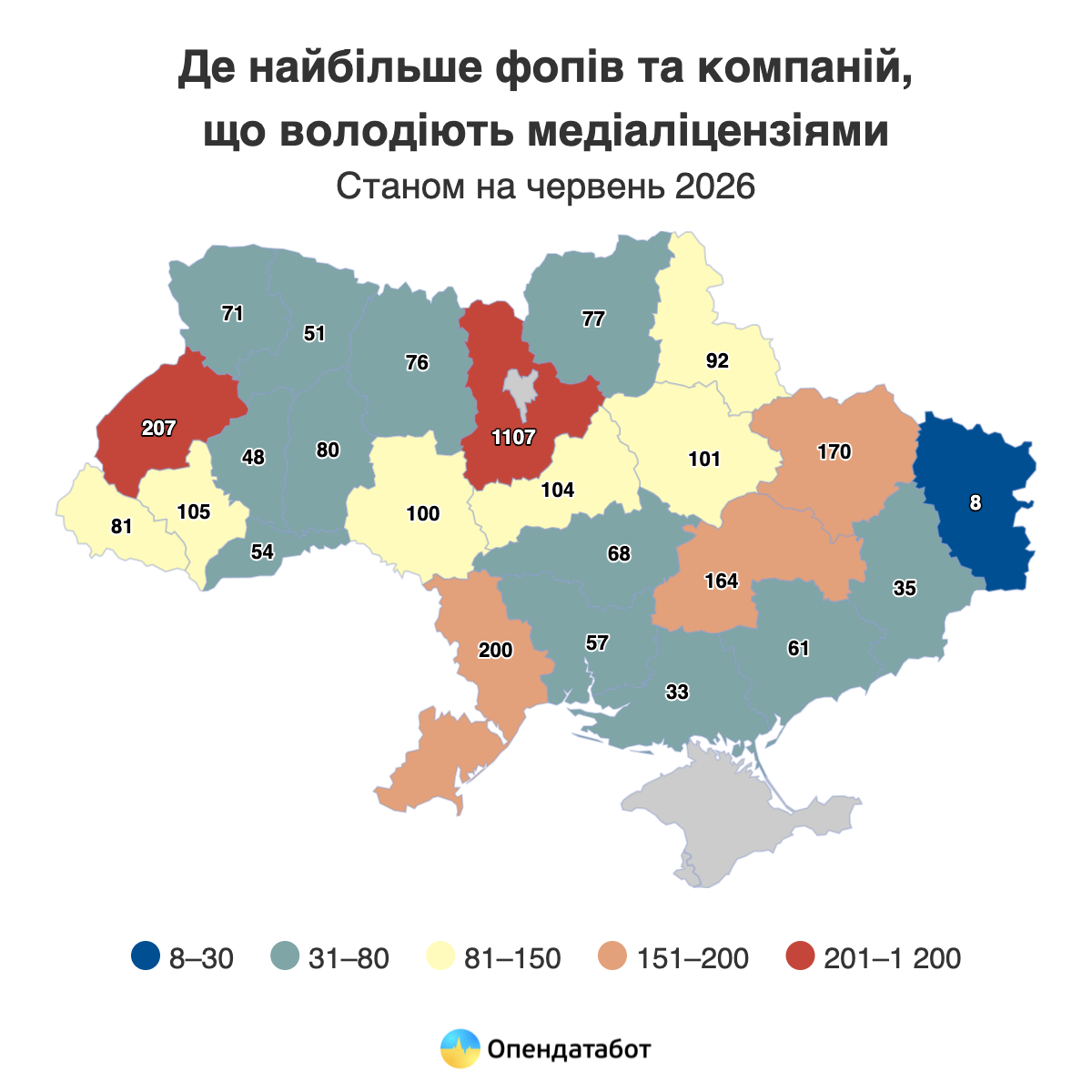
One in three companies or sole proprietorships with media assets is registered in the Kyiv region—1,107 owners. They are followed by Lviv Oblast (207 entities), Odesa Oblast (200), Kharkiv Oblast (170), and Dnipropetrovsk Oblast (164).
Among foreign media outlets, broadcasters from the United Kingdom, Gibraltar, and the United States are the most common.
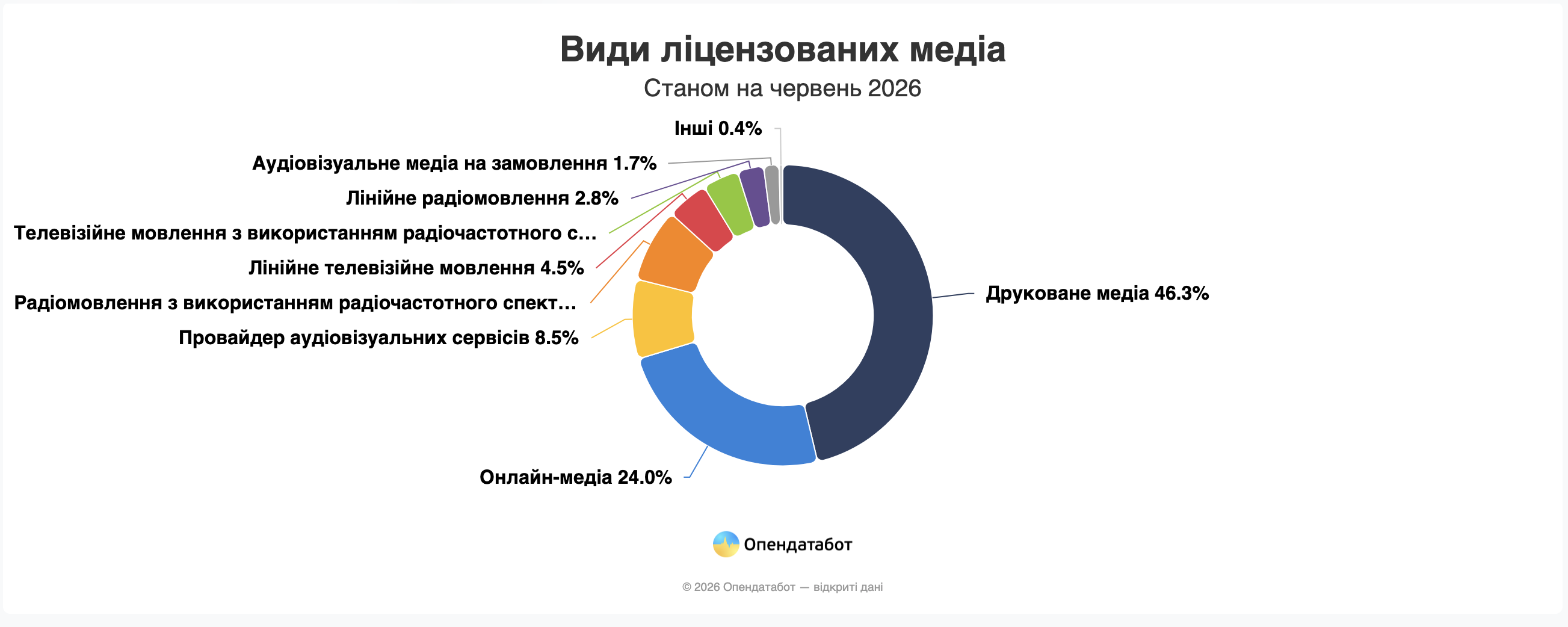
More than half of all registrants are print media: 1,675 companies or sole proprietorships. Another 27% are online media—870. Rounding out the top three are audiovisual service providers: 309 companies or sole proprietorships (9.8%). These include platforms and services that provide access to media content via the internet (e.g., Megogo, Sweet.tv, Kyivstar TV), cable operators, and satellite operators (e.g., Viasat, Xtra TV). It is worth noting that a single registrant may hold multiple types of licenses.
https://opendatabot.ua/analytics/media-licensed-2026
Vehicle traffic through the “Solotvyno–Sighetu Marmatiei” checkpoint on the Ukrainian-Romanian border will be temporarily suspended from June 8 to 17, 2026, the State Customs Service of Ukraine (SCSU) reported.
It is noted that the restrictions will be in effect daily from 9:00 a.m. to 4:00 p.m.
“According to information from the Romanian side, the closure is related to infrastructure work on the historic bridge across the Tisa River,” the SCS added.
At the same time, during this period, pedestrian traffic through the checkpoint will continue as usual.
The SCS asks citizens and carriers providing passenger transportation to take this information into account when planning their trips and, if necessary, to choose alternative border crossing routes.
According to data from Worldsteel’s annual compendium, Ukraine produced 7.9 million tons of pig iron in 2025, up from 7.1 million tons in 2024.
Pig iron exports from Ukraine rose to 2 million tons last year, compared to 1.3 million tons in 2024.
Apparent pig iron consumption in Ukraine in 2025 amounted to 5.9 million tons, compared to 5.8 million tons a year earlier.
According to Worldsteel, against the backdrop of rising pig iron production, steel output in Ukraine in 2025 fell to 7.4 million tons from 7.6 million tons in 2024. By this measure, Ukraine ranked 23rd in the world, down from 22nd a year earlier.

In May, the National Health Service of Ukraine (NHSU) paid 16.1 billion UAH to contracted healthcare facilities under the Medical Guarantees Program (MGP).
According to the NHU’s Telegram channel, specifically, 1.2 billion UAH was paid to healthcare facilities for emergency medical care, 2.3 billion UAH for primary care, and over 11.7 billion UAH for specialized medical care.
The NHIC specifies that, based on the global rate, specialized healthcare facilities were paid 5.3 billion UAH for services in May, 5.9 billion UAH for treated cases in April, under the package “Ensuring the retention of personnel capacity to provide medical care to the population in areas of active hostilities,” medical facilities were paid 257 million UAH, and under the package “Readiness and provision of medical care to the population in areas where hostilities are taking place”—171 million UAH.
In addition, the National Health Service of Ukraine (NSZU) paid UAH 884 million to pharmacies under the “Affordable Medicines” reimbursement program.
Affordable Medicines, HEALTHCARE, medical facilities, medical guarantees, НСЗУ
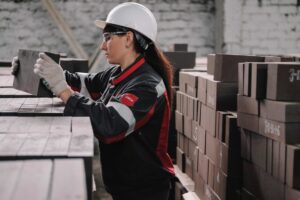
PJSC “Zaporizhogneupor”, Ukraine’s largest refractory products manufacturer and a member of the Metinvest Group, reported a 4.4-fold increase in net loss for January–March of this year compared to the same period last year—rising to UAH 29.990 million from UAH 6.982 million
According to the company’s interim report, which is available to the agency “Interfax-Ukraine,” revenue from ordinary activities for this period decreased to UAH 869.871 million from UAH 970.715 million in the first quarter of 2025.
Retained earnings as of the end of March amounted to 59.283 million UAH.
According to the annual report, the company reported a net profit of 52.291 million UAH in 2025, while in 2024 the profit was 156.801 million UAH, with revenue from ordinary activities amounting to UAH 4,287,569 million (in 2024 – UAH 3,524,855 million).
Throughout 2025, refractory products were sold throughout Ukraine, excluding the temporarily occupied territories (TOT), and exports were directed to the following destinations: the Republic of Moldova (77% of total exports); Bulgaria (13%); Latvia (4%); North Macedonia (4%); Estonia (2%). A total of 2,815 thousand tons of products worth UAH 40.8 million were sold for export in 2025. In 2025, there was a 10% increase in gross export shipments in physical terms compared to 2024 (+262 tons).
In total, the plant sold 62,595 thousand tons of refractory products in 2025 and 62,976 thousand tons in 2024.
The number of employees as of the end of 2025 was 1,431, which is 3.9% more compared to 2024 (an increase of 53 employees). This increase was due to a decrease in employee turnover, the fulfillment of the hiring plan, and the additional recruitment of employees to implement projects. In 2025, the employee turnover rate decreased by 17.2% compared to 2024. The payroll fund for the company’s full-time employees in 2025 increased by 81.469 million UAH (+16.5%) compared to 2024, totaling 575.179 million UAH. The average monthly income of full-time employees was UAH 34,542, an increase of UAH 5,757 compared to 2024.
The company’s key development priorities include reducing costs; improving product quality and competitiveness; optimizing processes for supplying the company with energy resources and raw materials; and exploring new technologies and current trends in refractory production. As part of the company’s technical development in 2026, ten types of refractory products are planned for production.
“Zaporizhvognetriv” is Ukraine’s largest manufacturer of high-quality refractory products and materials.
According to the National Securities and Stock Market Commission (NSSMC) data for the first quarter of 2026, Metinvest B.V. (Netherlands) owns 50.7899% of Zaporizhogneupor’s shares, while Zaporizhstal holds 49.2101%.
The company’s authorized capital is UAH 75.925 million, with a par value of UAH 13 per share.
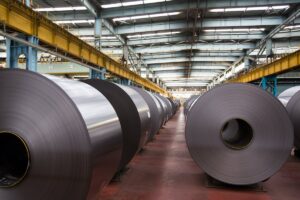
According to the 2025 results, Ukraine increased its apparent steel consumption by 13.9% compared to 2024—from 3.6 million tons to 4.1 million tons, according to data from Worldsteel’s annual compendium.
Per capita steel consumption in Ukraine reached 105.3 kg in 2025, compared to 95.9 kg a year earlier. Globally, this figure averaged 209 kg per person, compared to 214.8 kg in 2024.
According to Worldsteel, Ukraine produced 7.4 million tons of steel in 2025 and ranked 23rd in the global ranking of producers. In 2024, the country produced 7.6 million tons of steel and ranked 22nd.
There are no Ukrainian companies on the list of the world’s 50 largest steel producers for the 2022–2025 period, whereas the Metinvest Group was included in this ranking in 2014–2021.
The world’s largest steelmaker in 2025, as in 2024 and 2023, was China Baowu Group, with production of 124.76 million tons of steel. In second place is ArcelorMittal with 63.43 million tons, followed by Nippon Steel Corporation with 57.78 million tons, Ansteel Group with 57.61 million tons, and HBIS Group with 42.49 million tons.
According to the results for 2022–2025, Ukraine did not make it into the top 20 largest steel exporters, whereas in 2021 it ranked 10th, having sold 15.7 million tons of steel products on foreign markets.
At the same time, in the ranking of net exporters, Ukraine ranked 9th in the world in 2025 with a volume of 1.7 million tons, compared to 10th place and 3.4 million tons in 2024.
In addition, Ukraine exported 0.4 million tons of ferrous metal scrap in 2025, compared to 0.3 million tons in 2024.



