

Ukraine did not export any titanium-bearing ore or concentrate from January through April of this year, whereas in the first four months of last year it exported 277 tons worth $496,000.
According to statistics released by the State Customs Service (SCS), this raw material was not exported in December of last year either.
In January–April 2026, Ukraine did not export niobium, tantalum, vanadium, or zirconium ores and concentrates, but imported 115 tons of such ores worth $265,000 from Spain (91.32% of imports by value) and the Czech Republic (8.68%).
As reported, in 2025 Ukraine reduced exports of titanium-bearing ores and concentrates by 96.2% in volume terms compared to 2024—to 277 tons; in monetary terms, exports fell by 95.7%—to $496,000. The main export destinations were Uzbekistan (35.61% of shipments in monetary terms), Turkey (35.01%), and Egypt (29.38%).
In addition, Ukraine imported 78 tons of titanium-bearing ore worth $118,000 from China (98.29%, shipments took place in January) and Kazakhstan (1.71%, shipments took place in May) last year.
During this period, Ukraine exported 2,466 thousand tons of niobium, tantalum, vanadium, and zirconium ores and concentrates worth $3.954 million to Spain (48.90%), Germany (24.53%), and Italy (17.19%). At the same time, the country imported 469 tons of such ores worth $1.194 million from Spain (72.86%), the Czech Republic (13.82%), and China (11.14%).
At the same time, experts pointed out discrepancies in the statistics on exports of titanium-bearing ores. However, in response to a request from the Interfax-Ukraine agency, the State Customs Service reported that complete data on titanium raw material exports is not provided due to restrictions on the volume of export and import operations involving military and dual-use goods, which are reflected in aggregate form under the heading “Other goods.” At the same time, they explained that, in particular, shipments of titanium-bearing ores from companies differ from the State Customs Service’s data.
“We would like to inform you that these shipments are included in the statistical exports from Ukraine, but are not reflected in the foreign trade statistics published by the State Customs Service (…) under the UCCTZED commodity code 2614 ‘Titanium ores and concentrates’ due to the following (…) In accordance with the provisions (…), for the purpose of data protection and confidentiality, any information deemed confidential is reported in full at the next, higher level of data aggregation regarding the goods,” the State Customs Service explained in its response to the agency.
It was clarified that information regarding customs clearance and the movement across Ukraine’s customs border of goods subject to export control is included in the list of information containing official data at the State Customs Service, in accordance with the relevant order.
In Ukraine, titanium-bearing ores are currently mined primarily by PJSC “United Mining and Chemical Company” (UMCC), which now manages the Vilnohirsk Mining and Metallurgical Plant (VGMC, Dnipropetrovsk Oblast) and the Irshansk Mining and Processing Plant (IGZK, Zhytomyr Oblast), as well as to Mezhyrichyn Mining and Processing Plant LLC and Valky-Ilmenite LLC (both LLCs are located in Irshansk, Zhytomyr Oblast). In addition, the production and commercial firm “Velta” (Dnipro) built a mining and processing plant at the Birzulivskoye deposit with a capacity of 240,000 tons of ilmenite concentrate per year.

According to the Interfax-Ukraine Culture project, in honor of International Museum Day, the Ivan Honchar Museum opened part of its collection and shared the stories of five exhibits that have survived the disappearance of villages, the changing of eras, the loss of traditions, and even the memory of themselves, the museum’s press service told the agency.
“Each of these items is not just an object, but an experience that cannot be contained within a single human biography. They preserve the memory of an environment that has already disappeared and give us a chance to experience it,” says Oleksandra Storchai, a researcher at the Ivan Honchar Museum.
These are items created decades and centuries ago, which today have become not just museum exhibits, but tangible witnesses to vanished worlds.
Among the main exhibits are two embroidered shirts from Bakota—a village in Podillia that was flooded in 1981 during the construction of the Novodnistrovsk Hydroelectric Power Plant. Today, this place is called the “Ukrainian Atlantis.”
The museum emphasizes that these shirts serve as a memory of the lives of people who were forced to leave their homes along with the village, which disappeared forever under the water.
The collection also features balamuty—traditional necklaces made of fossilized mother-of-pearl. According to legend, deposits of this material in Ukraine were exhausted by the end of the 19th century, so today it is virtually impossible to recreate such jewelry.
Another exhibit is a salba, a chest ornament covered with coins from various countries and eras. It combines coins from the Austro-Hungarian Empire, the United States, and Canada, some of which date back to the 18th century.
Separately, the museum displayed a Volyn shirt with a restrained aesthetic and complex embroidery techniques, as well as one of the oldest shirts in the collection—featuring a slanted sleeve. Such a cut was already considered outdated by the early 20th century.
The museum notes that all these items have one thing in common—they have outlived their owners, the eras, and the environments in which they were created, yet they continue to preserve the memory of them.
The Ivan Honchar Museum is one of Ukraine’s key museums dedicated to the preservation and study of Ukraine’s traditional culture and ethnographic heritage.
https://interfax.com.ua/news/culture/1168579.html
The state-owned company Ukrposhta reported a total profit of UAH 106.3 million for January–April, with EBITDA of UAH 122.9 million, the company’s CEO Ihor Smiliansky announced on Facebook on Monday.
“EBITDA (operating profit)—a measure of the core business’s performance—improved from a negative 13.6 million UAH to a positive 122.9 million UAH. And this is without taking into account the sale of assets. It consists solely of operating income,” he noted.
According to the CEO, the company’s equity reached UAH 2.3 billion without additional budget funding.
“So, who doesn’t have the cards, and who holds the trump cards right now?” Smiliansky concluded in a remote discussion with Andriy Pyshnyy, Governor of the National Bank of Ukraine, regarding Ukrposhta’s financial capacity to “restore and accumulate capital through operating activities” and obtain a banking license.
As reported, Ukrposhta posted a net loss of 204.8 million UAH for January–March 2026, which is 1.1 million UAH, or 0.5%, higher than in the same period of 2025, while its revenue grew by 1.1% to 13.11842 billion UAH.
The company’s equity in the first quarter of this year decreased from UAH 2.208 billion to UAH 2.003 billion.
In April of this year, Ukrposhta received UAH 461.5 million for its building, the former sorting center near the railway station in Lviv, which was purchased by the Eurotek Invest fund owned by Mykhailo Veselskyi, the owner of the Arsen supermarket chain.

On the occasion of the 40th anniversary of the accident at the Chornobyl Nuclear Power Plant, the art and technology exhibition “Chornobyl. 40 Years Later. A History That Obligates” was held in Kyiv. The exhibition was organized by the State Agency of Ukraine on Exclusion Zone Management with the financial support of the European Union.
One of the thematic areas of the exhibition was the evolution of approaches to nuclear safety after the accidents at the Chornobyl NPP and the Fukushima Daiichi NPP — from safety culture to modern severe accident management systems and post-Fukushima modernization of power units.
Specially for the exhibition, the engineering company Energy Safety Group provided expert support in preparing a separate information and technology stand titled “Lessons of Severe Accidents for a Safe Future”, dedicated to how modern engineering responds to severe accident development scenarios and what technical solutions today form a multi-level protection system for modern nuclear power plants.
Forty years after the accident at the Chornobyl NPP and fifteen years after the accident at the Fukushima Daiichi NPP make it possible to look particularly clearly at the development of the industry through the prism of the lessons learned.
After the accident at the Chornobyl NPP, the global nuclear energy sector deeply reconsidered the importance of safety culture. At the practical level, this meant a very simple but fundamental thing: for any deviation of parameters from the norm, there must be defined instructions, trained personnel, and practiced action scenarios. Twenty-five years later, the accident at the Fukushima Daiichi NPP again forced the world to review approaches to the resilience of power units — this time under conditions of loss of external power supply, cooling, and the development of severe accidents.
After the accident at the Chornobyl NPP, the international nuclear community came to an important conclusion: safety must be determined not only by technologies, but also by how people think, make decisions, and respond to risks. Thus, in 1986, the concept of “safety culture” appeared. Its essence is that:
“Safety culture” became the main lesson of Chornobyl for the whole world.
The lessons of the accidents at the Chornobyl NPP and the Fukushima Daiichi NPP changed not only approaches to risk management, but also the very logic of modern nuclear safety. It became obvious: even after a reactor shutdown, safety depends on the ability of systems to remove residual heat for a long time, maintain power supply for critical functions, and keep possible consequences within protective barriers.
That is why, after the accident at the Fukushima Daiichi NPP in 2011, large-scale stress tests of nuclear power plants were conducted in Europe and around the world — in-depth inspections that assessed the resilience of power units to extreme external events, complete blackout, loss of cooling sources, and the development of severe accidents. These inspections made it possible to assess the real safety margin beyond the design operating conditions and to determine which technical solutions were necessary to further strengthen the resilience of plants.
Today, the safety of nuclear energy is based on a multi-level principle of protection, where each subsequent level compensates for the loss of the function of the previous one and ensures the resilience of the plant even in the most complex emergency scenarios.

Source: prepared on the basis of data from SSTC NRS
In Ukraine*, in response to the accident at the Fukushima Daiichi NPP, an extraordinary in-depth safety assessment of NPP power units, including facilities of the Chornobyl NPP, was initiated by a decision of the National Security and Defense Council enacted by a Decree of the President. In implementation of this decision, the State Nuclear Regulatory Inspectorate, in cooperation with the State Technogenic Safety Service and the operating organizations of the nuclear industry, developed an Action Plan, while NPP operators conducted targeted stress tests at all sites. Based on their results, the C(C)SUP — the Comprehensive (Consolidated) Safety Upgrade Program for NPP Power Units of Ukraine — was reviewed and supplemented. The responsible executor of this program is the NPP operator, NNEGC “Energoatom”.
Source: prepared on the basis of data from SSTC NRS
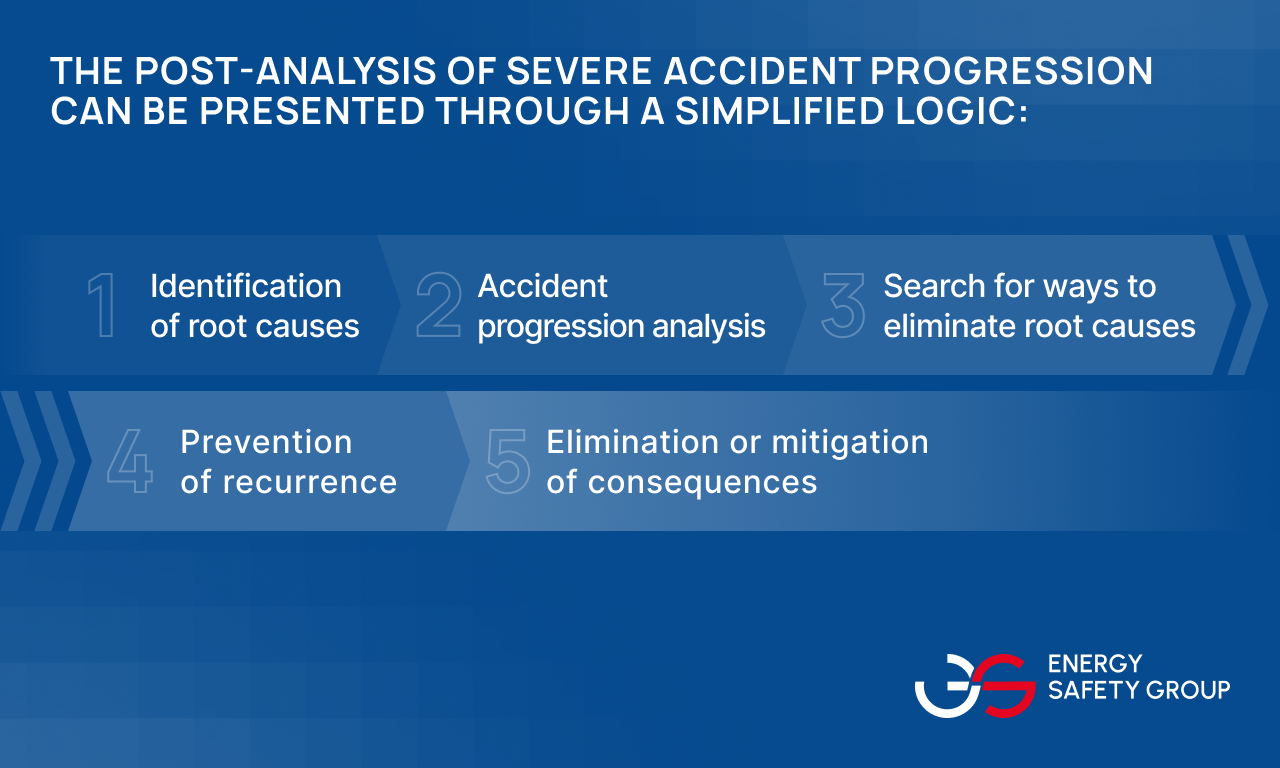
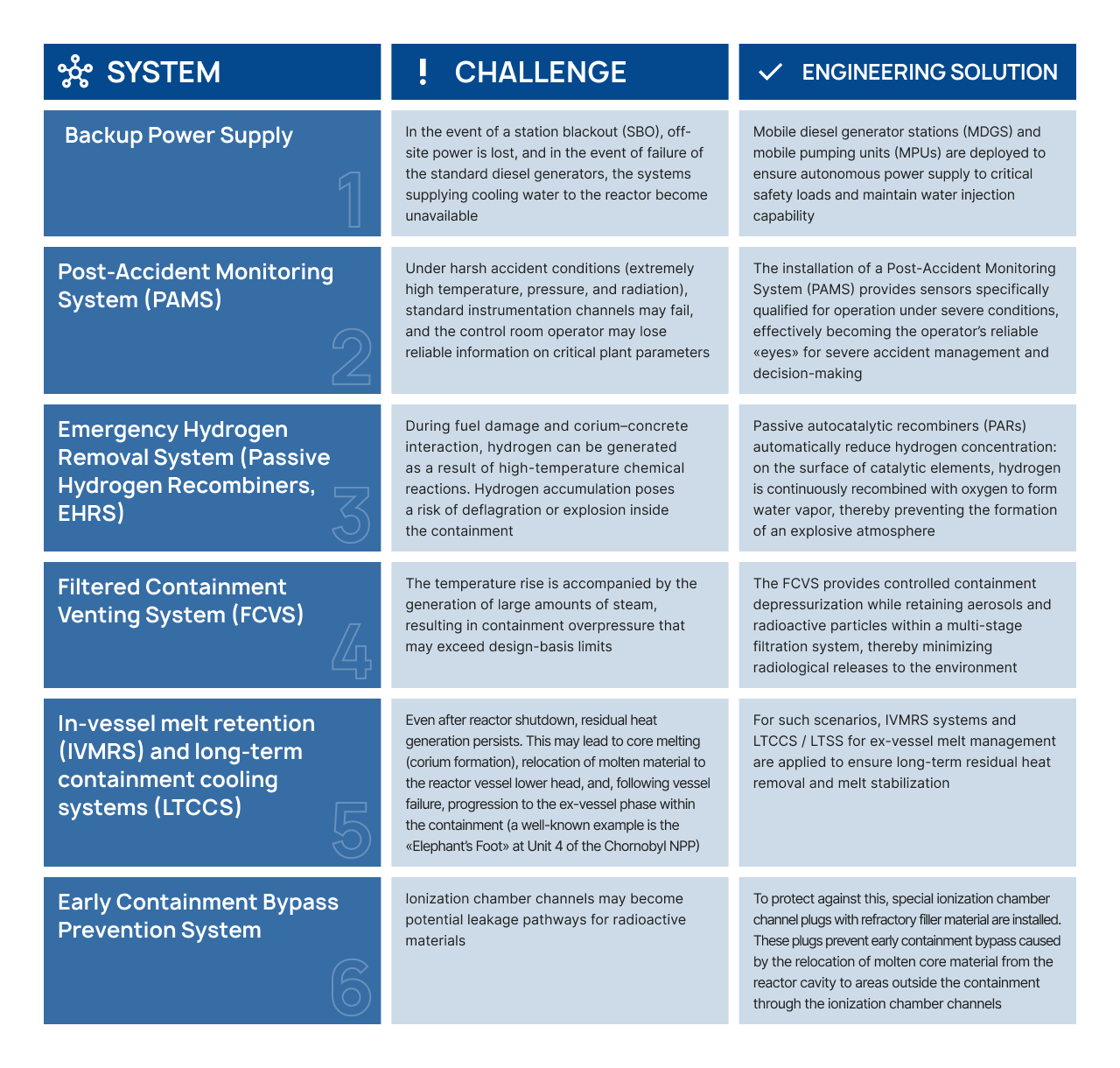
The lessons of severe accidents gave impetus to the continuous improvement of safety systems and other beyond-design-basis equipment in nuclear energy. By implementing post-Fukushima modernizations, Ukraine consistently demonstrates its commitment to the principle of continuous improvement of the safety of power units at operating NPPs. The result of this evolution has been reliable engineering solutions for all key challenges associated with severe accidents, which today are already a standard for the newest Generation III+ reactors.
To show how modern engineering responds to specific scenarios of severe accident development, the main challenges and the corresponding safety systems and beyond-design-basis equipment are presented below.
The development of nuclear safety largely takes place through the analysis of severe accidents, the review of potential scenarios, and the search for technical solutions to contain them or minimize their consequences. A significant part of the systems that were previously considered additional or beyond-design-basis, after the accident at the Fukushima Daiichi NPP, effectively became a new standard for modern power units.
For specialists in the nuclear industry, this means constant work on risk assessment, resilience of safety systems, post-accident management, and adaptation of international experience to the real operating conditions of nuclear power plants. Greater attention is paid to the modernization of safety systems, analysis of scenarios for the development of severe accidents, and the development of solutions capable of ensuring the resilience of power units under beyond-design-basis operating conditions.
It is precisely these areas that today are associated with the work of companies operating in the field of nuclear engineering and modernization of safety systems at nuclear power plants, including Energy Safety Group, which participates in the implementation of projects for nuclear facilities in Ukraine and other European countries.

In January–April of this year, Ukraine reduced imports of aluminum ores and concentrates (bauxite) by 48.5% in volume terms compared to the same period last year—to 6,946 thousand tons from 13,494 thousand tons.
According to statistics released by the State Customs Service (SCS), bauxite imports in monetary terms decreased to $1.186 million from $1.476 million in January–April 2026.
Imports came from China (59.36% of shipments in monetary terms) and Turkey (40.64%).
Ukraine did not re-export bauxite in 2026, just as it did not in 2025.
As reported, in 2025, Ukraine increased imports of aluminum ores and concentrates by 23.7% in physical terms compared to the previous year—to 43.5 thousand tons—and by 15.8% in monetary terms—to $4.754 million. These imports came mainly from Turkey (81.84% of shipments in monetary terms), China (15.97%), and Guyana (2.19%).
Ukraine did not re-export bauxite in 2025, just as it did not in 2024 and 2023.
In 2024, Ukraine increased its imports of bauxite by 77.4% in volume terms compared to 2023—to 35,173 thousand tons—and by 74% in monetary terms—to $4.107 million. Imports came mainly from Turkey (78.48% of shipments in monetary terms), China (19.48%), and Spain (1.9%).
Bauxite is an aluminum ore used as a raw material for producing alumina, and from that, aluminum. It is also used as a flux in ferrous metallurgy.
In Ukraine, bauxite is imported, in particular, by the Mykolaiv Alumina Plant (MAP), which is currently idle.

According to the Interfax-Ukraine Culture project, the National Union of Cinematographers of Ukraine is launching a series of creative evenings dedicated to the 100th anniversary of Ukrainian animation, which will be celebrated in 2027, the National Union of Cinematographers of Ukraine announced on its Facebook page.
“Animation is a language capable of uniting generations,” the organizers note.
The first evening will take place on May 19 at 6:00 p.m. in the Blue Hall of the House of Cinema and will be dedicated to the creative legacy of director, artist, and educator Yevhen Syvokon.
The evening’s program features Syvokon’s own works, as well as films by his students. The organizers describe the event as a “warm gathering of remembrance and gratitude,” during which the images created by the artist will come to life and the voices of his students and colleagues will be heard.
The event will be moderated by film scholar Natalia Hrytsenko and animation director Stepan Koval—winner of the Taras Shevchenko National Prize of Ukraine, recipient of the Silver Bear at the Berlin International Film Festival, and creator of the animated films “Tram No. 9 Was Going,” “The Mitten,” “Clay,” and “The Labyrinth.”
Ukrainian animation dates back to 1927, when director Vyacheslav Levandovsky created the first Ukrainian animated film, “The Tale of the Straw Bull.”
Admission to the event is free.
https://interfax.com.ua/news/culture/1168609.html
Animation, film studio, National Union of Cinematographers of Ukraine



