

The Zhydachiv Pulp and Paper Mill (ZhCPK, Lviv Oblast) plans to invest approximately UAH 50 million of its own funds in production development in 2026 to improve manufacturing processes in order to reduce production costs, purchase new equipment to expand the product range, and improve product quality.
According to the company’s 2025 financial report, published in the disclosure system of the National Securities and Stock Market Commission (NSSMC), in the near future, the company plans to purchase an automated production line for four-valve corrugated boxes with three-color printing (UAH 46.5 million), as well as an automated packaging line for corrugated products (UAH 8.5 million).
In addition, there are plans to purchase a 500 kW solar power plant (UAH 9.5 million).
The report does not specify the amount of funds invested in development in 2025, but it notes that over the past five years, the plant has purchased fixed assets for production purposes totaling UAH 160.91 million, including machinery and equipment worth UAH 125.3 million.
Most of the funds were invested in 2024 (55.9% of the total investment), while in 2025 – 3% (2021 – 20%, 2022 – 9.5%, 2023 – 11.6%).
According to the report, ZhCPK increased its net profit by 85% in 2025 compared to 2024—to UAH 9.85 million—as net revenue grew by 19.2%—to UAH 524.3 million.
Exports accounted for 2.6% of sales (UAH 13.9 million), specifically to Poland, Moldova, and Latvia.
ZhCPK has an annual production capacity of 40,300 tons of paper (corrugating medium, linerboard, wrapping paper), 50,000 tons of cardboard (boxboard and linerboard for glued cardboard), corrugated cardboard – 100 million square meters, and egg trays – 48 million units per year.
As reported, ZhCPK slightly increased its corrugated packaging output last year to 19.9 million square meters. Packaging board output decreased by 4.4% to 10,400 tons, while wrapping paper output increased by 38.4% to 5,200 tons.
As of the first quarter of 2026, according to the NSSMC, the shareholders include Melfort Trading (21.118%), Hangli International Holdings (20.154%), Halefield Holdings (nearly 12.09%), Grammel Holdings (nearly 10%), as well as the closed-end investment fund “Seventh” LLC “Asset Management Company ”Svarog Asset Management,“ associated with businessman Kostyantyn Hryhorishyn – 17.65%, and FC ”Meridian” – nearly 8.64%.
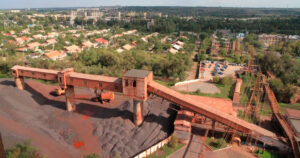
Based on its performance in January-March of this year, Kryvyi Rih Iron Ore Plant (KZRK) saw its net loss increase 4.4-fold compared to the same period last year—to UAH 378.948 million from UAH 85.925 million.
According to KZRK’s interim report, available to the agency “Interfax-Ukraine,” revenue from ordinary activities for this period fell to UAH 135.457 million from UAH 705.526 million.
Retained earnings as of the end of March 2026 amounted to UAH 144.526 million.
In Q1 2026, KZRK reduced iron ore production (sintering and blast furnace) by 4.7 times—to 50,000 tons from 236,000 tons in the first quarter of 2025. Exports accounted for 88.8% of total sales (89.11%).
Approved production capacity for iron ore mining as of the first quarter of 2026 is 269,000 tons (483,000 tons in Q1 2025 tons), while actual raw ore production amounted to 68.2 thousand tons (294.3 thousand tons). Capacity utilization in the first quarter of 2026 was 25.3% (60% in the first quarter of 2025).
Major customers (accounting for more than 5% of total revenue) in the first quarter of 2026 were U. S. Steel Košice, s.r.o., Lentimex spol.s.r.o., KIZARA GROUP LTD, and METINVEST HOLDING LLC. KZRK’s products are sold on domestic and foreign markets (Slovakia, the Czech Republic, Serbia, and Austria).
For 2026, the company plans to produce 3 million tons of commercial products with an average iron content of 56.86%.
In the first quarter of 2026, the company did not attract external investments or credit funds; business operations were financed using its own funds. The company’s capital expenditures for the first quarter of 2026 amounted to UAH 25.422 million (compared to UAH 48.343 million in the first quarter of 2025).
According to the interim report for the fourth quarter of 2025, due to the inability to maintain wages at the level of comparable enterprises—a situation compounded since 2025 by the inability to pay wages on time and in full—1,375 employees left the company in 2025. The current number of production-category employees is insufficient to maintain core production processes. To halt the exodus of personnel, the company must fully fund the repayment of wage arrears, ensure their timely payment, and provide a competitive salary
The report for Q1 2026 notes that despite the difficult situation with the sale of finished products due to the ongoing aggression by the Russian Federation, work is currently continuing at the plant’s mines on the construction of the following levels: “Ternivska” level – 1,500 m, “Kozatska” – 1,500 m level, ‘Pokrovska’ mine – 1,415 m level, “Kryvorizka” mine – 1,465 m level.
As reported, KZRK increased its net loss by 3.2 times in the first nine months of 2025 compared to the same period in 2024—to 1.487217 billion UAH, while net revenue for this period decreased by 41.6%—to 1.601822 billion UAH.
The annual report for 2025 has not yet been published.
KZRK ended 2024 with a net loss of 2.14015 billion UAH, while in 2023 it amounted to 63.411 million UAH. Net revenue in 2024 amounted to UAH 3.443 billion, compared to UAH 5.578 billion in 2023.
In 2024, the plant produced 1.693 million tons of raw ore; the volume of marketable ore was 1.370 million tons. The plan for 2025 is 4.385 million tons of raw ore and 3.6 million tons of marketable ore.
As reported, on May 23, 2025, TViy Energosupply LLC (Kyiv) filed a petition with the Commercial Court of Dnipropetrovsk Oblast to initiate bankruptcy proceedings against KZRK due to unpaid bills for electricity consumption. The Commercial Court of Dnipropetrovsk Oblast ruled to open bankruptcy proceedings against KZRK on June 9 of this year.
KZRK specializes in underground iron ore mining. It comprises four mines: “Pokrovska” (formerly “Zhovtneva”), the “Kryvyi Rih” mine (“Batkivshchyna”), “Kozatska” (formerly ‘Hvardiyiska’), and “Ternivska” (formerly the Ordzhonikidze Ore Administration, later named after Lenin).
According to the National Securities and Stock Market Commission (NSSMC) data for the fourth quarter of 2025, the main shareholder of KZRK is Starmill Limited (Cyprus), which owns 99.8812% of its shares. Operational control of the plant was exercised by the Privat Group prior to the initiation of bankruptcy proceedings.
In May 2023, Ukraine imposed sanctions against dozens of foreign companies linked to Russian individuals that own significant assets in Ukraine, including KZRK. Some of these assets had already been seized, but the sanctions paved the way for their confiscation. The corresponding Presidential Decree No. 279 of May 12 was published on the President’s website. In particular, the list of legal entities includes Starmill Limited, which owns 99.89% of KZRK under the operational control of the Privat Group.
The company’s authorized capital is 1 billion 991.233 million UAH.
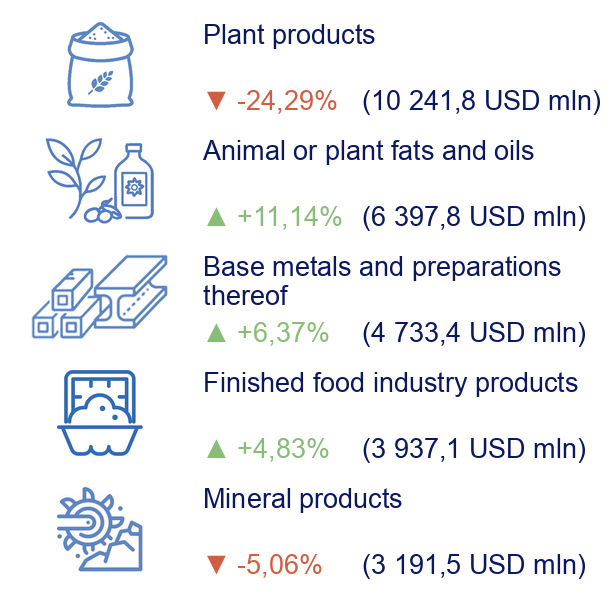
Dynamics of export of goods in January-December 2025 by the most important items in relation to the same period of 2024, %

Vietnam’s apartment market has cooled sharply following a period of rapid price growth: developers are facing a decline in transactions, buyer caution, and the need to stimulate sales.
According to local media reports, demand for apartments has dropped significantly amid high interest rates, inflationary pressures, and general geopolitical instability. Vietnam’s Ministry of Construction has also recorded a decline in transaction volumes nationwide, confirming the market’s shift from a phase of frenzied growth to more selective demand.
However, the market’s problem is not limited to a decline in buyer interest. An imbalance in supply persists in Vietnam: in the largest cities, primarily Hanoi and Ho Chi Minh City, there remains a shortage of affordable housing, while a significant portion of new projects falls into the higher-priced segment. Vietnam Investment Review notes that in the first quarter of 2026, Hanoi and Ho Chi Minh City continued to face a gap between supply and demand due to a shortage of affordable apartments.
The most pressing issue remains housing costs. In Hanoi, prices for new apartments continued to rise in the first quarter of 2026, reaching an average of approximately 128 million dong per square meter, while the secondary market has already begun to show signs of a price correction. Developers attribute the price increases to rising costs of construction materials, financing, and land.
In Ho Chi Minh City, the trend is different: after prices rose in 2025, the market began to cool, and in some areas, prices fell by 1–7%, which partially stimulated demand.
The Vietnamese government is trying to curb market overheating and expand the supply of affordable housing. Earlier, Prime Minister Pham Minh Chinh called for accelerating housing construction, simplifying administrative procedures, and developing social housing, as rising prices have made real estate purchases unaffordable for many families.
Additional pressure on the market is being created by the government’s plans to curb speculative demand. In January 2026, Reuters reported that Vietnam was preparing tax measures against speculation in the real estate market, where in 2025 apartment prices rose by 20–30% and land prices by 20–25%.
Thus, the Vietnamese apartment market is entering a more complex phase: prices remain high, there is a shortage of affordable supply, but demand is no longer ready to automatically absorb new properties at any price. For developers, this means the need to revise pricing policies, offer installment plans, discounts, and more realistic purchase terms. For buyers, it presents an opportunity for stronger bargaining positions, especially in the secondary market and in areas where supply is growing faster than demand.

The Winner Group, one of the leaders in Ukraine’s automotive market, intends to acquire premises in the UNIT.City innovation park (Kyiv).
On May 14, the Antimonopoly Committee of Ukraine granted permission to Winner Group Ukraine LLC, a company with foreign investment, to acquire control over Re Citylook LLC, owned by Ukrainian entrepreneur and UNIT.City founder Vasyl Khmelnytskyi, according to a report on the AMCU website.
Winner Imports Ukraine, which has been operating in Ukraine for over 30 years, is the official importer of Ford, Volvo, Jaguar, Land Rover, MG, and Porsche vehicles in the country, as well as the exclusive representative of Bentley.
In addition to automotive distribution and retail, the Winner Group is engaged in leasing activities and also develops and manages commercial real estate.
According to YouControl, in 2025, Winner Group Ukraine LLC reported UAH 87.6 million in net profit (UAH 33.9 million in 2024).
The UNIT.City innovation park, established in Kyiv on the site of a former motorcycle factory, brings together startups, IT companies, R&D centers, and educational spaces to foster the development of an innovation ecosystem.

In April 2026, TAS Insurance Group (Kyiv) paid out UAH 374,100 under its insurance contracts, which is 78% more than during the same period in 2025.
According to the insurer’s website, 18.8% of the total payouts were for comprehensive auto insurance (CASCO), or UAH 70.23 million (38.5% more than in March 2025); 54.7% were for mandatory auto liability insurance (OSCPV), or UAH 204.5 million (2.53 times more); “Green Card” – 13.4%, or UAH 50.7 million (+23.3%).
The share of voluntary medical insurance (VMI) in the company’s claims portfolio was 11.7%, or UAH 43.6 million (+46.4%). In turn, claims under property insurance contracts increased by 30.7% to UAH 1.4 million.
Under other insurance contracts, TAS Insurance Group paid out UAH 4.24 million in April 2026, which is 10% more than in April 2025.
TAS Insurance Group was established in 1998. It is a universal insurer offering over 80 types of insurance products across various categories of voluntary and mandatory insurance. It maintains an extensive regional network: 28 regional offices and branches, and 450 sales offices throughout Ukraine.



