

Production of corrugated cardboard boxes by Ukraine’s leading companies in the industry in August 2026 decreased by 11% compared to August of last year—to 46 million square meters, according to data from the “UkrPapier” association.
Compared to July of this year, corrugated packaging output decreased by approximately 8%.
The decline in finished packaging output was accompanied by a reduction in the production of raw materials for it. In August, companies produced 33,100 metric tons of packaging board, including paper for corrugation, which is 7.8% less than last year’s figure.
Total cardboard production amounted to 42 thousand metric tons, down 3.1% year-over-year.
August’s performance contrasts with last year’s results. By the end of 2025, Ukrainian companies had increased production of corrugated cardboard boxes by 2.1%—to 599.6 million square meters.
Corrugated packaging is widely used in the food industry, e-commerce, logistics, consumer goods manufacturing, and export shipments; therefore, its production volume serves as an indicator of activity across several economic sectors.
According to previously published data from the association, in the first seven months of 2026, corrugated packaging production also lagged behind last year’s level by approximately 2.7%. August significantly exacerbated this downward trend.
Under martial law, the “UkrPapier” Association does not publish individual production figures for each company.
Source: “UkrBumaga”.
CARDBOARD, CORRUGATED PACKAGING, PACKAGING, PRODUCTION, UKRAINE

On September 30, Kyiv will host the professional gathering “METRONOM. Kyiv,” dedicated to collaboration between developers and architects and the creation of added value in real estate projects. The event is organized by the DMNTR media group.
The meeting will take place from 4:00 PM to 10:00 PM at 2 Knyaziv Ostrozkykh Street, near the “Arsenalska” metro station.
“METRONOM. Kyiv” is designed for a professional audience of up to 200 participants, including investors, developers, architects, manufacturers of building materials, and representatives of the real estate market.
The business program will be centered around three practical case studies. Teams of developers and architects will present real-world projects entering the market and demonstrate how collaboration between the client and the architect is structured, which decisions influence a property’s value, and how the architectural concept is integrated into the development model.
Among the event’s headliners are representatives from A Development, AVG Group, and A. Pashenko Architects: Oleksiy Baranov, Yulia Polyukhovich, Andriy Pashenko, and Andriy Voitko.
The second case study will be presented by SAGA Development and BGV Development—Andriy Vavrysh, Anna Viken, Yevhen Binyavskyi, and Serhiy Zalevskyi.
The third case study will feature representatives from “Creator-Bud” and AIMM—Igor Guda, Maxim Myatko, Dmytro Struk, Yulia Dementyeva, and Lyudmila Chumak.
Registration for participants will begin at 4:00 p.m. The business session, featuring presentations of the three case studies, will run from 5:00 p.m. to 7:30 p.m. Following that, from 7:30 p.m. to 10:00 p.m., there will be an informal program featuring jazz, a buffet, and networking.
The organizers are offering three participation options. A standard ticket costs 2,500 UAH and includes participation in the business session, a cocktail reception, and networking.
A premium ticket, priced at 5,000 UAH, includes priority registration, seats in the premium section, an extended evening program featuring a buffet, a cigar ceremony, and a whiskey tasting, as well as a separate networking session.
Online participation costs 1,500 UAH and includes access to the live stream of the event’s business program from 5:00 PM to 7:30 PM.
Seating is limited. Participation in the event and access to the online stream are available only after prior registration and payment.
Registration: DMNTR Media Group, tel. 077 777 25 47, 044 461 91 28.
Registration and ticket purchase form.
Open4business – information partner
ARCHITECTURE, DEVELOPMENT, DMNTR, KYIV, REAL ESTATE, МЕТРОНОМ

Residents of the village of Piddington in Oxfordshire held a symbolic referendum on leaving the United Kingdom to protest the government’s plans to establish a large center for asylum seekers nearby, according to The Daily Telegraph.
285 people voted in favor of Piddington’s “independence,” 26 voted against it, and one ballot was deemed invalid. Voter turnout was approximately 92%. The vote has no legal force and does not trigger any procedure for the village to leave the United Kingdom.
The reason for this unusual referendum was the British Home Office’s plans to convert part of the former military facility Bicester Garrison Site A, located between Piddington and Upper Arncott, into a temporary accommodation center for asylum seekers.
According to official documentation, the facility is designed to accommodate a maximum of 1,256 people, primarily single adult men. By comparison, the population of Piddington itself is about 350 people, so the potential number of residents at the center could be more than three times the village’s population.
The project involves the use of existing buildings at a former military base, the construction of modular housing, and the creation of medical and social infrastructure, security systems, parking lots, and recreational areas. The government’s application is currently under review.
Local authorities have also criticized the project’s planning process. The Cherwell District Council reported that the municipality was not consulted prior to the announcement of the government’s plans, and that the authorities only learned of the intention to open the center shortly before the public announcement in June. The council is demanding additional clarification from the government regarding security, the strain on infrastructure, policing, and social services.
The organizers of the vote emphasize that the idea of “independence” was primarily a way to attract the central government’s attention. Following the referendum, the village is even discussing the tongue-in-cheek name “Principality of Piddington” and other symbolic attributes of a separate state.
The British authorities, for their part, explain the creation of large specialized centers as an effort to gradually phase out the practice of housing asylum seekers in hotels. The Home Office states that former military facilities are intended to provide more manageable and less expensive housing for people awaiting decisions on their applications. The government expects to reduce costs by more than 1 billion pounds in this way.
However, the decision to establish a center at Bicester Garrison has not yet been finalized. The Home Office’s official website states that the use of new military sites is possible only after the necessary assessments, approvals, and planning procedures have been completed.
Original source: The Daily Telegraph, September 16, 2026.

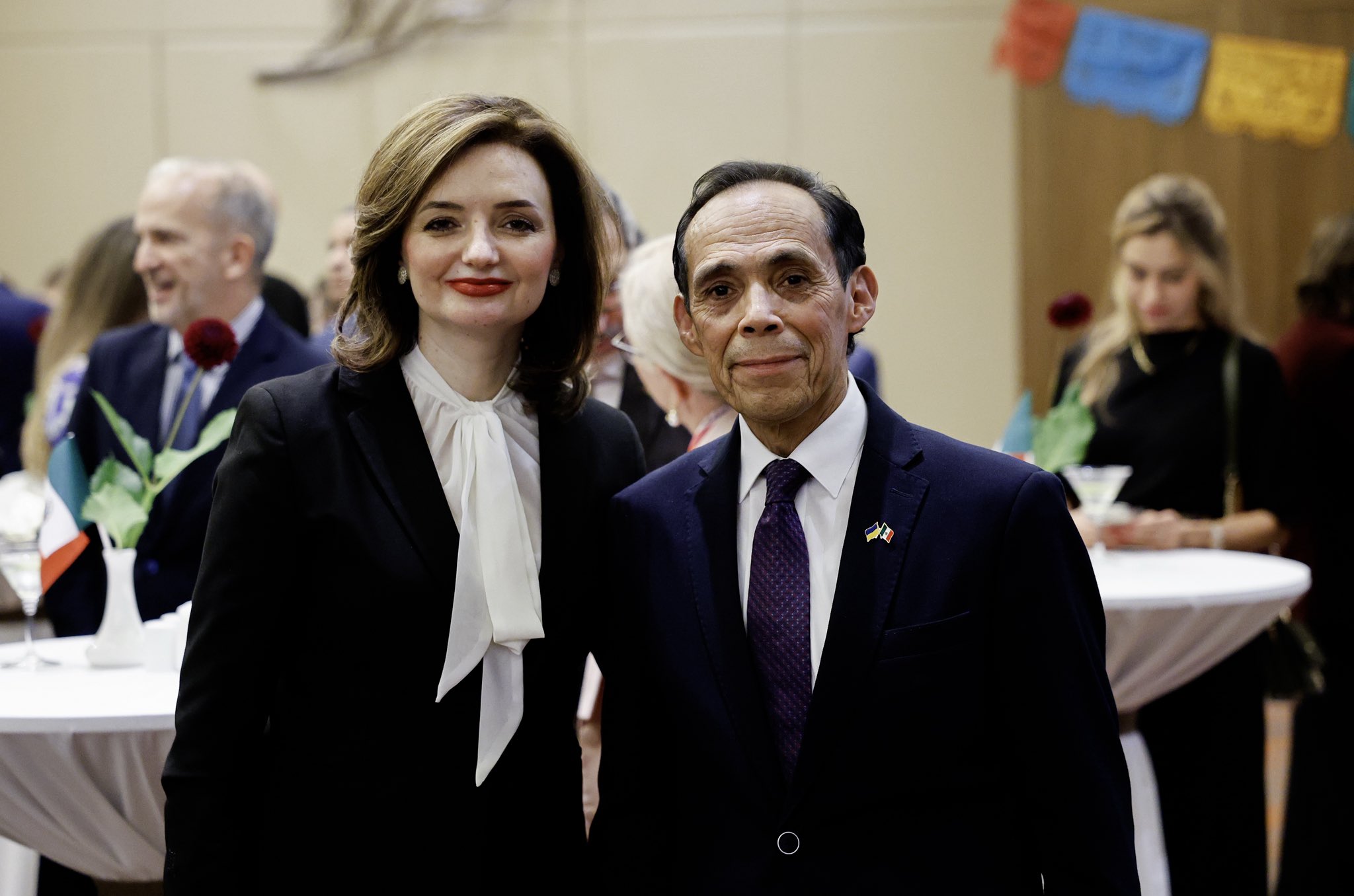
Mexico and Ukraine have significant potential for further expanding bilateral relations in the political, economic, scientific, and academic spheres, said Audencio Contreras González, Mexico’s Ambassador Extraordinary and Plenipotentiary to Ukraine.
“I am convinced that Mexico and Ukraine have significant potential for further strengthening bilateral relations. Our countries deserve broader, deeper, and more dynamic relations—ranging from open political dialogue based on mutual respect to mutually beneficial scientific, academic, and economic cooperation,” the ambassador said at a diplomatic reception in Kyiv marking the 216th anniversary of the start of Mexico’s struggle for independence.
The event was attended by Ukraine’s Deputy Minister of Foreign Affairs Mariana Betsa, as well as representatives of government agencies, the diplomatic corps, academic and business circles, civil society, and the Mexican community.
Contreras González noted that celebrating Mexico’s national holiday in Ukraine holds special significance.
“We celebrate it together with a people whom we sincerely admire and who, under extremely difficult circumstances, deeply value their identity, their sovereignty, and their right to independently determine their own future as an independent state living in peace, just as the Mexican people do,” the diplomat emphasized.
According to him, Mexico’s foreign policy is based on the constitutional principles of non-interference, the peaceful settlement of disputes, and the rejection of the use of force in international relations.
“It is precisely these principles that define our clear position on condemning the invasion of Ukraine, upholding international law, and promoting dialogue to achieve a just and lasting peace,” the ambassador stated.
He also emphasized the importance of cultural diplomacy and closer ties between the societies of the two countries, despite the significant geographical distance.
“Strengthening bilateral relations begins with our societies—which are geographically distant but share common values and traits, as well as a centuries-old history of statehood—getting to know one another better,” noted Contreras González.
During the reception, guests were introduced to elements of Mexican culture and national traditions, including music, cuisine, and the traditional decorative art of papel picado.
The ambassador expressed hope for the swiftest possible establishment of a just and lasting peace in Ukraine and the further strengthening of Ukrainian-Mexican cooperation.
Mexico recognized Ukraine’s independence on December 25, 1991, and diplomatic relations between the two countries were established on January 14, 1992.
The Embassy of Ukraine in Mexico City was opened in January 1999. Mexico initially maintained diplomatic relations with Ukraine through its embassies in Russia and later in Poland; in 2000, an honorary consulate began operating in Kyiv. The Permanent Embassy of Mexico in Ukraine began operations on May 1, 2005, and its official inauguration took place on June 20, 2005, during a state visit by Mexican President Vicente Fox.
Audencio Contreras González heads the Mexican Embassy in Ukraine and presented his credentials to the President of Ukraine on August 16, 2024.
In August 2026, “Express Insurance” collected 125 million UAH in insurance premiums, a 24.1% increase compared to the same period in 2025, according to the insurer’s website.
It is noted that the company received the largest volume of insurance premiums from comprehensive auto insurance (CASCO) policies—84.4 million UAH, which is 28.6% higher than last year’s figure. Under mandatory auto liability insurance (OSAGO) policies, the company collected nearly 38.6 million UAH in insurance premiums—a 15.6% increase. Revenue from other types of insurance totaled nearly 2 million UAH (+17.8%).
The company also reports that the number of insurance policies issued increased by 9.3%.
In August, the insurance company paid out 60.3 million UAH in insurance claims, which is 36.9% more than last year.
Express Insurance was founded in 2008. It is part of the UkrAVTO group of companies. It specializes in auto insurance.
The company has more than 300 insurance agents throughout Ukraine and is actively expanding its network of partner auto service centers.

Nibulon Joint Venture LLC has joined the “Agency for Humanitarian Demining of Ukraine’s Waterways” consortium with the aim of helping to build Ukraine’s institutional capacity in this area, the company’s press service reported.
“The joint work will encompass humanitarian demining of Ukrainian waters, the development of technological solutions, scientific research and innovation, the implementation of standards, personnel training, and the execution of international projects,” the statement reads.
Nibulon noted that its participation in the consortium is a continuation of the company’s work in the field of humanitarian demining. With the support of the German organization DEG Impulse gGmbH, the company formed a specialized unit and strengthened its technical capabilities, specifically with GCS-200 mechanized demining machines. In July 2026, Nibulon received the relevant certification, confirming its professional readiness to carry out such work.
The company added that its participation in the Agency for Humanitarian Demining of Ukrainian Waters represents another consolidation of practical experience, infrastructure, and scientific and engineering expertise aimed at building Ukraine’s systemic capacity in underwater demining.
The initiative to create this consortium was launched by the NGO “International Business People’s Club.” The consortium also includes representatives from the Admiral Makarov National University of Shipbuilding and the “West-East” group of companies, which specializes in engineering and technological solutions.
Before the war, “Nibulon” Joint Venture LLC cultivated 82,000 hectares of land across 12 regions of Ukraine and exported agricultural products to more than 70 countries worldwide. In 2021, the grain trader exported 5.64 million metric tons of agricultural products—the highest volume in its history. After the war began, the company was forced to relocate its headquarters from Mykolaiv to Kyiv. Currently, “Nibulon” cultivates 52,000 hectares of land across four clusters. In addition to 23 grain elevator complexes, Nibulon has its own trucking and rail transport capabilities, as well as a fleet built at its own shipyard. During wartime, this fleet continues to provide river transportation services.
The company is also actively developing its own humanitarian demining unit to restore safety on leased lands and assist Ukraine’s agricultural sector. It is a certified mine action operator.



