
As part of Rinat Akhmetov’s Steel Front military initiative, Metinvest is working on exporting bunkers for the border between Poland and Russia, the company’s Chief Operating Officer (COO) Alexander Mironenko said in an interview with Pryamyy TV channel.
“We are mainly working with our Western partners on shelters. This is very relevant right now: we are showing them our solutions for the construction of various structures. For example, a hospital that fully complies with NATO Role2 standards. It has been inspected by numerous delegations: military medics, engineers, and foreign specialists, and everyone agreed that the solutions are quite effective,” said Myronenko.
According to him, the company has presented its engineering solutions based on “hideouts” at many military-themed exhibitions and meetings, and they are very popular.
“We are currently working on entering the international market with these solutions, for example, for the construction of the border between Poland and Russia, using our experience and proposals for underground structures. The NATO army does not have such experience, so they are very interested in this. And we exchange information and experience with them,” said the COO.
He added that the shelters have undergone a major transformation. Initially, they were simply “barrels” buried in the ground. “Now we provide a full service — it is essentially an underground house with its own lighting, generator, stove, and all amenities: just plug the generator into the outlet, and the room is ready for use,” the COO clarified.
“The unique product we are proud of is, of course, the protective structures for the Patriot and SAMP/T air defense systems. And now we are developing protection for the Hawk air defense system control module, which operates in Ukraine. In my opinion, this is a unique experience, because we are talking about state-of-the-art technology designed to protect the sky from the enemy, but certain shortcomings have been revealed in real combat conditions. Together with the military, we corrected them – we made the control modules, radar installations, and other systems safer so that personnel could feel confident even in dangerous situations and conduct air defense of our cities and towns,” explained the top manager.
He added that the company plans to continue supporting the military in all areas, both through the purchase of equipment and through the provision of its own products.
“In production, we will focus on protecting equipment: we will improve existing solutions and develop new ones for different types of equipment. The second area is the development of ”shelters” and solutions based on them. An underground training center has already been built on the basis of such shelters, and we are now completing the construction of another large underground center for pilot training. This is a large niche in which we plan to continue working and developing,” Myronenko concluded.
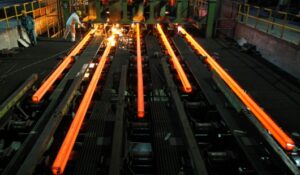
According to preliminary data, Ukrainian metallurgical companies reduced their total rolled steel production in January-February this year by 16.8% compared to the same period last year, from 957,000 tons to 797,000 tons.
According to information from the Ukrmetallurgprom association on Monday evening, 390,300 tons of rolled steel were produced in February, compared to 406,400 tons in the previous month.
As reported, Ukrainian steel companies increased their total rolled steel production by 4.8% in 2025 compared to 2024, to 6.521 million tons from 6.222 million tons.
In 2024, Ukraine increased its total rolled steel production by 15.8% compared to 2023, to 6.222 million tons from 5.372 million tons.
In 2023, Ukraine increased its total rolled steel production by 0.4% compared to 2022, to 5.372 million tons.
In 2022, the country reduced its total rolled steel production by 72% compared to 2021, to 5.350 million tons.
In pre-war 2021, 19.079 million tons of rolled steel were produced, which was 103.5% of the 2020 level.

According to Serbian Economist, Serbia plans to start construction of its first nuclear power plant by 2035 and is cooperating with French energy company EDF as part of its preparations, Minister of Mining and Energy Dubravka Jedovic Handanovic said in an interview with RTS.
The minister stressed that EDF can help Serbia with its experience and knowledge in preparing the project. At the same time, she said, no decision has yet been made on the specific technology for the future nuclear power plant.
The preparatory process for the construction of the nuclear power plant is estimated to take approximately four years: by mid-2027, the authorities intend to complete the first phase, which involves analyzing the regulatory framework and requirements, after which the second phase, including preparation for construction, will begin. The ministry noted that the first additional studies are planned to be carried out jointly with EDF with the support of the French Development Agency (AFD) on the basis of an intergovernmental agreement between Serbia and France.
Against the backdrop of the launch of the nuclear agenda, Serbia is simultaneously in contact with other potential partners and technology suppliers.
Potential partners and companies involved in the preparation and negotiations:
France – EDF (as well as Egis Industries as part of the preliminary technical study contractors).
Serbia also signed a memorandum with Korea Hydro & Nuclear Power (KHNP, South Korea) on cooperation in the field of nuclear energy and personnel training.
Serbia considered Rosatom (Russia) as a possible partner for the exchange of experience.
Separately, it was reported that Emirates Nuclear Energy Company (ENEC, UAE) was ready to share its roadmap for the development of a nuclear program.
The United States (agreements/information exchange between regulators and willingness to support program preparation) and China (memorandum with the China Institute of Atomic Energy) were also mentioned in the context of contacts.
https://t.me/relocationrs/2404
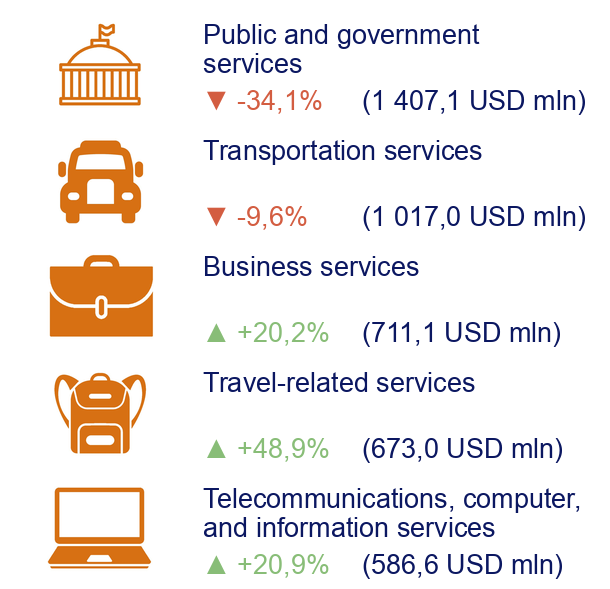
Dynamics of imports of services in January-September 2025 by the most important items compared to the same period in 2024, %
According to preliminary data, Ukrainian metallurgical enterprises reduced pig iron production in January-February of this year by 11.2% compared to the same period last year, to 1.012 million tons.
According to information from the Ukrmetallurgprom association on Monday evening, 461,900 tons of pig iron were produced in February, compared to 549,900 tons in the previous month.
As reported, Ukrainian metallurgical enterprises increased pig iron production by 11.2% in 2025 compared to 2024, to 7.884 million tons.
In 2024, Ukraine increased pig iron production by 18.1% compared to 2023, to 7.090 million tons.
In 2023, Ukraine reduced pig iron production by 6.1% compared to 2022, to 6.003 million tons.
In 2022, the country reduced pig iron production by 69.8% compared to 2021, to 6.391 million tons.
In pre-war 2021, 21.165 million tons of pig iron were produced, which was 103.6% of the 2020 level.

The European Union has officially allowed the import of planting material for common cherries (Prunus cerasus), blue cherries (Prunus canescens), and their hybrids from Ukraine, according to the State Service of Ukraine for Food Safety and Consumer Protection (Derzhprodspozhyvsluzhba).
According to the report, the decision was made by the European Commission (EU Executive Regulation 2025/1949) after reviewing the technical dossier prepared by the Ukrainian side. The document allows the import of unvaccinated plants up to two years old in a dormant state (without leaves) into the EU.
“The opening of the EU market for Ukrainian planting material is another step towards deeper integration into the European space and strengthening Ukraine’s reputation as a reliable trading partner,” the agency said.
The State Service of Ukraine for Food Safety and Consumer Protection emphasized that exporters must ensure unconditional compliance with the phytosanitary requirements of Regulation (EU) 2019/2072. Each shipment must be accompanied by a phytosanitary certificate, and non-compliance with the importing country’s standards is grounds for refusal to issue it.
The agency drew attention to the need to recognize the equivalence of Ukraine’s certification system for the full export of material covered by Council Directive 2008/90/EC. In this context, an important step was the Commission Implementing Decision (EU) 2026/75 of January 12, 2026, on the equivalence of material for the propagation of fruit plants grown in third countries.