

The Inzhur Investment Group, which includes an asset management company with three investment funds, an investment firm, a securities broker, and a securities custodian, plans to increase its assets under management from the current 9.36 million UAH to 100 billion UAH over the next five years, said the group’s founder and head, Andriy Zhurzhii.
“100 billion is our dream and our plan. That’s for the next five years. In other words, we’ll end this year with more than 10 billion—10 to 11 billion in assets under management. And over the next five years, we’ll reach 100 billion based on today’s figures. In other words, if there are any devaluation processes, then, of course, we’ll get there faster,” he said during the “Forbes Business Breakfast with Fedorin” on Wednesday, adding that there was a day when the group managed to attract 500 million UAH at once.
According to him, the group has attracted 131,560 investors to its funds, with a minimum investment of 11 UAH.
“We’ve set ourselves the goal of reaching 1 million investors in ‘Inzhur’ by the end of 2028. We plan to end this year with 150,000–200,000 investors: we’re already on track for 170,000, and we’ll have to work hard to reach 200,000, but the team is doing its best,” noted Zhurzhii.
In his view, to increase the number of investors to 2–3 million, it is necessary to invest more in the community and in its education and experience; therefore, the group launched an educational program with Prometheus, which attracted 14,000 registrants in just one week.
The head of “Injur” also expressed the opinion that the Ukrainian market is not yet ready for stocks.
“We will still grow through some form of debt instruments—bonds or quasi-debt instruments, when we’re talking about funds. Stocks will be the next stage,” Zhurzhii believes.
asset, FUND, Injur, INVESTMENT, INVESTOR

The National Agency for Asset Tracing and Management (ARMA) received five bids by the deadline for the competition to select a manager for IDS Ukraine—the producer of “Morshynska” and “Mirgorodska,” which is linked to Russian oligarch Mikhail Fridman.
“The competitive selection process has reached its final stage. Next up is the evaluation of the submitted proposals and the selection of the most professional and capable administrator,” the agency reported on Facebook on Saturday.
IDS Ukraine’s assets were transferred to ARMA’s management pursuant to a court ruling. This involves an integrated production complex with a full cycle of operations: from mineral water extraction to production and distribution of products, including abroad. In late 2024, the Ministry of Justice filed a petition with the High Anti-Corruption Court (VAKS) to transfer the corporate rights of all seven companies in the group to the state, but the case is still pending in court.
In March 2023, an administrator—LLC “Carpathian Mineral Waters”—was selected for two companies in the group—PJSC “Morshyn Mineral Water Plant ‘Oscar’” and PJSC “IDS” (IDS Ukraine)— but the agreement was not approved by the Antimonopoly Committee, and in 2025 it was terminated as unfulfilled.
In the fall of 2025, then-Prime Minister Yulia Svyrydenko announced that ARMA had launched a procedure to transfer the entire IDS asset complex to management through a public auction. On June 22, 2026, it was reported that ARMA would make another attempt to select a manager.
IDS Ukraine opposes holding the tender. Among its arguments is that more than 50% of the company’s shares are owned by verified international investors: the Patarkatsishvili family (34.83%), the Georgian government (7.73%), and minority shareholders (7.45%). It was also noted that ARMA does not have the proper authority to hold the competition and has not identified the assets as required by law.
In addition, IDS Ukraine stated that all shareholders—not just sanctioned individuals with Russian citizenship—have been completely removed from management and do not have access to the company’s revenues.
Revenues to Ukraine’s state budget from assets under ARMA’s management in January–July 2026 amounted to only 210 million UAH, compared to 1.3 billion UAH for the same period in 2025, said Pavlo Velykorechanyn, an expert with the Verkhovna Rada’s Anti-Corruption Committee and former deputy head of ARMA, in an exclusive interview with the “Interfax-Ukraine” news agency.
Thus, revenue has fallen by more than six times.
For comparison, according to Velykorechanyn, 7.5 billion hryvnias were transferred to the state budget in 2023, in part due to major cases involving special confiscation.
He noted that the current 210 million hryvnias is largely the result of managing assets transferred to ARMA back in 2024–2025. A significant portion of the revenue is linked to payments from Naftogaz.
According to Velykorechanyn’s assessment, there are currently virtually no new economically attractive assets in the agency’s portfolio. Furthermore, regarding certain properties, the results of tenders to select managers are being annulled, after which courts rule such decisions unlawful, forcing the state to fund property appraisals again.
He identified the length of the procedure for transferring assets to management as a separate problem. While the property remains without a manager, the state is forced to bear the costs of its security and maintenance, while the asset may physically deteriorate or lose value.

Despite the fact that the Register of Seized Assets contains tens of thousands of items, the number of assets with real economic potential accounts for only a small portion of the portfolio, said Pavlo Velykorechanyn, an expert on the Verkhovna Rada’s Anti-Corruption Committee and former deputy head of ARMA, in an exclusive interview with the Interfax-Ukraine news agency.
According to him, a significant portion of the property exists only on paper in the registry or is in such a condition that commercial management of it is impractical.
Among such assets, Velykorechanyn cited ruined farms, old, unusable vehicles, illiquid basement spaces, property lacking the necessary documentation, as well as assets destroyed after the start of the full-scale war.
Agricultural assets that have effectively ceased to exist for a long time—such as records of unharvested crops from previous years—constitute a separate category.
In Velykorechanyn’s view, ARMA must conduct a comprehensive identification of the portfolio and separate out the business assets that are truly economically attractive.
It is advisable to promptly sell illiquid or rapidly depreciating property through auctions rather than keeping it on the registry for years.
He also proposed reviewing court decisions regarding assets for which a manager has not been appointed within several months. Otherwise, the state continues to finance the storage and security of property that is gradually losing value.
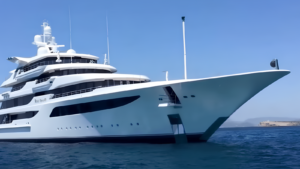
The sale of the seized yacht “Royal Romance,” which is linked to Viktor Medvedchuk, has effectively been blocked due to a change in the procedure for the sale of Ukrainian assets located abroad, stated Pavlo Velykorechanin, an expert with the Verkhovna Rada’s Anti-Corruption Committee and former deputy head of ARMA, in an exclusive interview with the “Interfax-Ukraine” news agency.
According to him, the mechanism developed in 2023 allowed for the sale of seized assets through the “Prozorro.Sales” system, including assets physically located outside Ukraine.
However, the new government regulation stipulates that the sale of seized property abroad must take place on the basis of an asset-sharing agreement between states.
According to international practice, such a division typically becomes possible only after a final conviction by a court.
As a result, Velikorecchanin estimates that the Royal Romance may remain frozen abroad for several years while the trials in the main criminal cases are ongoing.
“The sale of Medvedchuk’s yacht has reached a dead end—these assets will simply remain frozen abroad for many years,” he stated.
The Royal Romance was previously seized in Croatia. Ukraine had attempted to arrange its sale, with the proceeds to be transferred to the state.
Holding a new competition to select an asset manager for IDS Ukraine, the producer of the “Morshynska” and “Mirgorodska” mineral waters, before the High Anti-Corruption Court issues a ruling may have limited prospects, said Pavlo Velykorechanyn, an expert with the Verkhovna Rada’s Anti-Corruption Committee and former deputy head of ARMA, in an exclusive interview with the “Interfax-Ukraine” news agency.
ARMA previously announced another tender to select an asset manager for IDS Ukraine and expects to hold it in September.
However, according to Velykorechanyn, there are legal obstacles that could significantly dampen the interest of potential participants.
In particular, certain court rulings lack a clear prohibition on current operators from using the companies’ assets. This could complicate the actual transfer of control to the new manager.
In addition, according to the company’s own data, the share of individuals subject to sanctions in IDS Ukraine is 49.7%, i.e., less than 100%. Under the new legislation, in such a situation, management requires either the consent of the other co-owners or a decision to forfeit the relevant share to the state budget.
The High Anti-Corruption Court (HACC) is currently considering a case regarding the forfeiture of the asset to the state; a decision is expected in the fall.
“Until the HACC issues a decision to forfeit this stake to the state and it is transferred to the State Property Fund, the prospects for ARMA conducting any tenders regarding IDS are highly uncertain,” Velikorechanyn noted.
Previously, several attempts were made to transfer IDS Ukraine’s assets into management. In particular, an agreement was signed with the company “Karpatska Dzherelna,” but the procedure for approving the concentration with the Antimonopoly Committee lasted about a year and a half and was not completed, after which the agreement was terminated.



