

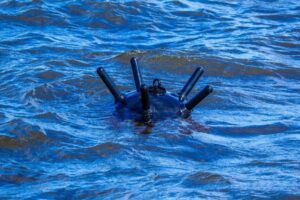
Turkey, Romania, and Bulgaria on Monday launched a joint mine-sweeping operation in the Black Sea to improve shipping safety, especially during the export of Ukrainian grain, Bloomberg reports.
The publication noted that the Istanbul-led initiative is the first major joint action by the Black Sea countries since Russia’s invasion of Ukraine in February 2022 and focuses on clearing mines drifting in certain areas of the Black Sea as a result of the war.
“Russia and Ukraine are key grain producers, and the war has jeopardized the safe passage of goods. Kyiv launched its own Black Sea export route last year after the failure of a secure corridor agreement backed by Russia, Turkey and the United Nations. It has successfully boosted exports and helped the economy grow faster than forecast, but the route remains risky,” Bloomberg writes.
Among the major maritime losses, the publication named a Russian missile attack near the key Ukrainian port of Odesa on a merchant ship, killing the captain and other crew members, as well as a ship hired by Cargill Inc. that was damaged in November by an explosion while leaving a Ukrainian port in the Black Sea.
Ukraine said in March that exports from its Black Sea ports had almost returned to pre-war levels after repeated attacks and disruptions following Russia’s full-scale invasion. However, ports around Odesa frequently face strikes from Russia that continue to interrupt operations, Bloomberg recalled.
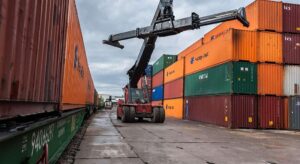
Ukraine has resumed container transportation through the Black Sea: a ship with containers entered one of the ports of Greater Odesa, Chornomorsk, on April 3, the Odesa-based Dumskaya newspaper reported.
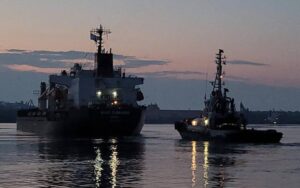
According to the report, the pioneering vessel was the T Mare, which flies the Panamanian flag. It is not classified as a container ship, but a vessel for the transportation of general cargo.
The publication noted that this is not yet a full-fledged specialized vessel, but a so-called feeder, which will be loaded with containers and then sent to a foreign hub for further transshipment to ocean container ships of global container lines.
According to MarineTraffic, a provider of ship tracking and maritime analytics, the vessel left Chornomorsk for the Romanian port of Constanta.
The T MARE is a containerized cargo vessel flying the Panamanian flag. Its total length (LOA) is 105 meters and width is 17 meters.
As reported, in March, the Ministry of Community Development, Territories and Infrastructure announced that in early April, Odesa ports would receive the first container ship since the beginning of the war.
Turkey, Romania, and Bulgaria will sign a joint agreement in January 2024 to counter the mine threat in the Black Sea, Turkish National Defense Minister Yashar Güler said, TRTHaber reported on Saturday, December 16.
“Within the framework of the Trilateral Initiative, launched under the leadership of our country against the mine threat in the Black Sea, on November 22-23, we held the third round of the meeting of the Task Force on Mine Action in the Black Sea, hosted by our ministry. We are also planning to hold a signing ceremony in Istanbul on January 11, 2024, with the participation of the defense ministers of the three countries,” said Yasar Güler.
The minister emphasized that Turkey responsibly and impartially implements the Montreux Straits Convention, which ensures balance in the Black Sea, and is determined to continue to do so.
EU Diplomacy Chief Josep Borrell says the events in Ukraine threaten global food security, and the EU will discuss with the UN Secretary General the prospect of reviving the “grain deal”.
“This affects all countries, but especially the weakest and poorest. In August 2022, the UN played a crucial role in mitigating this suffering through the Black Sea Grain Initiative. However, in July, Russia decided to abandon this agreement,” Borrell wrote in his blog post, looking ahead to the UN General Assembly’s High Level Week that opens in New York.
“We will discuss with UN Secretary General Guterres ways and means to revive it. Sustainable development goals are in the focus of the UNGA,” said the EU High Representative for Foreign Affairs.
Azerbaijani President Ilham Aliyev has said that a feasibility study (feasibility study) of the project of laying a power transmission line along the bottom of the Black Sea, which envisages supplying “green” energy from Azerbaijan to Europe via Georgia, will be submitted by November.
“In December last year, an agreement was signed between Azerbaijan, Georgia, Hungary and Romania, certified by the European Commission, on the construction of an integrated “green” power transmission line from Azerbaijan to Europe along the bottom of the Black Sea. The work on the feasibility study has already started. We expect it to be presented probably in September-October,” Aliyev said in Shusha.
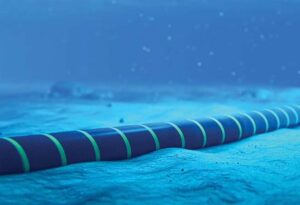
On December 17, 2022, Azerbaijan, Georgia, Romania and Hungary signed a strategic partnership agreement in Bucharest on the construction of Black Sea Energy submarine electric cable with a capacity of 1,000 MW and a length of 1,195 km. The cable will be designed to supply “green” electricity generated in Azerbaijan through Georgia and the Black Sea to Romania for subsequent transportation to Hungary and the rest of Europe.
In June, it was decided that Bulgaria would join the project.
The laying of the cable will take 3-4 years.
The European Commission plans to provide 2.3 billion euros for laying the cable, which will be the longest in the world.

The leaders of Azerbaijan, Georgia, Romania and Hungary have signed an agreement on laying a submarine electric cable under the Black Sea to supply Azerbaijani energy to Europe.
Ursula von der Leyen, head of the European Commission (EC), considers the Black Sea electricity cable project, which will supply Azerbaijan with electricity to Europe, ambitious.
“I can only say: what an ambitious project (of the Black Sea electric cable). It will connect us on both sides of the Black Sea and go further toward the Caspian Sea – both for digital communications and energy,” von der Leyen said Saturday at a signing ceremony in Bucharest for the “Strategic Partnership Agreement on the Development and Transmission of Green Energy between the governments of Azerbaijan, Georgia, Romania and Hungary.”
She said the implementation of the agreements will help the European Union strengthen security of supply by transmitting electricity from renewable sources to the EU through Romania and Hungary. “A cable under the Black Sea could supply electricity to our neighbors in Moldova and the Western Balkans and, of course, to Ukraine,” the EC head said.
According to EU Commissioner for Enlargement and Neighborhood Policy Oliver Varghea, an agreement between Azerbaijan, Georgia, Romania and Hungary on a submarine cable for electricity transmission via the Black Sea (Black Sea Energy) was signed as part of a EUR 17 billion European investment plan.
The nearly 1,200-kilometer cable will transmit electricity from Azerbaijan and Georgia to Romania and Hungary. The project is to be implemented within six years.



