
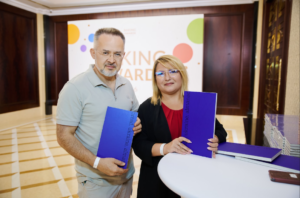
After several years of work, the publication “Bread. Ukraine. Almanac” has been released in Ukraine — a bilingual informational and historical art book dedicated to Ukrainian bread, its role in history, culture, everyday life and the modern food industry.
At the heart of the publication is an attempt to show that the concept of Ukrainian bread is much broader than the familiar product on the everyday table. For some, it is the taste of childhood and a family recipe; for others, it is palianytsia, regional baked goods or bread from a local bakery. At the same time, behind these familiar images stand the history of the development of agriculture, milling and breadmaking, folk traditions and the modern large-scale food industry.
The almanac traces how bread accompanied Ukraine and Ukrainians through different historical periods. It was preserved in family memory and rituals, became an image in cinema, poetry, photography and other forms of art, and with the development of industry turned into an important part of a large production complex.
A special place in the publication is devoted to the dramatic pages of Ukrainian history. The authors address the tragedy of the Holodomor, during which bread became a symbol of the very right of a person to life. It acquired a new symbolic meaning after the beginning of the full-scale war. One of the best-known examples was the word “palianytsia,” which in 2022 became a distinctive linguistic marker of Ukrainian identity.
At the same time, “Bread. Ukraine. Almanac” tells not only about the past. Considerable attention is paid to modern breadmaking, artisanal technologies, regional traditions and the development of the industry. In the book, bread appears simultaneously as an everyday product, a cultural phenomenon, the result of the work of the agricultural and food sectors, and part of the country’s economic history.
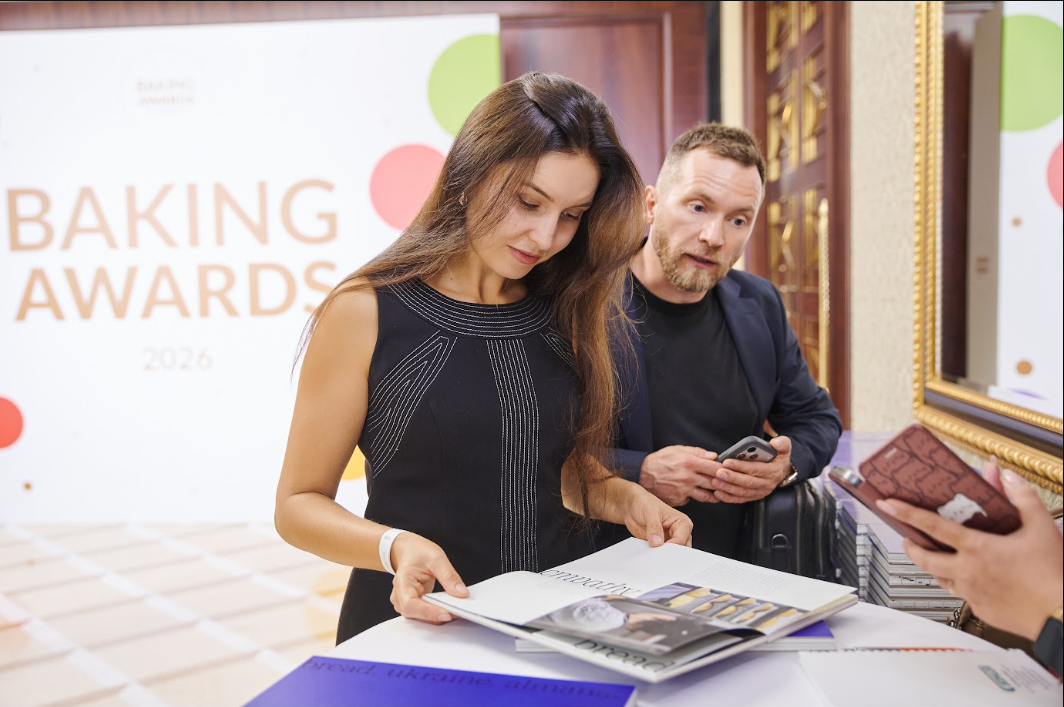
At the same time, the authors do not attempt to give a single definition to the concept of “Ukrainian bread.” The book is structured as a collection of different stories, each of which reveals a separate part of this topic — from old mills and family recipes to industrial bakeries, modern technologies and the artistic interpretation of bread.
This approach leaves the reader room for further exploration of the topic: after one piece, one can turn to an old Ukrainian film; after another, one can study regional baked goods, the history of milling, traditional technologies or modern Ukrainian breadmaking in greater detail.
“Bread. Ukraine. Almanac” has been prepared in Ukrainian and English, and is therefore intended not only for a Ukrainian but also for an international audience. The publication can be used as a presentation book about Ukraine, its history, gastronomic culture and one of the country’s most important industries.
The almanac is designed as a modern collectible art book. A distinctive color palette, unconventional layout, archival and contemporary visual materials create a separate visual language for the publication and emphasize its gift-book character.
The premiere of the almanac took place during Baking Awards 2026. The publication was presented by Yurii Duchenko, President of the All-Ukrainian Association of Bakers, and Rodion Rybchynskyi, Director of the “Flour Millers of Ukraine” Union.
The print run of “Bread. Ukraine. Almanac” is limited. Detailed information about the publication and the possibility of ordering it are available on the official “Bread. Ukraine” website.
The partners of the “Bread. Ukraine. Almanac” edition were the All-Ukrainian Association of Bakers and the “Flour Millers of Ukraine” Union. The industry organizations unite enterprises of Ukraine’s breadmaking and flour-milling industries and work to develop the domestic market, increase the competitiveness of Ukrainian products and expand their presence abroad. Among their areas of activity are strengthening Ukraine’s export potential, promoting Ukrainian flour, bakery products and other grain-processing products in foreign markets, developing international contacts and facilitating the participation of Ukrainian producers in specialized international events.
Food and non-alcoholic beverages in Ukraine fell by 0.2% in July 2026 compared to June, but remained 6.5% more expensive than a year earlier. Food alone, excluding non-alcoholic beverages, rose in price by 6.4% over the year.
The most significant year-over-year increases among major food categories were recorded for fish and fish products (22.4%), sunflower oil (21.8%), and bread and bakery products (18.6%).
Bread prices rose by 15.4%, pasta by 9.9%, milk by 8%, vegetables by 7.8%, cheese by 4.6%, and meat and meat products by 2.4%.
At the same time, a number of products became significantly cheaper over the course of the year. Eggs cost 25.4% less than in July of last year, fruit—9.5% less, and sugar—8.1% less.
In July alone, eggs became 6% cheaper, vegetables 5.9% cheaper, and meat and meat products 0.6% cheaper. At the same time, fruit prices rose by 1.5%, fish by 1.3%, and sunflower oil by 1.2%.
Seasonal trends are particularly noticeable: since the beginning of the year, eggs have become 43.1% cheaper, while fruit has become 26.2% more expensive and vegetables 18.7% more expensive.
The sole shareholder of Public Joint-Stock Company “Khlibprom Concern” has approved a decision to convert the company into a limited liability company, according to information cited from the National Securities and Stock Market Commission’s (NSSMC) disclosure system.
The decision to reorganize one of Ukraine’s largest bread producers was adopted on July 23, 2026. The newly formed LLC “Khlibprom Concern” will become the full legal successor to the assets, contracts, rights, and obligations of the private joint-stock company.
The shares of the private joint-stock company will be converted into a stake in the LLC’s authorized capital at a ratio of 1:1. The authorized capital of the successor entity will amount to approximately 163.55 million UAH.
The company explained the reorganization as a necessity to simplify corporate governance. The conversion to an LLC does not involve the sale of the company or a change in its ultimate owner.
The organizational and legal form of a limited liability company involves fewer regulatory procedures; in particular, the company will not be required to maintain a share register or comply with certain requirements applicable to joint-stock companies.
In 2025, Khlibprom Concern’s revenue increased by 9.5% compared to the previous year, reaching 2,228.92 million UAH. The company’s net loss decreased by a factor of 13.5, to 5 million UAH, compared to 67.57 million UAH in 2024.
The company’s assets as of the end of 2025 totaled 1 billion 190.76 million UAH, while its liabilities decreased by 10.1% to 509.95 million UAH.
“Khlibprom Concern” is one of the largest producers of bread, baked goods, and confectionery products in Ukraine. The company produces up to 160 metric tons of products daily, including frozen semi-finished dough products.
The company’s structure includes five processing facilities in the Lviv and Vinnytsia regions. The company’s brand portfolio includes Agrola, Bandinelli, 2go, “Lyublyanna,” and “Vinnitsakhleb.” The ultimate beneficial owner of the company is Natalia Antonova.

Rising costs of raw materials and energy resources have led to an average 40% increase in the price of bread and flour in Ukraine over the past two years, according to the Ukrainian Flour Millers Association.
According to the association’s analytical report, published on the APK-Inform website, the price growth rate has been consistently high: in 2024, bread rose in price by 20-22%, and in 2025 — by another 19-23%. A similar 40% increase over a two-year period was also recorded for wheat flour.
According to the association, the price of premium wheat bread rose by 44% over the year to UAH 63.5/kg, rye bread by 45% to UAH 50.6/kg, and loaves by 34% to UAH 30.9/kg.
“Currently, the actual selling prices of flour are 10-15% lower than the declared prices and are practically equal to the cost price. With the average cost of grade 2 wheat at 10,300 UAH/ton and processing costs of no less than 2,500 UAH/ton, a 3% profit margin is a great achievement for flour millers,” the report notes.
Experts note that unlike bakers, who can compensate for the low profitability of social varieties with premium and small-piece products, millers are deprived of this opportunity due to the small sales volumes of packaged flour.
At the same time, “Flour Millers of Ukraine” noted a growing trend in Ukraine toward home baking.
“The population is increasingly turning to home baking. It is much cheaper, tastier, and becoming fashionable,” the industry association noted, adding that premium bread under the Tsar Bread and Kulynichi brands, which is distinguished by its excellent taste, costs more than UAH 100 per 1 kg and is unaffordable for many residents of Ukraine.

The cost of bread produced by individual entrepreneurs has increased by approximately 25% since the blackout began, and poppy seed rolls by 40% due to the need to maintain generators, purchase fuel, and cover logistics costs, according to Nina Yuzhanina (European Solidarity), a member of the Verkhovna Rada Committee on Finance, Tax and Customs Policy.
She said that she occasionally buys bread outside the city — in small private bakeries that operate as individual entrepreneurs.
“When there is electricity, production is stable and prices are predictable. When there is no electricity, work is done exclusively on generators with constant fuel costs. The result is already noticeable: the cost of bread has increased by about 25%, and poppy seed rolls by almost 40%. The reasons are obvious: fuel, generator maintenance, and logistics disruptions. This is not a question of excess profits — it is an attempt to cover costs and survive,” she wrote on Telegram.
Yuzhanina stressed that with such an increase in prices for bakery products, it will be difficult to maintain sales volumes, as the additional costs will not disappear.
“There are more than 4,000 sole proprietors (groups 1-3) in Ukraine who are engaged in baking bread. And if, against this backdrop, mandatory VAT payments are introduced for them, it will not only be a blow to small businesses, but a real tax blackout — with the risk of production closures and further price increases,” the parliamentarian stressed.
As reported, the prospect of introducing mandatory VAT payments for sole proprietors in groups 1-3 is currently being considered as part of the adaptation of Ukrainian legislation to EU standards and the National Revenue Strategy, which provides for the gradual abolition of the simplified system in its current form. The main risk lies in a significant increase in the administrative burden: entrepreneurs will have to keep accounting records, register tax invoices, and add +20% to the cost of their goods or services, which may make small businesses uncompetitive compared to large players. Although this decision is aimed at de-shadowing the economy and combating schemes for the use of sole proprietorships by large businesses, for the actual self-employed population, such a step could become a critical financial barrier.

Argon Food, a company specializing in the production of bakery products and the storage and transportation of other food products, has installed a solar power plant with a peak capacity of 114 kW, according to Andriy Ocheretny, deputy mayor of Vinnytsia, on Facebook.
“A solar power plant with a peak capacity of 114 kW was installed on the roof of the enterprise. The station was put into operation at the end of May, and since then, thanks to its operation, the enterprise has covered almost all of its electricity needs,” he wrote on Facebook.
According to Ocheretny, the company has become one of the applicants for participation in the Procedure for partial compensation of expenses for the purchase of equipment used for the production of electricity from renewable energy sources within the city program.
“In the context of blackouts, the transition to ”green” energy is the path to energy independence. This strategic decision helps businesses reduce production costs, retain staff, and create new jobs, while contributing to the sustainable development of the community,” concluded the deputy mayor of Vinnytsia.



