
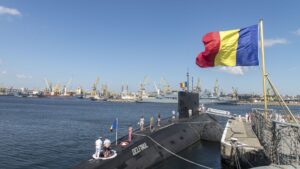
The Romanian Navy has begun testing the new Black Talon drone countermeasure system at the military port of Constanța on the Black Sea. The system, developed as part of a long-standing collaboration with the U.S. Navy, is scheduled to enter operational service by the end of October 2026.
Black Talon is designed to detect, track, and monitor unmanned aerial vehicles near critical port infrastructure. According to the Romanian military, the system includes a high-performance 3D radar, electro-optical equipment, and passive electromagnetic radiation detection devices. The system provides a 360-degree field of view and can target detected objects.
The threat detection radius is approximately 10 km. One of the primary countermeasures is electronic jamming—Black Talon is capable of disrupting the communication channel between a drone and its operator, allowing the threat to be neutralized without necessarily destroying the drone physically.
Currently, Romanian military personnel are undergoing training to operate the new equipment. Following Constanta, plans are in place to equip the military ports of Mangalia, Tulcea, and Braila with similar systems. The U.S. side is to provide three more systems. Thus, protection will cover Romania’s military ports on both the Black Sea and the Danube, particularly near the Ukrainian border.
At the same time, the Romanian Navy is preparing to deploy the Sentinel system to monitor threats from the sea and underwater. It will use sonar capable of detecting unmanned underwater vehicles, combat divers, and mini-submarines. According to Navy officials, Black Talon and Sentinel can be integrated to form a comprehensive surveillance system covering the air, surface, and underwater spaces around the military ports.
The commander of the Constanta military port, Rear Admiral Ciprian Mandaki, announced on September 16 that the program has been implemented jointly with the U.S. Navy for several years and has now entered the operational phase. Black Talon is primarily intended to protect critical military infrastructure from aerial drones.
The強化 of security in Constanța follows a serious incident on June 5, 2026, when a maritime drone was detected in the civilian section of the port, near Pier No. 78. At approximately 10:30 a.m., the drone self-detonated. There were no casualties, as the area had already been cordoned off by Romanian intelligence services, the coast guard, and the military. The Romanian Ministry of Defense officially reported that the drone did not belong to the Romanian military and was of a type used in the war in Ukraine. The investigation into the incident was handed over to the prosecutor’s office.
Following this incident, Romanian authorities ordered the acceleration of measures to protect port infrastructure. At the same time, the Black Talon program itself had been launched earlier and was being developed as part of Romania’s cooperation with the United States in the field of maritime security.
For Ukraine, the strengthening of security at Romanian ports is of particular importance due to the proximity of Constanța and the Danube ports to the Ukrainian border and their role in the region’s Black Sea and Danube transportation infrastructure.
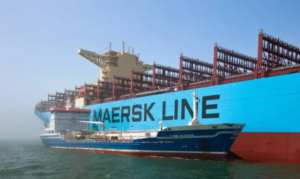
The international transportation and logistics group A.P. Moller—Maersk has temporarily suspended maritime container shipping through the terminal of Chornomorsk Fish Port LLC in the Odesa region.
The decision was made amid a deteriorating security situation and intensified Russian attacks on Ukrainian port infrastructure. However, this does not mean a complete suspension of Maersk’s operations in Ukraine.
“Due to the current situation affecting our operations, the feeder operator is unable to continue providing services to Ukraine via the Black Sea Fishing Port,” Maersk’s Ukrainian division reported.
The service has been suspended until further notice. The company did not explicitly cite the Russian attacks as the reason for this decision; however, the announcement came after a series of strikes on ports and civilian vessels in the Odesa region.
The vessel MEDKON MIRA V.629S, which was scheduled to deliver imported containers to Chornomorsk, will be redirected to the Romanian port of Constanta for unloading.
It is also planned to reroute shipments destined for Chornomorsk that are already in Port Said, Egypt, or en route there, to Constanta. Customers for whom unloading in Romania is not suitable are advised to submit a request to change the destination.
“Chornomorsk Fish Port” is not a term referring to a fishing harbor in the everyday sense, but rather the official name of a separate enterprise and a multifunctional cargo terminal in the village of Burlachya Balka near Chornomorsk.
The company was previously known as “Illichivsk Sea Fishing Port,” and in 2018 it adopted its current legal name—LLC “Black Sea Fishing Port.”
Despite its historical name, the enterprise operates a full-fledged container terminal. It has deep-water berths, Liebherr container handlers, mobile cranes, storage yards, and truck and rail weighing facilities.
The Black Sea Fishing Port is an independent operator and should not be confused with the state-owned seaport of Chornomorsk. The main deep-water port of Chornomorsk and other ports in the Greater Odesa region continue to operate, according to Ukrainian authorities.
The company has suspended only maritime shipments through this specific terminal. Maersk continues to offer cargo delivery to Ukraine via land and multimodal routes, including through Romania and Poland.
Rerouting containers through Constanța may increase transit times and shipping costs. After unloading in Romania, cargo will need to be transported to Ukraine by road or rail.
For Ukrainian importers, this means additional costs for land logistics, changes to documentation, and a possible delay in receiving goods.
At the same time, this decision enhances Constanta’s role as a regional transshipment hub for Ukrainian cargo.
Prior to Maersk, Kernel, a major Ukrainian producer and exporter of agricultural products, had suspended operations at one of its facilities in Chornomorsk following a series of attacks.
However, Ukrainian authorities have not imposed a general ban on ships calling at ports in the Greater Odesa area. Decisions to change routes are made by individual carriers and shipowners with the safety of crews, vessels, and cargo in mind.
A.P. Moller — Maersk is a Danish transportation and logistics group founded in 1904. The company provides maritime container shipping services and manages port terminals, warehouses, and land-based logistics infrastructure.
Maersk operates in approximately 130 countries, serves over 100,000 customers, and has a fleet of more than 700 container ships and a network of 67 terminals in 42 countries. The group employs more than 100,000 people. Thanks to its scale, Maersk is one of the key players in global container trade, and changes to its routes can significantly affect the timing, cost, and availability of international shipments.
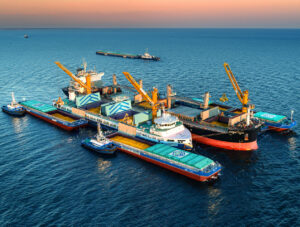
Nibulon” JV LLC (Mykolaiv), one of the largest operators at the grain market of Ukraine, in January-June 2023 transported by its own fleet from the branch “Bessarabskaya” (Izmail) to Constanta, Romania about 80 thousand tons, or 15% of the total shipments of the company during this period.
According to the grain trader’s website, this was made possible by the redeployment of the fleet from Nikolaev, which involved disassembly of the vessels, their transportation by land to the Danube and their subsequent reassembly at the Bessarabian branch. In total two port tugs “Nibulon-12” and “Nibulon-14”, tugs “Nibulon-3” and “Nibulon-11” and two handling machines Terex Fuch mhl 385 were transported this way.
The announcement indicates that the Nibulon also began providing tug, mooring and unmooring services for vessels on the Danube. In January-June 2023, the number of hours worked in this way increased 18-fold.
“In the spring, Nibulon was able to resume shipping on the Middle Dnieper. Now tugs “Nibulon-10”, “Hermes-2” and non-self-propelled barges UAK-1, UAK-2, UAK-3, UAK-4 work here, and the branch “Kremenchugskaya” acts as a central transshipment hub that receives grain from water transport and reloads it into the cars”, – stressed the press service of grain trader and added that during April and May 2023 more than 15 thousand tons of grain were transported this way.
It is noted that the shipping company of the grain trader plans to increase the volume of services to third parties in Ismail, as well as to increase the volume of traffic to Constanta by optimizing the routes.
“The experience of sea routes in winter and spring allows the company to choose exactly sea routes instead of the Danube, which affects the speed of the fleet,” summarized the “Nibulon”.
JV Nibulon LLC was founded in 1991. Before the Russian military invasion, grain trader had 27 transshipment terminals and complexes to receive the crops, the capacity for one-time storage of 2.25 million tons of agro products, a fleet of 83 ships (including 23 tugs) and owned the Nikolayev shipyard.
“Nibulon” before the war worked 82 thousand hectares of land in 12 regions of Ukraine and exported agricultural products to more than 70 countries.
The grain trader exported a maximum of 5.64 million tons of agricultural products in 2021, reaching a record volume of deliveries to foreign markets in August – 0.7 million tons, the fourth quarter – 1.88 million tons and in the second half of the year – 3.71 million tons.
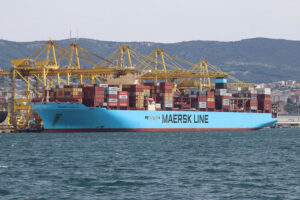
One of the world leaders Danish transport and logistics company A.P. Moeller-Maersk AS, which stopped its ship calls to Ukraine since February last year after a full-scale Russian invasion, has resumed delivery of clients’ cargoes to the Ukrainian port of Reni from Constanta (Romania) by barge, the company’s official website says.
“Development in Ukraine remains in focus, as well as the implementation of solutions for our customers in terms of security,” it said.
According to it, Maersk is launching a new weekly barge service from Constanta port to Reni port on two routes – via Constanta/Danube Canal and the Black Sea with a transit time of approximately 1.5 days.
It is reported that the company’s system is updated and accepts reservations from customers with delivery to the port of Reni. Their implementation will be subject to the working capacities, subject to the proper documentation, including the legal adoption of the provision of Ukraine on the risks in the region.
The company advised to contact its local representatives for more detailed information about deliveries to the port of Reni.
In the fourth quarter of 2022, A.P. Moeller-Maersk AS decreased its net profit by 18.8% and revenue by 3.7%, which was worse than experts’ forecasts. Net income in October-December was $4.95 billion compared to $6.094 billion in the same period of the previous year. Revenue fell to $17.82 billion compared to $18.506 billion.
The average freight rate was down 3.5% for the fourth quarter of 2021, and freight volume fell 14%.
Maersk also stopped operations in the Russian market. All services in Russia ceased operations in the first quarter, and in the third quarter the deal to sell a 30.75% stake in Global Ports Investments was closed. The process of selling the remaining assets – two warehouses and four tugboats – continued.
Maersk generated EBITDA of $36.81 billion and EBIT of $30.86 billion in 2022.



