
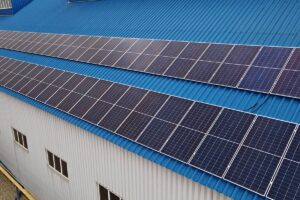
In the summer of 2026, Nibulon Joint Venture LLC installed ground-mounted solar power plants (SPPs) at its Bessarabsk, Zolotonosha, and Denykhiv branches, the company’s press service reported.
As a result, five grain elevator complexes are now equipped with solar power plants, accounting for over 20% of the company’s total capacity. Depending on the elevator’s operating mode, each SPP covers between 25% and 50% of its electricity needs, the statement noted.
The solar power plants at the three branches have a total capacity of up to 350 kW each and are equipped with 546–566 double-sided solar panels with a capacity of up to 620 W. The plants can operate either from the external power grid or in conjunction with diesel generators in the event of a power outage.
The company noted that the development of its own solar power generation is part of its decarbonization strategy. By 2030, Nibulon plans to equip 30% of its grain elevator complexes with solar power plants.
Installing solar power plants reduces the need to purchase electricity on the market and allows surplus electricity to be fed into regional power grids. Additionally, operating solar power plants alongside diesel generators reduces diesel fuel consumption during scheduled or emergency power outages.
Before the war, Nibulon Joint Venture LLC cultivated 82,000 hectares of land across 12 regions of Ukraine and exported agricultural products to more than 70 countries worldwide. In 2021, the grain trader exported 5.64 million metric tons of agricultural products—the highest volume in its history. After the war began, the company was forced to relocate its headquarters from Mykolaiv to Kyiv. Currently, “Nibulon” cultivates 52,000 hectares of land across four clusters. In addition to 23 grain elevator complexes, Nibulon has its own trucking and rail capabilities, as well as a fleet built at its own shipyard. Even during wartime, this fleet continues to provide river transportation services.
The company is also actively developing its own humanitarian demining unit to restore safety on leased lands and assist Ukraine’s agricultural sector. It is a certified mine action operator.
Schneider Electric, a global leader in energy technologies, has been named the world’s most sustainable company for the third consecutive year by TIME magazine and Statista. The award is based on a ranking of the world’s 5,000 largest and most influential companies and reflects Schneider Electric’s long-standing commitment to integrating sustainability principles into its business strategy, corporate governance, and operations.
In pursuing its vision of advancing energy technologies to drive progress for all, Schneider Electric leverages its leadership in electrification, energy efficiency, and digitalization to create a positive impact on a global scale.
“We are honored to receive this recognition from TIME and Statista for the third consecutive year,” said Olivier Blum, CEO of Schneider Electric. “As energy becomes an increasingly important driver of economic growth, competitiveness, and social development, the need for smarter energy use continues to grow. We are convinced that intelligent energy management is a key driver of efficiency and decarbonization, helping our customers create long-term value while reducing emissions. It is this conviction that has guided Schneider Electric’s development for many years and continues to underpin our innovations, operations, and the advancement of energy technologies.”
This year’s recognition is particularly significant, as Schneider Electric recently unveiled its new sustainability program, Impact 2030. It is built around four strategic pillars: electrifying the world, transforming industry, unlocking human potential, and empowering local communities. The company assesses progress quarterly using measurable metrics, ensuring transparency and accountability at all levels.
In the first quarter of 2026, Schneider Electric reported an 82.5% reduction in Scope 1 and Scope 2 CO₂ emissions compared to the 2017 baseline, confirming the increased sustainability and efficiency of the company’s own operations.
Schneider Electric also reported the following results:
As part of the Impact 2030 program, Schneider Electric is also strengthening collaboration with its partner ecosystem, as the company is convinced that large-scale change can only be achieved through joint efforts. This applies first and foremost to collaboration with suppliers:
in the first quarter, more than 1,100 suppliers joined the Zero Carbon Pathway initiative, aimed at reducing the carbon footprint and strengthening climate responsibility at all stages of the value chain.
Amid growing global uncertainty and fragmentation, Schneider Electric also believes that long-term sustainable development is only possible with a strong local foundation. It is communities and people who are the driving force behind sustainable change, helping to translate global goals into tangible results at the local level. In the first quarter of 2026:
“As we embark on a new phase of implementing our sustainability strategy, we are combining ambition with responsibility. This third consecutive recognition confirms that we are moving in the right direction, and at the same time commits us to achieving even more,” said Esther Finidori, Director of Sustainability at Schneider Electric. “Impact 2030 lays the foundation for scaling our positive impact, and we are committed to accelerating this progress quarter after quarter.”
In addition to being named the world’s most sustainable company by TIME and Statista for the third consecutive year, Schneider Electric is also the only company to have ranked first on the Corporate Knights Global 100 list twice—in 2021 and 2025. Furthermore, Schneider Electric has been included on the Climate A List of the international environmental organization CDP for 15 consecutive years, confirming its consistent leadership in the fight against climate change.
DECARBONIZATION, Schneider Electric, Statista, SUSTAINABLE DEVELOPMENT, TIME

To achieve climate neutrality by 2050, Ukraine needs to attract approximately EUR550 billion in additional investment beyond what it is currently investing in decarbonization.
This was reported in a press release by the DIXI Group think tank, citing new data from the Climate Neutrality Tool, developed by the Stockholm Environment Institute (SEI) specifically for Ukraine as part of the “Green Agenda for Armenia, Moldova, and Ukraine” project with support from the Swedish International Development Cooperation Agency (Sida).
“According to new data from the Climate Neutrality Tool—a model developed by SEI specifically for Ukraine—achieving climate neutrality by 2050 is both realistic and feasible,” the center noted.
As stated in the press release, SEI analyzed the sectors that have the greatest impact on greenhouse gas emissions in Ukraine and assessed their potential for transitioning to a clean economy. In particular, the energy sector has the greatest investment needs: approximately EUR 311 billion. This is followed by transportation—approximately EUR133 billion—and industry—EUR90 billion. Funding will not come solely from the public sector but will be shared between public and private entities.
SEI transferred the Climate Neutrality Tool to the Green Transition Office and, in May, conducted training for government officials on its use. Ukrainian government representatives gained the analytical capabilities and expert knowledge needed to assess decarbonization pathways, plan for green reconstruction, and support both Ukraine’s National Energy and Climate Plan (NECP) and its Low-Carbon Development Strategy through 2050.
SEI’s main partner in Ukraine is the Green Transition Office, an independent advisory body under the Ministry of Economy, Environment, and Agriculture of Ukraine.
The project is funded by the Swedish International Development Cooperation Agency (Sida). The tool covers 55 measures identified as the most effective for reducing emissions in Ukraine and enables policymakers and experts to create and compare various scenarios regarding emissions reductions, investment needs, GDP growth, and new jobs.
“We have developed a practical tool that allows Ukraine to continuously analyze and update its transition path to a clean economy. As new data becomes available and political priorities shift, the government can easily rerun the model and make informed decisions based on the latest data,” said Gotham Mutkumaran, an expert in energy system modeling at SEI Tallinn.
CLIMATE NEUTRALITY, DECARBONIZATION, DIXI Group, INVESTMENTS, SEI
Schneider Electric launches Zeigo™ Hub, a scalable platform to accelerate the decarbonization of supply chains and achieve global net-zero ambitions
Schneider Electric, a global leader in digital transformation of energy management and automation, today announced the launch of Zeigo™ Hub by Schneider Electric, a powerful new digital platform designed to help organizations decarbonize their supply chains at scale. This innovative solution marks a significant step forward, enabling companies to achieve their Scope 3 emissions targets and move confidently and clearly toward net-zero emissions.
Global supply chains are increasingly under pressure from customers and regulators to report, disclose, and take action to reduce their emissions.
Zeigo Hub addresses this growing need for progress and transparency by offering a modular, action-oriented approach to sustainability. The platform enables organizations to engage suppliers of all sizes, track emissions across multiple tiers of suppliers, and achieve measurable results through training, tools, and expert support.
“A decarbonized supply chain is no longer just a ‘nice-to-have’—it’s a strategic necessity,” said Laura Eve, Vice President of SaaS Sustainability Solutions at Schneider Electric. “With Zeigo Hub, we are providing companies with the tools and analytics to help transform their supply chains into engines of sustainability.”
A new era of supplier engagement and innovation
Zeigo Hub is designed to engage suppliers at all stages of their sustainability journey, regardless of their size, maturity, or experience. The platform removes traditional barriers to participation with phased onboarding, a user-friendly interface, and built-in learning tools that allow suppliers to immediately begin calculating and managing their emissions.
Unlike static data collection tools, Zeigo Hub encourages two-way collaboration through personalized learning paths, decarbonization toolkits, and comparative analytics dashboards. This creates a dynamic and accessible environment where suppliers can make informed, measurable decisions and initiators (customers) can scale positive impact across their entire supply chain.
The platform’s powerful analytics engine provides real-time visualization of supplier engagement, emissions dynamics, and progress toward science-based targets.
The data is structured to support CDP, CSRD, and TCFD reporting, as well as internal sustainability reporting, ensuring transparency and compliance with global standards.
Each supplier invited to Zeigo Hub gets access to individual decarbonization roadmaps and verified solution providers, enabling real emissions reductions across the entire network. All participation costs are covered by the initiating company, removing financial barriers for suppliers and ensuring broad, inclusive engagement. As part of Schneider Electric, Zeigo Hub is an integral part of a global ecosystem of sustainability experts, advisory services, and decarbonization solutions, providing companies with deep support and trust that goes beyond traditional software.
Zeigo Hub leverages advanced agentic AI capabilities to accelerate decarbonization processes, improve data-driven decision-making, and scale impact across complex value chains. It is the first product launched as part of Schneider Electric’s AI-native ecosystem, unveiled on May 15, 2025, which combines the company’s leading expertise in sustainability with innovations in artificial intelligence. Thanks to agentic AI, the platform’s functionality improves and personalizes the user experience by simplifying data entry through web scraping and upload tools, tailoring invitations to participate, and providing additional oversight of the program on behalf of corporate sponsors.
Fostering global impact through collaboration
Schneider Electric is already a recognized leader in supply chain decarbonization, both through its collaboration with leading global brands and through its own award-winning internal initiative, the Zero Carbon Project.
Since 2021, the company has launched more than 20 global supply chain decarbonization programs, including the cross-industry initiatives Energize, Catalyze, and Materialize. Today, Schneider Electric collaborates with more than 40 brands that sponsor programs with over 2,700 registered suppliers.
Zeigo Hub will serve as the technological foundation and tool for collaborative action within supply chain decarbonization programs, making large-scale climate change more accessible than ever before. By facilitating collaboration between customers and suppliers, the platform helps companies foster a culture of continuous improvement and shared responsibility. This approach not only accelerates emissions reduction, but also increases supply chain resilience and strengthens long-term business value.
“Zeigo Hub is a bold step forward in the sustainable development of supply chains,” said Iv. “It’s about turning ambition into real action — empowering every supplier, every partner, and every organization to contribute to a zero-emission future.”
Zeigo Hub is now available to organizations worldwide. To learn more about how the platform can support your supply chain decarbonization transformation, visit https://www.zeigo.com/zeigo-hub.
About Schneider Electric
Schneider’s purpose is to create impact by empowering everyone to make the most of our energy and resources, enabling progress and sustainability for all. We call this Life Is On.
Our mission is to be the trusted partner in sustainability and efficiency.
We are a global leader in industrial technology, bringing global expertise in electrification, automation, and digitalization to smart industries, reliable infrastructure, future-ready data centers, intelligent buildings, and intuitive homes. Leveraging our deep industry expertise, we provide integrated, end-to-end industrial IoT solutions powered by artificial intelligence with connected products, automation, software, and services, creating digital twins to deliver profitable growth for our customers.
Our company’s main resource is our 150,000 employees and over a million partners working in more than 100 countries around the world to ensure proximity to our customers and stakeholders. We support diversity and inclusion in everything we do, guided by our meaningful goal of a sustainable future for all.
Discover the latest insights shaping sustainability, Energy 4.0, and next-generation automation at Schneider Electric Insights.
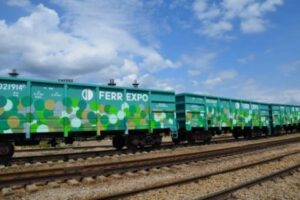
Ferrexpo Plc (the U.K.), managing Poltava Mining and Yeristovo Mining in Ukraine, has started cooperation with specialists Ricardo Plc (the U.K.), as part of decarbonization plans by 2050. “The Group undertakes a commitment to achieve net zero carbon emissions from its operations by the year 2050,” the company said in a press release on Monday. In addition, the group undertakes an initial commitment to achieve a minimum of a 30% reduction in combined Scope 1 and 2 emissions by 2030.
According to the press release, Ricardo to also help enhance the group’s existing climate change scenario reporting and review the role of Ferrexpo’s iron ore pellets within the circular economy. Results of Ricardo’s analysis expected to enhance the group’s carbon reduction targets and to further develop climate change reporting in 2022.
Jim North, Interim Group Chief Executive Officer, said that whilst iron ore pellets offer our customers the opportunity to significantly reduce carbon emissions already, it is important to signal a clear intention to decarbonise our own operations.
“It is on this basis that we have adopted the targets announced today, to demonstrate both our focus on climate change and our understanding of the importance of decarbonisation,” North said.
He said that Ferrexpo jointly with Ricardo intends to be a workstream that develops science-based reduction targets and a timeline for the stages of decarbonisation in each aspect of the Ferrexpo business.
“In the 18 months to June 2021, the group has already recorded a carbon reduction in excess of 20%2, which is a demonstration of our commitment to the environment,” North said.
Tim Curtis, Energy & Environment Managing Director at Ricardo Plc, said that Ricardo’s experts have been helping organisations around the world to develop robust and science-based pathways to achieving net zero carbon emissions and they will support Ferrexpo with the development of its decarbonisation targets and providing objective expertise to help realise this ambition.
Ricardo Plc is a world-class environmental, engineering and strategic consulting company.
Ferrexpo is an iron ore company with assets in Ukraine.

The metallurgical industry will play a key role in achieving Ukraine’s carbon neutrality, according to representatives of the largest Ukrainian metallurgical companies speaking during the international forum “Decarbonization of the Steel Industry: a Challenge for Ukraine” taking place in Kyiv.
According to a press release from GMK Center, the ambitious plans of the EU and the United States to achieve carbon neutrality by 2050 are putting pressure on Ukrainian metallurgical companies. To compete successfully on foreign markets, Ukrainian producers also need to have CO2 reduction targets and decarbonization strategies.
“Now Metinvest is developing a detailed roadmap to reduce CO2 emissions. We are very careful in working out each step that will eventually lead our production to carbon neutrality, because such a large-scale transformation should not harm the sustainability of our business. We hope to conclude partnerships today, which will allow us to follow the path of decarbonization,” CEO of Metinvest Group Yuriy Ryzhenkov said during the event.
During the forum, Metinvest signed two memorandums of cooperation for the implementation of joint projects to reduce greenhouse gas emissions. One of them was signed with Primetals Technologies – an international company providing a full range of technologies, products and services for the metallurgical industry, the other – with K1-MET – a leading Austrian research center in metallurgy.
The press release notes that Ukraine actively declares its intention to follow the direction of decarbonization. In January 2020, the country presented the Green Energy Transition Concept, which sets a goal to achieve a carbon neutral economy by 2070.
In April 2021, the government presented the draft of the second Nationally Determined Contribution to the Paris agreement. It assumes that Ukraine by 2030 will reduce CO2 emissions by 65% compared to 1990, in particular industrial enterprises – by 61%.



