
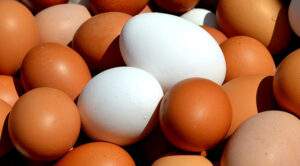
In January-August 2025, Ukraine exported nearly 1.4 billion eggs worth $119.5 million, which is 2.6 times more than in the same period of 2024, according to the Ukrainian Poultry Union.
The industry association noted that in August, Ukrainian producers exported 168.2 million eggs worth a total of $16.4 million, which is 81.9% more than in the same period of 2024.
The main buyers of Ukrainian eggs in January-August 2025 were Spain (11% of total exports), Croatia (10.9%), and the United Kingdom (10.6%).
The largest shipments in August were to Spain (37.1 million eggs), the Czech Republic (28.9 million eggs), and Poland (21.7 million eggs).
Ukraine has the potential to expand bilateral agricultural trade with the US, particularly in the export of meat, eggs, corn, and queen bees, according to the State Service for Food Safety and Consumer Protection following a working visit to the US by the agency’s head, Serhiy Tkachuk.
The State Service noted that during the visit, Tkachuk held meetings with representatives of three departments of the US Department of Agriculture.
Together with the USDA Foreign Agricultural Service (FAS), the parties discussed increasing bilateral trade in agricultural products. Ukraine has the potential to replace Russian and Chinese products on the American market, the agency assured. Particular attention was paid to opening the US market for Ukrainian poultry and eggs.
Negotiations with the USDA Food Safety Inspection Service (FSIS) focused on access to the US market for Ukrainian poultry meat and eggs. The State Service of Ukraine for Food Safety and Consumer Protection has already provided all the necessary information and expressed its readiness to undergo inspections, including online. This practice has been successfully applied in cooperation with the United Kingdom, Canada, and the EU.
The Ukrainian side emphasized the importance of moving forward with applications for the export of pork and beef, and the FSIS confirmed its readiness to begin technical consultations.
The meeting with the USDA Animal and Plant Health Inspection Service (APHIS) was devoted to the epizootic situation, the procedure for assessing the status of diseases, and inspections.
In addition, the meetings discussed the prospects for exporting Ukrainian corn and queen bees. The American side positively assessed the dynamics regarding corn and promised to consider the issue of bees in the near future.
“These dialogues confirm that even in times of war, the Ukrainian agricultural sector remains a reliable and promising partner. We feel the support of our American colleagues and their willingness to move forward in opening up new opportunities for Ukraine,” concluded the head of the State Food and Consumer Service.
Ukrainian producers exported chicken eggs worth $103.1 million in January-July 2025, which is 2.6 times more than in the same period last year, according to the Ukrainian Poultry Farmers Union, citing data from the State Customs Service.
The industry association specified that in July this year, 190.6 million eggs worth $17 million were exported, which exceeded the figure a year ago by 86%.
The top three importers of Ukrainian chicken eggs in July 2025 were Spain (21.5 million eggs), the United Kingdom (21.4 million eggs), and Poland (22.7 million eggs).
According to the Ukrainian Poultry Farmers Union, the main buyers of Ukrainian eggs in January-July were Croatia (11.8%), the United Kingdom (10.6%), and Spain (9.5%).

Romania has expanded the list of goods imported from Ukraine that require a license to enter the country to include eggs and poultry meat, Euractiv.ro reported, citing information from the Romanian government. The publication reminded that Romanian poultry producers faced a “serious problem” due to the import of eggs and poultry meat from Ukraine, which are sold at prices significantly lower than the cost of production in Romania.
According to the Minister of Agriculture Florin Barbu, after discussions with representatives of the poultry industry, the government decided to add eggs and poultry meat to the list of products that can be imported from Ukraine only with a license. The list also includes cereals, seeds, flour and sugar.
“It is our duty to protect Romanian production,” Barbu said.
In addition, he reminded that Romania, as a member of the European Union, must comply with certain production requirements in the poultry sector, which is why Romanian poultry farmers have “30% higher costs than in Ukraine.”
Barbu also emphasized that there is no ban on imports of Ukrainian eggs and poultry meat.
“We have made this decision on licensing to ensure that when the food industry needs these products and Romania is not completely self-sufficient, only Romanian processors will be able to import them under license,” he added.
After the European Commission decided not to extend the ban on imports of Ukrainian grain to five neighboring EU countries (Bulgaria, Poland, Romania, Slovakia, and Hungary) in September 2023, Romania introduced import licenses for grains and oilseeds from Ukraine and Moldova. This measure, introduced in October last year, was extended.
According to this decision, only Romanian companies engaged in the production of oil and fat products, flour milling, animal feed production and livestock farming are entitled to import agricultural products from Ukraine and Moldova.
The Eastern Interregional Main Department of the State Service of Ukraine for Food Safety and Consumer Protection has announced the introduction of restrictions on imports of hatching eggs, poultry and poultry products from the Republic of Poland to Ukraine due to the registration of Newcastle disease in the country, the press service of the agency said.
According to the order of the Chief State Veterinary Inspector of Ukraine dated July 13, 2023, the ban does not apply to products that have been treated by a method that guarantees the destruction of the causative agent of this disease according to the requirements for the import (transfer) to the customs territory of Ukraine of food products of animal origin, feed, hay, straw, as well as by-products of animal origin and products of their processing, processing, approved by the order of the Ministry of Agrarian Policy and Food № 553 of November 16, 2018 year
Newcastle disease is known as pseudoplague of birds, or Asian plague – a contagious and fatal viral disease affecting all types of birds (chickens, pigeons, turkey, etc.). One of the most contagious poultry diseases in the world, caused by a virus of the Paramyxoviridae family, in which many birds die without showing any symptoms. Pseudorabies plague can cause death even in vaccinated poultry.
According to Polish media reports, the disease was detected for the first time in 50 years at a poultry farm in Bialystok district, where 43.41 thousand chickens are kept for slaughter.

The European Commission is studying the situation on the poultry, egg and frozen fruit markets and is ready to return to tariff quotas if Ukraine maintains the current scale of their supplies to Europe, EU Agriculture Commissioner Janusz Wojciechowski said.
During the session of parliamentary committee on agriculture, which took place on Monday, he said that at the moment there is no reason to prohibit import of any other goods, except wheat, corn, rapeseed and sunflower, from Ukraine to Bulgaria, Poland, Romania, Hungary and Slovakia. These goods are also allowed to transit the territory of these five countries, reports pap.pl.
According to Wojciechowski, market inspections, according to the current legal regime, will end in November, and according to the updated rules, if the procedure begins in June, they will end in September.
“The situation in the poultry market is not only local, but European-wide, and it is very likely that if imports do continue on this scale in the current months, there will be a return to the tariff quotas that were in place before liberalization,” he said.
As the commissioner said, the EC is monitoring the situation in the egg market. There is an increase in imports, and this is also covered by the excessive import procedure. “If this procedure shows excessive imports, there will be quotas or an import ban,” he added.
According to Wojciechowski, imports of frozen fruit from Ukraine to the EU reached 44,000 tons in 2022, an increase of 18.9 percent from 37,000 tons in 2021.
“This situation will be controlled. If during the season it becomes clear that there is a threat to Polish, European producers, the European Commission is ready to impose restrictions even in an emergency, express mode. It depends on the situation during the season, how the situation will develop in the coming months,” he stressed.
According to the Commissioner, since April 2022 until the end of March 2023, Ukraine exported 48 million tons of wheat, corn, rapeseed and sunflower seeds, 24 million tons of which were sent to Africa and Asia, about 24 million tons – to the EU countries, 10.3 million tons of which – to the five frontline countries.
Voytsekhovskyy specified that 4.1 million tons of Ukrainian grain arrived in Poland, of which 3.3 million tons remained in the country, and 700 tons were in transit.
The largest transit country, through which the Ukrainian grain passed, was Romania, through which 9 million tons passed, of which 2.5 million tons remained in the country.
As Voytsekhovskyy stated, there was no uncontrolled import of grain from Ukraine to the EU. Because of the growing problem in the frontline countries, a temporary import ban was imposed on Bulgaria, Poland, Romania, Hungary and Slovakia. “Existing restrictions are ‘likely’ to be extended,” wrote the Polish publication.
The European Commissioner recalled that free trade with Ukraine is very beneficial to the Polish economy. In 2022, almost 10 billion euros of goods were exported from Poland to Ukraine, and less than 6 billion zlotys (EUR 1.254 billion) were imported. At the same time, he noted that this is 1/3 of all EU exports, the value of which was EUR30 billion. In second place is Germany with exports of EUR4 billion.
“If someone asked me why I am in favor of liberalization of trade with Ukraine, it is only because not only political but also economic reasons demanded it,” the Polish edition quoted the European commissioner as saying.



