
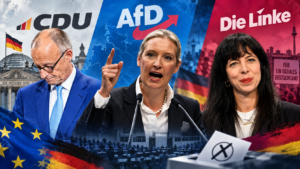
Regional elections in Germany on September 20 demonstrated the weakening positions of traditional parties and the further fragmentation of the German electorate: Alternative for Germany (AfD) won in Mecklenburg-Vorpommern, while in Berlin the Left took first place, according to an analysis by the Experts Club analytical center.
In Mecklenburg-Vorpommern, AfD received 38.2% of the vote, compared with 16.7% in the previous elections in 2021. The Social Democratic Party of Germany received 35.5%, the Left — 6.5%, and the Greens — 5.7%. Chancellor Friedrich Merz’s Christian Democratic Union received 4.9% and, for the first time in history, failed to cross the five-percent threshold in a state election.
The CDU received 13.3% in the previous election in this state, meaning it lost more than 8 percentage points of support. According to the preliminary distribution of seats, AfD receives 32 seats, the SPD — 29, while the Left and the Greens receive five each. Since the other parliamentary forces rule out a coalition with AfD, the voting result alone does not determine the composition of the future state government.
In Berlin, the results demonstrated a different political configuration. The Left received 25.7% of the vote, compared with 12.2% in the previous election. The CDU came second with 18.8%, AfD received 16.3%, the Greens — 14.3%, and the SPD — 12.1%. The incumbent coalition of the CDU and the Social Democrats lost its parliamentary majority.
Experts Club points out that the September 20 results continued a trend that emerged at the beginning of the month. On September 6, AfD took first place in the election in Saxony-Anhalt with 43.8%, while the CDU received 17.2%. In 2021, the CDU had 37.1% in this state, while AfD had 20.8%.
Thus, according to Experts Club, the results of the September elections should not be reduced exclusively to a movement of the German electorate in a single ideological direction. In two eastern states, AfD received the greatest support, while in Berlin the Left strengthened significantly. This indicates that some voters of traditional parties are shifting toward different alternative political forces depending on the region and the structure of local problems.
According to Infratest dimap, in Mecklenburg-Vorpommern AfD managed to mobilize around 66,000 citizens who had previously not voted, as well as attract around 48,000 former SPD voters and approximately 32,000 former CDU supporters.
At the same time, the SPD’s result in this state is largely associated with the personal support enjoyed by Minister-President Manuela Schwesig. Almost half of Social Democratic voters surveyed after the election said that they would not have supported the party without her. This demonstrates the importance of the personal ratings of state-level politicians even when their parties have weaker positions at the federal level.
A separate problem for the CDU was voters’ perception of the party’s economic competence. Only 13% of respondents in Mecklenburg-Vorpommern named the CDU as the political force best able to solve economic problems. Some 89% of respondents also agreed with the statement that before the federal election the party had promised a great deal but delivered little. These results characterize one specific federal state and cannot automatically be applied to Germany as a whole.
In Berlin, one of the central factors of the campaign was the housing issue. The Left focused attention on rental costs, the shortage of affordable housing and regulation of the activities of large property owners. At the same time, migration and security remained among the important issues for AfD voters.
“These elections show not a linear movement of German society in one ideological direction, but a fragmentation of the electorate. In Mecklenburg-Vorpommern, protest is concentrated around AfD, while in Berlin the Left became the main recipient of the protest vote and the vote of young urban residents. In other words, the common denominator is not ideology, but the declining ability of traditional parties to keep different groups of voters within the former model of the political center,” said sociologist and co-founder of the research company Active Group Oleksandr Poznii.
According to him, the mobilization of citizens who had not previously participated in elections is particularly illustrative. This may indicate not only a redistribution of the already established electorate, but also an expansion of the base of individual political forces.
Poznii also drew attention to the decline in confidence among some voters in the CDU’s traditional economic competence. In his view, for centrist parties the coming months will be associated primarily with the need to restore the confidence of different groups of voters, rather than only with personnel discussions.
Federal dynamics also demonstrate changes in party support. In the September ARD-DeutschlandTrend conducted by Infratest dimap from August 31 to September 2 among 1,319 voters, AfD was supported by 27% of respondents, the CDU/CSU by 21%, the Greens by 15%, the SPD by 13%, and the Left by 12%.
At the same time, state elections do not directly change the composition of Germany’s federal government or Berlin’s foreign policy. However, they influence the domestic political debate on the economy, budget spending, energy, migration and other issues.
The preliminary results of the elections in Mecklenburg-Vorpommern and Berlin were released on the night of September 21. The final results are to be approved after the electoral records are checked.
The material was prepared on the basis of a study by the Experts Club analytical center, “AfD won in Mecklenburg, the Left in Berlin: regional elections increased pressure on Germany’s traditional parties,” published on September 21, 2026. Experts Club study on Experts.news
The Serbian business publication Parametar has prepared an interesting analysis of the parliamentary elections in Serbia. President Aleksandar Vučić has called for early parliamentary elections on October 25. Serbia has 250 parliamentary seats to fill, but in essence, the campaign is turning into a choice between preserving the current model of government and attempting a political reset.
The main favorite is the “Aleksandar Vučić—United Serbia” bloc centered around the SNS. Vucic himself is running as a candidate for prime minister. According to the Serbian media outlet Parametar, his campaign will focus on stability, infrastructure development, investment, economic growth, and the argument that the country must not return to a period of political instability.
For the first time, the main competitor is not a traditional party, but the Student List, which emerged from the protests following the tragedy in Novi Sad. Its main themes are corruption, government accountability, the independence of institutions, and bringing new people into politics. The movement’s slogans are as simple as possible: “Students Will Win” and “Either Serbia or the Mafia.”
Part of the opposition has already decided to support the students, but there will be no single anti-government list. Running separately are the pro-European “European Serbia,” the “People’s Serbia” bloc, Ivica Dačić’s Socialists, and several national-conservative and sovereigntist groups.
The campaigns of the two main power centers are also divided by fundamentally different emotional agendas. According to sociologist and co-founder of Active Group Aleksandar Pozniy, Vučić will build his campaign primarily around the theme of stability—reminding voters of economic growth, large-scale infrastructure projects, an influx of investment, and the overall progress Serbia has made in recent years. This strategy aims to convince voters that a change in government carries the risk of losing the country’s hard-won achievements. The Student List, on the other hand, will appeal to the long-standing demand for fighting corruption and reforming the political system, contrasting the current elite with new faces unaffiliated with traditional parties. Thus, the election may largely turn into a clash between two basic formulas—“stability and economic results” versus “a change in power and the cleansing of institutions.”
That is precisely why the key question will be what voters deem more important: preserving economic and political stability or the demand for profound systemic change.
Parties representing national minorities will traditionally form a separate segment. A special electoral system applies to minorities: they are not required to clear the general 3 percent threshold, and when seats are allocated, their results are adjusted using a special coefficient. At the start of the campaign, the Union of Vojvodina Hungarians (SVM), the Bosnian parties SPP and SDA, representatives of the Albanian and Romani populations, and a number of small regional groups are expected to participate. Their composition may still change before the registration deadline.
Polling data so far is conflicting. Faktor Plus gives the SNS about 47% and the Students’ Party about 32%. An earlier CRTA poll showed the opposite picture—about 45% for the Students’ Party versus 36% for the SNS.
On international betting platforms, Vučić currently appears to be the clear favorite, but there is still a month and a half until the election, and the final list of candidates is still taking shape.
Read more at Parametar.rs.
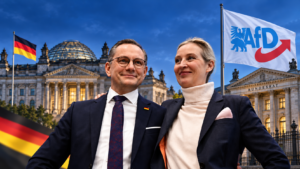
The record victory of the Alternative for Germany (AfD) in the state elections in Saxony-Anhalt does not give the party the ability to independently change Germany’s foreign policy or stop military support for Ukraine, but it is capable of increasing political pressure on the federal authorities, according to an analysis by the Experts Club information and analytical center.
In the September 6 election, AfD received 43.8% of the vote and 39 of the 83 seats in the Landtag. An absolute majority requires 42 deputies. The simplest arithmetic option for creating a majority is an alliance between AfD and the five deputies of the Sahra Wagenknecht Alliance (BSW), which would provide 44 votes. At the same time, there is currently no agreement on such a coalition. The CDU, SPD, Greens and The Left reject cooperation with AfD.
Even if AfD forms a state government, its powers will be focused primarily on education, culture, the police, regional administration, infrastructure and the state budget. Foreign policy and defense, in accordance with Germany’s Basic Law, fall within the competence of the federal government.
“The government of Saxony-Anhalt does not receive a separate vote in NATO and cannot independently cancel federal funding for aid to Ukraine,” emphasized Experts Club founder Maksym Urakin.
Saxony-Anhalt has four of the 69 votes in the Bundesrat. This allows the state government to influence part of federal legislation, especially on issues affecting the powers of the states, but it needs allies among other regions to block decisions.
Magdeburg will also not be able to introduce a political ban on the transit of military cargo for Ukraine. At the same time, state authorities participate in approving certain transport and administrative procedures, so a confrontational stance by the regional authorities could theoretically lead to delays and additional bureaucratic difficulties.
Important Bundeswehr facilities are located in Saxony-Anhalt, including the Army Combat Training Center in the Gardelegen—Letzlingen area, the Klietz training ground, where Ukrainian Leopard 1A5 crews underwent training, as well as logistics units in Burg. At the same time, these structures are subordinate to the federal defense authorities, not to the state government.
The consequences for Ukrainians living in the state itself may become more immediate. AfD advocates reducing social support for Ukrainians, changing approaches to integration programs and strengthening return policies. The state cannot abolish the temporary protection regime established at EU level, but it can influence additional regional programs and administrative practices.

According to “Serbian Economist”, early parliamentary elections in Serbia are scheduled for October 25, 2026, according to local media reports.
Previously, President Aleksandar Vučić had mentioned two possible dates—October 18 or 25. Now, Serbian publications such as Blic, Danas, and others are reporting that October 25 has been chosen. The National Assembly is expected to be dissolved in the coming days, after which the campaign is set to officially begin.
The main question is whether the ruling Serbian Progressive Party (SNS) will be able to retain its majority amid protracted protests and growing support for the student movement.
Recent polls paint a very mixed picture. According to Faktor Plus, in the spring the SNS had about 46% support, while a potential student-led slate had about 29%. More recent surveys have shown that the gap may be even smaller: in July, CRTA estimated support for the student list at 44.9% and for the SNS at 35.7%. At the same time, other polls, as before, put the SNS at 45–47%.
At this point, a brief analysis is as follows:
SNS / the bloc centered on Vučić—the favorite, with a projected range of 36–47%
The Student List—the main competitor, with potential support of approximately 29–45%, but highly dependent on polls
Ivica Dačić’s SPS—5–7%, a likely coalition partner
The pro-European opposition—may achieve a notable result overall but remains fragmented
Mi—Snaga Naroda, NPS, SSP, ZLF, Nova DSS—are fighting to clear the electoral threshold and influence the future coalition
The baseline scenario for now is as follows: the SNS will most likely remain the leading force, but the election could be the most competitive in recent years.
According to The Serbian Economist, early parliamentary elections in Serbia are scheduled to take place on October 18 or 25, 2026, as per current plans, President Aleksandar Vucic said on August 20.
“Parliamentary elections in Serbia will, apparently, take place on either October 18 or 25, and we will know the exact date in a few days,” Vučić said on Radio and Television of Serbia (RTS).
Previously, Serbian authorities had been considering holding the election in late October or early November; however, according to the president, the likely date has now been practically determined. That said, the election has not yet been officially scheduled, so October 18 and 25 remain the two dates under consideration.
According to Serbia’s Law on the Election of Members of Parliament, parliamentary elections are scheduled by the President of the Republic, and no fewer than 45 and no more than 60 days must elapse between the date of the announcement and Election Day. Election Day must fall on a non-working day.
As early as August 16, Vučić stated that the elections would be scheduled “very soon”—within the next 15 to 25 days. Prior to that, on August 14, he had indicated a broader timeframe for the elections—October or November.
At the same time, the parliamentary and presidential elections will most likely take place at different times. In July, Vučić stated that the parliamentary elections should take place first, followed by the presidential elections. On August 6, he also announced that he intends to resign from the presidency before joining the election campaign.
Commenting on the upcoming campaign on August 20, Vučić also confirmed that the Serbian Progressive Party (SNS) will run in the elections with its own electoral list. Referring to the decision by the Socialist Party of Serbia (SPS) to run independently, he noted that citizens should have the opportunity to choose between different political options.
The previous early parliamentary elections in Serbia took place on December 17, 2023. According to the results, the “Aleksandar Vučić—Serbia Must Not Stop” list received the most votes.
https://t.me/relocationrs/3504

According to The Serbian Economist, Serbian President Aleksandar Vucic stated that the country’s upcoming parliamentary and presidential elections will be held separately.
According to Vučić, parliamentary elections will most likely take place first, followed by presidential elections. He noted that the decision to schedule the elections could be made in August or September, and the actual voting could take place in October or November.
The president explained that he supports holding the elections separately because, as he put it, opposition parties and other participants in the political process had previously pushed for this. He added that this format would give voters more opportunities to make separate decisions regarding the parliamentary and presidential campaigns.
During his address, Vučić also announced that a package of aid measures for citizens is likely to take effect in mid-September. He had previously noted that these measures could include one-time assistance for pensioners and reduced costs for medications. According to him, the government is also considering additional support for adult citizens, though details have not yet been disclosed.
In addition, Vučić announced the launch of the “Ko si bre ti” portal, through which citizens will be able to anonymously report unscrupulous officials and suspected corruption. He stated that he would personally read a portion of the reports every day, and that reports concerning corruption would be forwarded to the prosecutor’s office.
Separately, the president commented on Serbia’s European integration, noting that the country has made no significant progress toward EU membership for nearly five years, despite its economic development. He also said that, in his assessment, neither Serbia nor Ukraine will become members of the European Union in the near future.
Vucic’s statements came amid Serbia’s preparations for a new election cycle and ongoing political tensions in the country. Holding parliamentary and presidential elections separately could change the dynamics of the campaign, as parties and candidates will be forced to conduct two separate political mobilizations.
https://t.me/relocationrs/3191



