
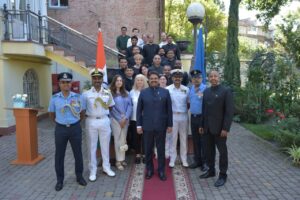
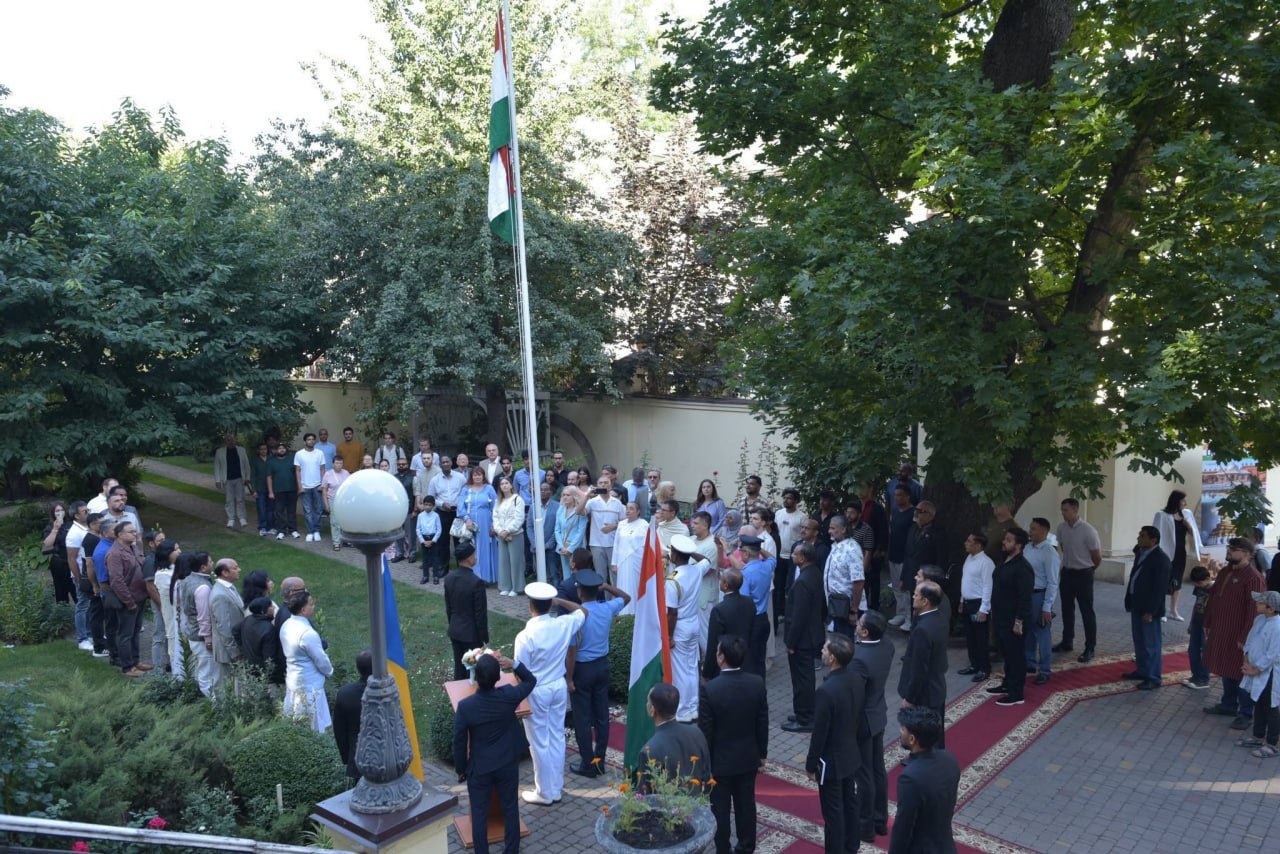
The Indian Embassy in Ukraine held a ceremonial event in Kyiv to mark India’s 80th Independence Day. The celebration took place at India House and was attended by representatives of the Indian community, Ukrainian government agencies, the business sector, the cultural sector, and civil society organizations.
At the ceremony, the recently appointed Indian Ambassador to Ukraine, Anjani Kumar, raised the national flag and read a message from Indian President Draupadi Murmu to those in attendance on the occasion of the holiday.
The event was attended by members of the Indian community living in Ukraine—including students and entrepreneurs—as well as representatives of Ukrainian government agencies, politicians, Indologists, writers, dancers, representatives of cultural and spiritual organizations, and Ukrainian friends of India. The embassy described the guest list as a broad representation of people connected to Indian-Ukrainian cultural and civic relations.
Anjani Kumar was appointed India’s new ambassador to Ukraine by a decision of the Indian Ministry of External Affairs on July 8, 2026. On August 10, Ukraine’s Deputy Minister of Foreign Affairs Oleksandr Mishchenko accepted copies of his credentials from him.
In an address on the eve of Independence Day, President Draupadi Murmu emphasized that India is moving toward its goal of becoming a developed nation by the centennial of its independence, and that development must provide opportunities for all segments of the population. She particularly highlighted the contributions of students, scholars, engineers, doctors, workers, farmers, entrepreneurs, and the Indian diaspora to the nation’s development.
“The true meaning of freedom lies in ensuring that all citizens can seize opportunities to realize their aspirations,” the President of India stated in her address to the nation.
Murmur also highlighted the role of Indians living abroad and diplomatic mission staff in strengthening the country’s international standing. Among the priorities for further development, she cited digitalization, economic growth, expanding opportunities for women and youth, developing modern infrastructure, and preserving cultural heritage.
India gained independence from Great Britain on August 15, 1947. Therefore, in 2026, the country will celebrate its 80th Independence Day, even though 79 years have passed since independence was achieved: the 1947 celebration is considered the first Independence Day. Indian authorities are referring to this year’s celebration specifically as the 80th Independence Day.
The holiday is one of India’s major national holidays. The central ceremony is traditionally held in Delhi, where the prime minister raises the national flag near the Red Fort and delivers an address to the nation.
India was among the first countries to recognize Ukraine’s independence following the collapse of the Soviet Union. Diplomatic relations between the two countries were officially established on January 17, 1992.
The Indian Embassy in Kyiv began operations in May 1992. Prior to that, India had a Consulate General in Odesa, which had been operating since 1962 and was closed in 1999.
The Embassy of Ukraine in New Delhi was opened in February 1993 and became one of the first diplomatic missions of independent Ukraine in Asia. It continues to represent Ukraine’s interests in India and to develop political, economic, cultural, and humanitarian ties between the two countries.
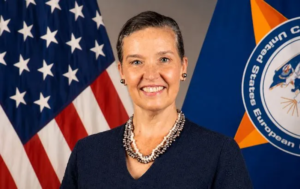
Sandra Oudkirk, who has more than 30 years of experience in the diplomatic service, has become the new U.S. chargé d’affaires in Ukraine.
This was reported on the website of the U.S. Embassy in Ukraine.
Sandra Oudkirk is a career diplomat and a member of the U.S. Senior Foreign Service who has represented the interests of the United States in various countries around the world for more than 30 years, holding positions with a steadily expanding range of authority and responsibility.
Since 2024, she has worked at the U.S. Department of Defense, where she initially served as deputy director of the George C. Marshall European Center for Security Studies and later became the civilian deputy and foreign policy adviser to the United States European Command. From 2021 to 2024, Sandra Oudkirk headed the American Institute in Taiwan.
While working in Washington, Oudkirk held positions in the Bureau of East Asian and Pacific Affairs, the Bureau of Energy Resources, and the Bureau of Economic and Business Affairs. She dealt with issues of strategic competition among major powers, energy security, countering threat financing, and imposing economic sanctions. She previously also worked as a senior watch officer at the U.S. Department of State Operations Center.
Abroad, she served in Taipei, Dublin, Ankara, Kingston, Istanbul, and Beijing.
Sandra Oudkirk was born and raised in Tampa, Florida. She graduated from Georgetown University’s School of Foreign Service. She is married to diplomat Scott Oudkirk and has three adult children. She speaks Chinese (Mandarin) and Turkish.
As reported, Julie Davis had served as U.S. chargé d’affaires in Ukraine since May 2025.
Davis’s predecessor, former U.S. Ambassador Bridget Brink, left the ambassadorial post in April 2025. She later openly stated that she had decided to resign because of the foreign policy of President Donald Trump’s administration.
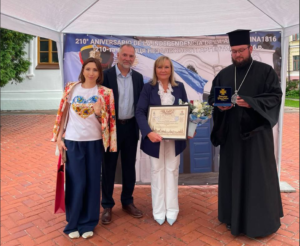
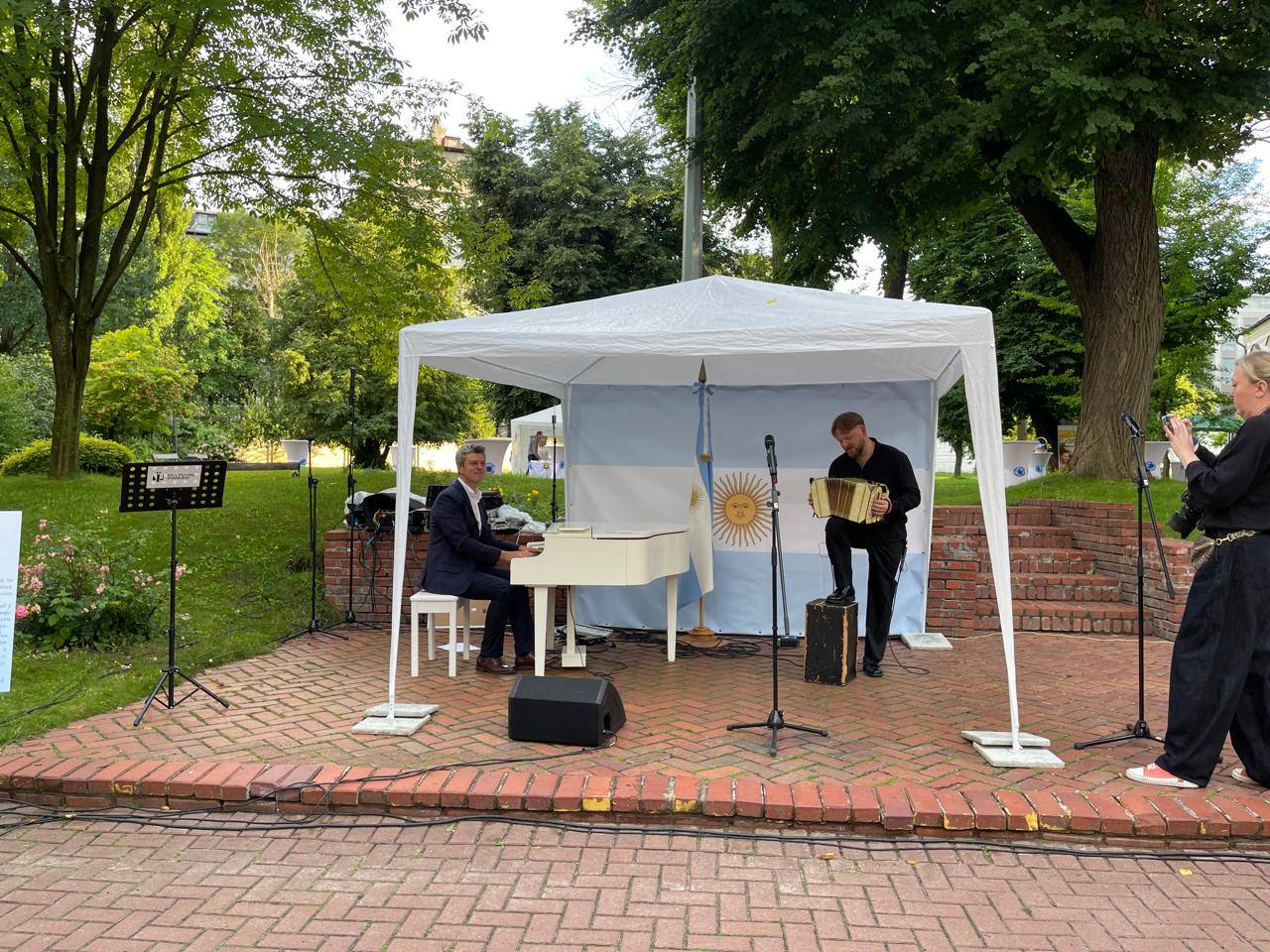
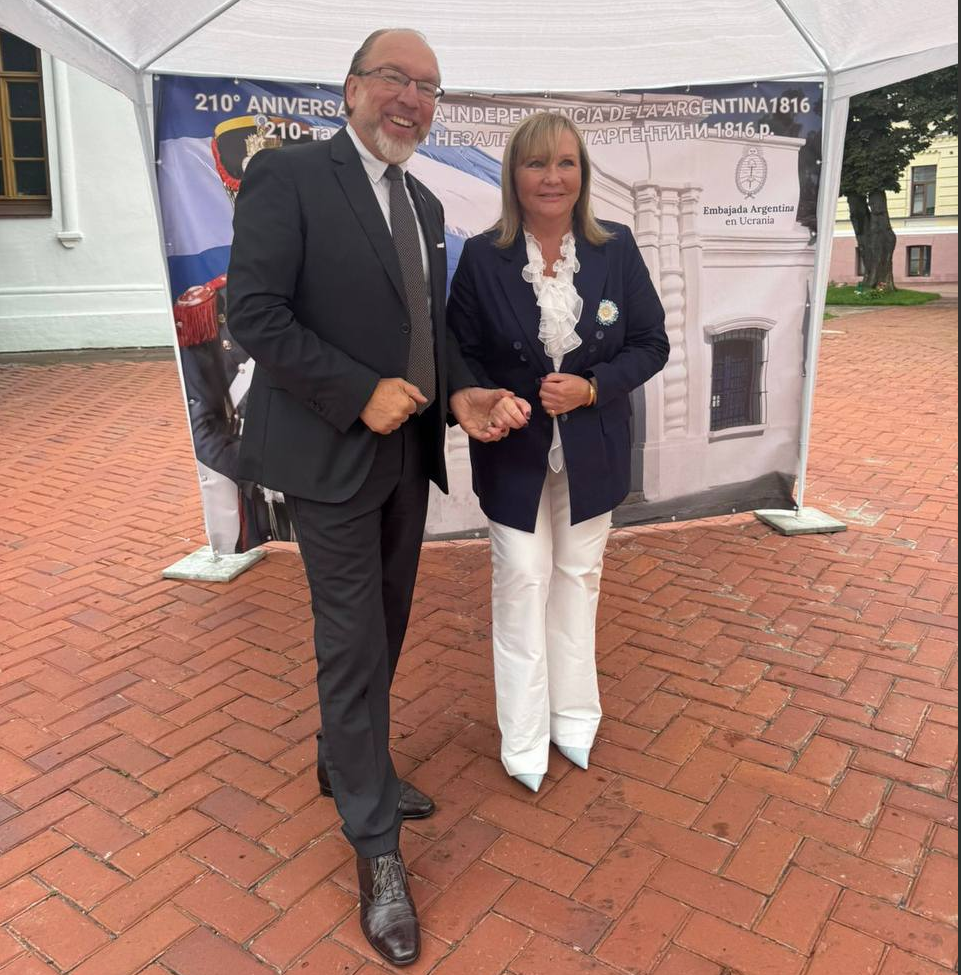
The Embassy of the Argentine Republic in Ukraine hosted a gala reception in Kyiv to mark the 210th anniversary of Argentina’s declaration of independence. The event took place at the “Sofia Kyivska” National Reserve and brought together representatives of the Ukrainian government, the diplomatic corps, the business community, religious organizations, and the Ukrainian-Argentine community.
In her opening remarks, Argentine Ambassador to Ukraine Elena Leticia Mikusinski noted that Independence Day is not only a memorable historical date for Argentines but also a symbol of their commitment to freedom, sovereignty, and the right of peoples to determine their own future.
According to the diplomat, holding the celebrations at St. Sophia Cathedral in Kyiv has special symbolic significance, as this monument is the cradle of Ukrainian statehood and national identity. She emphasized that, despite the differences in the historical paths of Argentina and Ukraine, both countries are united by a desire to defend freedom, independence, and national sovereignty.
The ambassador emphasized that Argentina continues to support Ukraine on the international stage. In particular, the country participates in the International Coalition for the Return of Ukrainian Children, is a member of the Ramstein-format Contact Group on Ukraine’s Defense, and consistently supports most UN General Assembly resolutions concerning Russian aggression against Ukraine. According to her, this position reflects Argentina’s unwavering commitment to the principles of international law, respect for Ukraine’s sovereignty and territorial integrity, and the achievement of a just and sustainable peace.
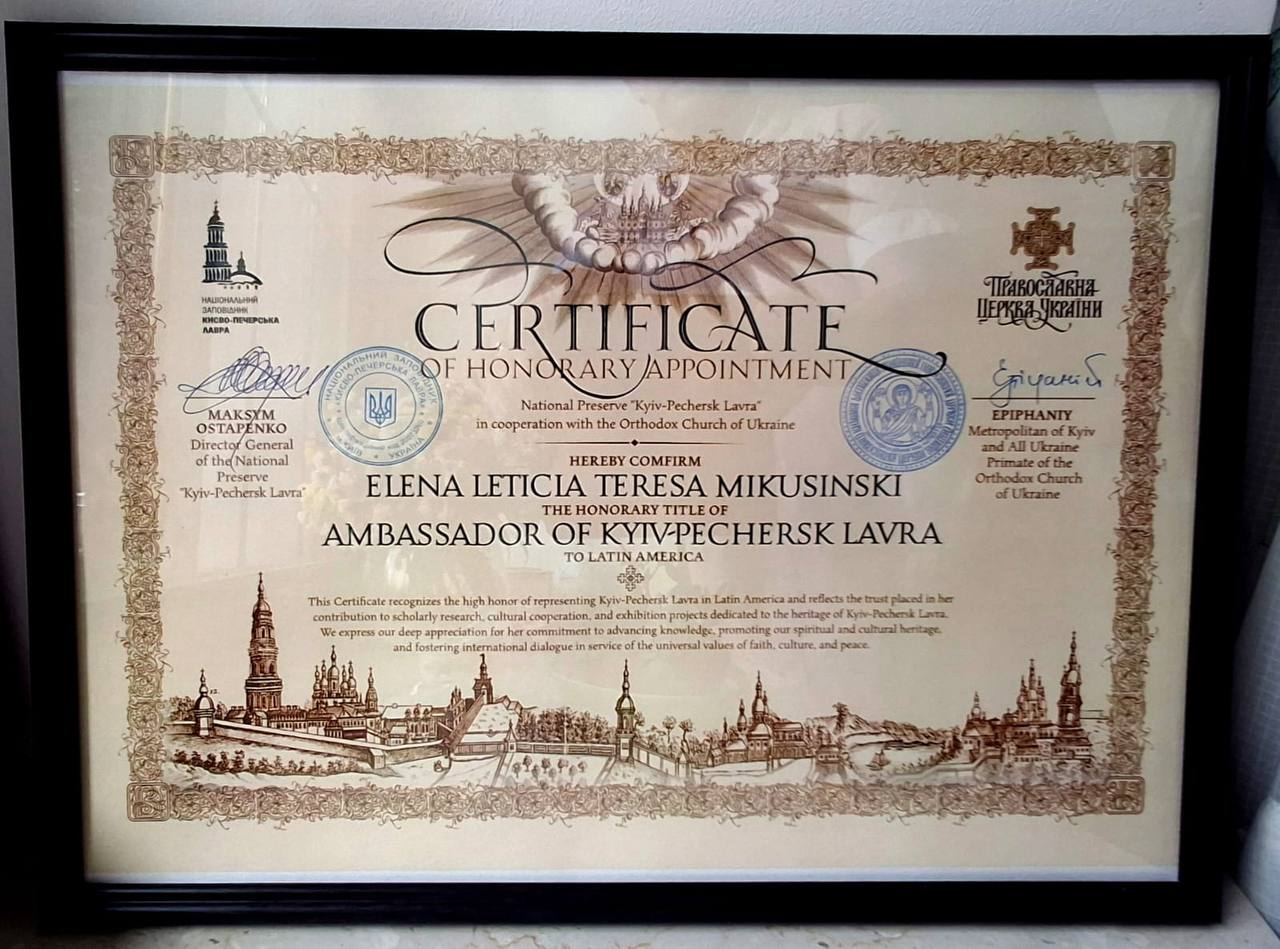
A special highlight of the evening was the presentation of an award to Elena Leticia Mikusinski, Argentina’s Ambassador to Ukraine. The Kyiv-Pechersk Lavra National Reserve awarded her the title of “First Ambassador of Lavra” in recognition of her contribution to the development of Ukrainian-Argentine relations, her support for Ukrainian cultural heritage, and her efforts to strengthen international cooperation.
In her speech, she paid special attention to the historical ties between the two nations. The ambassador recalled Nobel laureate César Milstein, the son of Ukrainian emigrants who made an outstanding contribution to world science, as well as Spanish language teacher Olga Anechkina-Shafran, who was born in Argentina and worked for many years in Kryvyi Rih. According to the diplomat, it is precisely such people who have been strengthening friendship and mutual understanding between the two countries for decades.
The head of the diplomatic mission also noted that modern Argentina is known not only for soccer, tango, and Malbec wine, but also for significant achievements in science and high technology. She recalled that the country is among those that independently develop and operate satellites, as well as build research nuclear reactors and develop technologies for nuclear medicine.
During the gala evening, guests were entertained by Ukrainian composer and pianist Yevhen Khmara, opera singer and defender of Ukraine Yuriy Ivaskievych, and guitarist Oleksandr Alekseenko. Guests were also treated to Argentine wines and traditional dishes.
Argentina recognized Ukraine’s independence on January 5, 1992, and diplomatic relations between the two countries were established on January 6, 1992. The Argentine Embassy in Kyiv began operations in 1993, and the Ukrainian Embassy in Buenos Aires has been in operation since 1993.
ARGENTINA, DIPLOMACY, EMBASSY, Saint Sophia of Kyiv, Мікусінські

The Embassy of Ukraine in the Hellenic Republic called on Ukrainian citizens who are in Greece or are planning trips around the country to take into account the increased risk of wildfires during the summer season. High temperatures, dry weather and strong winds may contribute to the rapid spread of fire throughout the country, the embassy reported.
Ukrainian citizens are advised to regularly check official announcements by the Greek authorities, in particular the daily Fire Risk Forecast Map published by the Greek Ministry of Climate Crisis and Civil Protection. The official website of Greece’s civil protection authorities also publishes up-to-date fire danger maps and information about the 112 emergency system.
The embassy emphasizes that wildfires can cause significant logistical difficulties for tourists and local residents, including road closures, power outages, disruption of transport infrastructure and deterioration of air quality. In areas near fire outbreaks, the Greek authorities may announce the evacuation of the population.
Ukrainian citizens are advised to comply with all instructions of the Greek authorities, follow official civil protection announcements, carry identity documents with them and think through an action plan in advance in case of an emergency. On a mobile phone, it is advisable to make sure that receiving emergency alerts from the 112 system is enabled.
If a fire is detected, it is necessary to call the Greek Fire Service at 199, and for emergency assistance — the single European number 112. In the event of possible changes to transport connections, citizens are advised to clarify information with tour operators, airlines or Athens International Airport at +30 210 353 0000.
In the event of a threat to life or health, Ukrainian citizens may contact the hotline of the Embassy of Ukraine in Greece in Athens: +30 693 276 5606, available via Signal, WhatsApp, Viber and Telegram. The hotline of the Consulate of Ukraine in Thessaloniki is also operating: +30 693 407 7385, the consulate’s email address is gc_grs@mfa.gov.ua. The 24-hour hotline of the Ministry of Foreign Affairs of Ukraine: +38 044 238 15 88.
In Greece, wildfires are one of the main seasonal risks during the summer period, especially in conditions of heat, drought and strong winds. For Ukrainian tourists and temporarily displaced persons, this means the need to plan routes more carefully, check the situation in the region where they are staying and respond promptly to messages from local services.
Carlo Formosa, the Italian Ambassador to Ukraine, met with representatives of Italian companies already operating in Ukraine, as well as with businesses implementing new projects in the country, according to a statement from the Italian Embassy in Ukraine.
“An opportunity to pool experience, contacts, and knowledge, establish new connections, and strengthen Italy’s presence in Ukraine,” the embassy’s Facebook post states.
The event served as a platform for exchanging experience, establishing new contacts, and strengthening cooperation among Italian companies operating in the Ukrainian market.
The embassy noted that the meeting took place following a series of webinars involving over 1,000 Italian companies and was aimed at further strengthening a cohesive and coordinated business community.
Particular attention was paid to the activities of the Italian Business Association (IBA), established several months ago at the embassy’s initiative to enhance the visibility and unifying potential of Italian business in Ukraine.
“The Embassy continues to facilitate dialogue between businesses and institutions, encouraging the exchange of expertise and the coordination of efforts within the ‘System Italy’ to support Italy’s economic presence in Ukraine,” the post states.
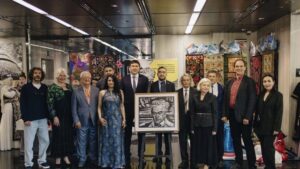
A public literary and psychological discussion titled “Masculine and Feminine: A Dialogue Through the Texts of Chingiz Aitmatov and Contemporary Realities,” dedicated to the work of Kyrgyz writer Chingiz Aitmatov, took place in Kyiv under the patronage of the Embassy of the Kyrgyz Republic in Ukraine, according to the embassy’s press service.
“For many Ukrainians, Taras Shevchenko is the voice of the nation. For many Kyrgyz, Chingiz Aitmatov is its intellectual and humanistic face,” said Idris Kadyrkulov, Ambassador Extraordinary and Plenipotentiary of the Kyrgyz Republic to Ukraine, in a comment to the agency during the event.

According to the diplomat, through Aitmatov’s works, the organizers sought to introduce Ukrainians not only to Kyrgyz literature but also to the humanistic values of the Kyrgyz people—respect for others, mutual support, love for loved ones, and responsibility.
The event was organized by the civic platform MÜTEŞEM QIRIM (MQ Community) and was dedicated to International Family Day. Participants began the meeting with a moment of silence to honor the memory of fallen Ukrainian soldiers and civilians.
As part of the event, a video message was shown from the writer’s son, Askar Aitmatov, who expressed support for the Ukrainian people and noted their resilience during the war.
The practical part of the discussion was led by psychologists Gennady Mustafayev and Katerina Goltsberg together with civic activist Leniye Ibragimova. The participants analyzed Aitmatov’s novellas “Jamila,” “My Little Poplar in a Red Scarf,” and “The Red Apple” through the lens of contemporary social challenges, family relationships, and personality psychology.

The event also featured Ukrainian-language editions of Chingiz Aitmatov’s books, an exhibition dedicated to Central Asian culture, and a portrait of the writer by People’s Artist of Ukraine Vasyl Perevalsky.
The organizers emphasized that the event served as an example of cultural diplomacy and humanitarian dialogue between Ukraine and Kyrgyzstan amid the war.



